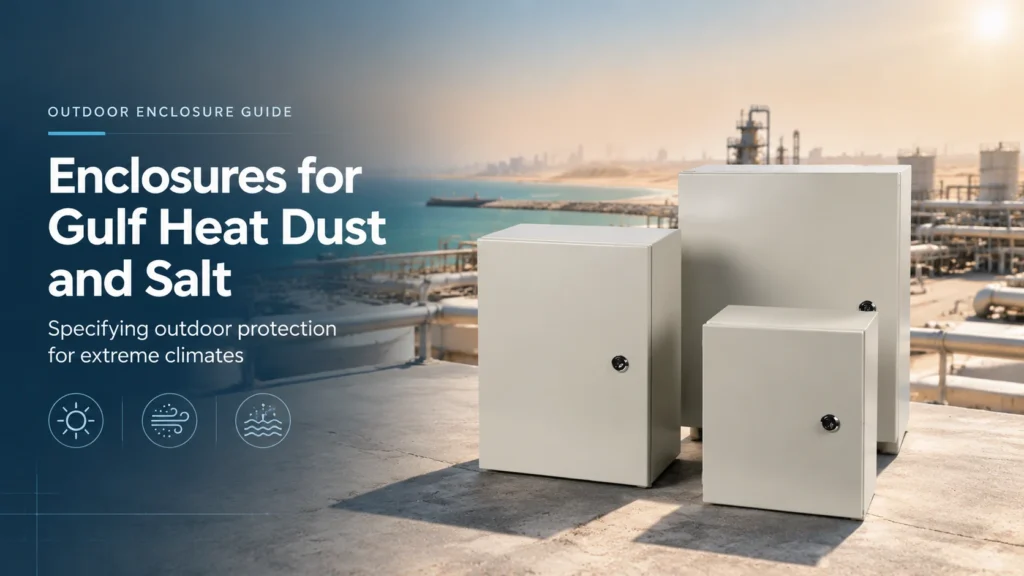
Specifying Enclosures for Gulf Heat, Dust and Salt
Specifying an enclosure for the Gulf is not the same exercise as specifying one for a European site, even when both are described as “outdoor, IP65”. Ambient temperatures of 45°C to 50°C, fine airborne sand, and salt-laden air along the coast change which materials survive and which fail in two summers.
This guide covers what actually determines service life in the UAE, Saudi Arabia, Qatar, Oman and Kuwait: which rating the site needs, why heat destroys gaskets and coatings before water ever gets in, and where 304 stops being adequate.
Three conditions drive almost every specification decision
Gulf projects differ from temperate ones in ways that show up on the enclosure, not just on the equipment inside it.
- Heat. Summer ambient in Riyadh, Doha and inland Dubai routinely reaches 45–48°C, and a metal box in direct sun runs considerably hotter. Gaskets harden, coatings chalk, and anything with a temperature-sensitive component inside derates.
- Airborne sand and dust. Dust storms carry fine particles that enter through any gap with a pressure difference across it. A box that keeps rain out can still fill with dust through a poorly sealed cable entry.
- Salt and humidity on the coast. Coastal developments in Dubai, Abu Dhabi, Jeddah and Doha combine high humidity with chloride exposure. This is the condition that separates 304 from 316.
The practical consequence: an enclosure selected on IP rating alone is only half specified. The material grade and the gasket compound matter as much as the second digit.
IP rating: what the site actually needs
| Location | Typical rating | Reason |
|---|---|---|
| Indoor plant room, air conditioned | IP54 to IP65 | Dust is the main risk; water only during cleaning |
| Outdoor, shaded by structure | IP65 | Occasional cleaning and driven rain in winter |
| Outdoor, exposed to sun and wind | IP65 to IP66 | Dust storms plus washdown during maintenance |
| Coastal or offshore-support | IP66 | Wind-driven salt spray, not immersion |
IP66 is the common specification on Gulf projects, and it is usually justified by dust and washdown rather than by water pressure. Moving to IP67 rarely helps here: the failure mode is not standing water, it is heat and chloride. Spend the difference on the material grade instead.

Heat, and what it does to the enclosure itself
The most common surprise on Gulf sites is that the enclosure fails structurally before the equipment inside it fails electrically.
Standard EPDM gaskets are rated to roughly 100°C continuous, which sounds adequate until a black or dark grey door in direct sun reaches far higher surface temperatures and the gasket takes that heat for years. The result is compression set: the gasket stops springing back, the door no longer seals evenly, and dust enters along one edge. Silicone gaskets cost more and handle sustained heat better. On a roof-mounted or fully exposed installation, that is the right upgrade.
Powder coatings fade and chalk under high ultraviolet load. Standard polyester powder will hold colour for a few years and then go chalky; a PVDF coating system holds gloss far longer at roughly twice the cost. For a project with a 20-year design life, the coating choice is a maintenance decision, not a cosmetic one.
The third heat effect is inside the box: any inverter, soft starter or electronic device will derate as internal temperature rises. Light colours and a rain hood that shades the top face both help, and shade from the structure is worth more than either.
Material: the coastal line is where budgets are won or lost
Powder-coated steel is the default for inland and shaded locations across the Gulf, and it performs acceptably where the coating stays intact.
On the coast, the deciding factor is what happens at every cut edge, weld and fixing point, where the coating is broken and bare steel is exposed. That is where chloride attack starts. 304 stainless resists it in most urban and industrial conditions but pits in sustained salt exposure; 316 is the grade that survives. Hinges, screws, earthing studs and gland plates have to match the body grade, because mixed metals create a galvanic couple and the fixing becomes the failure point.
For a coastal project the price difference between 304 and 316 is small against the labour of replacing a box on a live installation, and it is usually the difference between passing and failing a corrosion inspection.
Sand, dust and the cable entry problem
Dust does not need a hole to enter; a gap of a fraction of a millimetre with a pressure difference across it is enough over a season. Two details matter more than the IP number:
- Gland sizing to the actual cable. An oversized gland leaves an annular gap that dust passes through and that no amount of sealant fixes properly.
- Blanked, not taped, spare entries. Unused knockouts on a Gulf site fill with sand, and the sand holds moisture against the steel.
Where a box is opened for maintenance in a dusty environment, a hinged door with a captive gasket reseats more reliably than a lift-off cover, which tends to be refitted unevenly under time pressure.
Frequently asked questions
Is IP65 enough for an outdoor enclosure in Dubai?
For a shaded outdoor location with occasional cleaning, IP65 is often adequate. For exposed positions and coastal sites, IP66 is the more common specification, mainly because of dust and washdown rather than rain.
Do I need 316 stainless inland?
Usually not. Inland sites in Riyadh or Al Ain do not see meaningful chloride exposure, and powder-coated steel or 304 is normally sufficient. The case for 316 is coastal and offshore-support work.
Will a standard gasket last in 45°C ambient?
It will age faster than in a temperate climate. Compression set is the failure mode: the gasket stops recovering and the door stops sealing evenly. Silicone is the usual upgrade for fully exposed installations.
Does a higher IP rating help with dust?
The first digit of the IP code covers solids, so a 6 in the first position means dust-tight. That is why IP65 and IP66 both handle dust well — the difference is in the second digit, which is about water. Cable entries and door seals determine whether the rating is actually delivered.
Where to go next
For the sealing details that decide whether a Gulf installation stays dust-tight, the waterproof enclosure buying guide covers gaskets, glands and door design in the order a project makes those decisions. The IP66 enclosure range lists the bodies we build for exposed and washdown locations.
Where the site is coastal, stainless steel enclosures sets out the 304 and 316 boundary in more detail, and this guide to inverter enclosures covers the heat and derating side of the same problem.