Enclosures for Typhoon-Exposed Sites in the Philippines
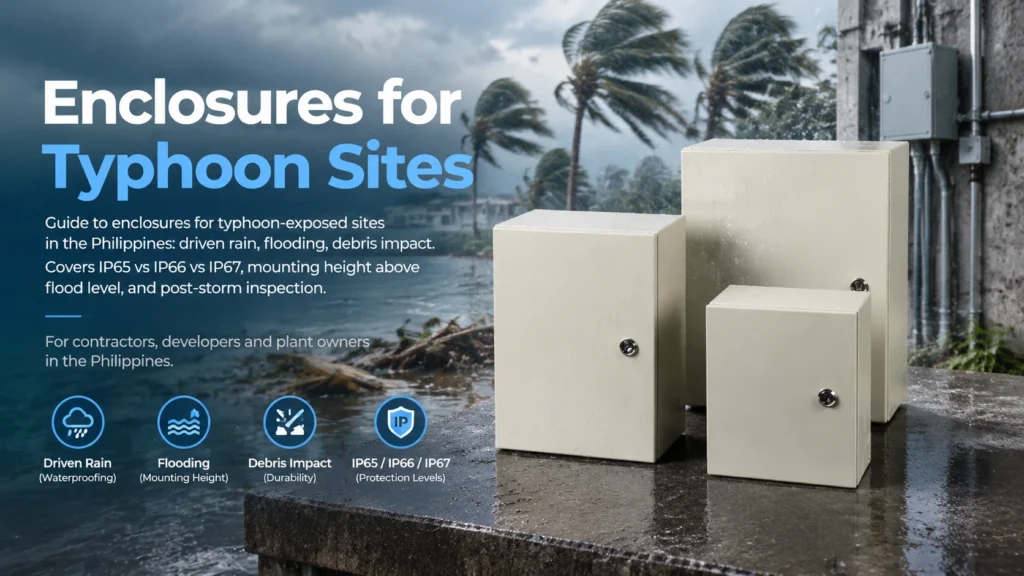
The Philippines gets around twenty tropical cyclones a year, and the ones that matter for electrical equipment are not only the violent ones. A week of horizontal rain driven by 60 km/h wind finds every gland that was sized loosely, and a flooded street finds every enclosure mounted at ground level.
This guide covers what a typhoon-exposed site needs from an enclosure, where IP65 stops being sufficient, and the installation details that decide whether a box survives the season.
What typhoon exposure actually demands
Three conditions arrive together, and they interact.
- Driven rain. Wind carries water horizontally and upward. Water that falls vertically is handled by a hood; water driven at pressure needs sealed entries and a gasket that is still compressed.
- Flooding. In low-lying urban areas, street flooding can reach the mounting height of a wall box. This is the only common situation where immersion protection becomes relevant.
- Debris and impact. Flying material damages enclosures and, more often, shears cable glands and conduits off the wall.
The IP code covers the first two, not the third. Impact resistance is a separate property, and on an exposed coastal installation it is worth specifying rather than assuming.
IP65, IP66 or IP67: where the line falls
| Mounting situation | Rating | Why |
|---|---|---|
| Indoor plant room, sheltered | IP54 to IP65 | Dust and cleaning, not weather |
| Wall-mounted under eaves | IP65 | Rain reaches it at an angle but not under pressure |
| Exposed wall, pole or roof | IP66 | Wind-driven rain at pressure during a cyclone |
| Ground level in a flood-prone area | IP67 | Short-term immersion, only if the entry points are also rated |
The fourth row is the one most often specified wrongly. IP67 on the box means nothing if the cable enters through a gland rated for a dry indoor cabinet. Glands, breathers and blanking plugs have their own ratings, and the assembly is only as watertight as its weakest entry.
Mounting height is a specification decision
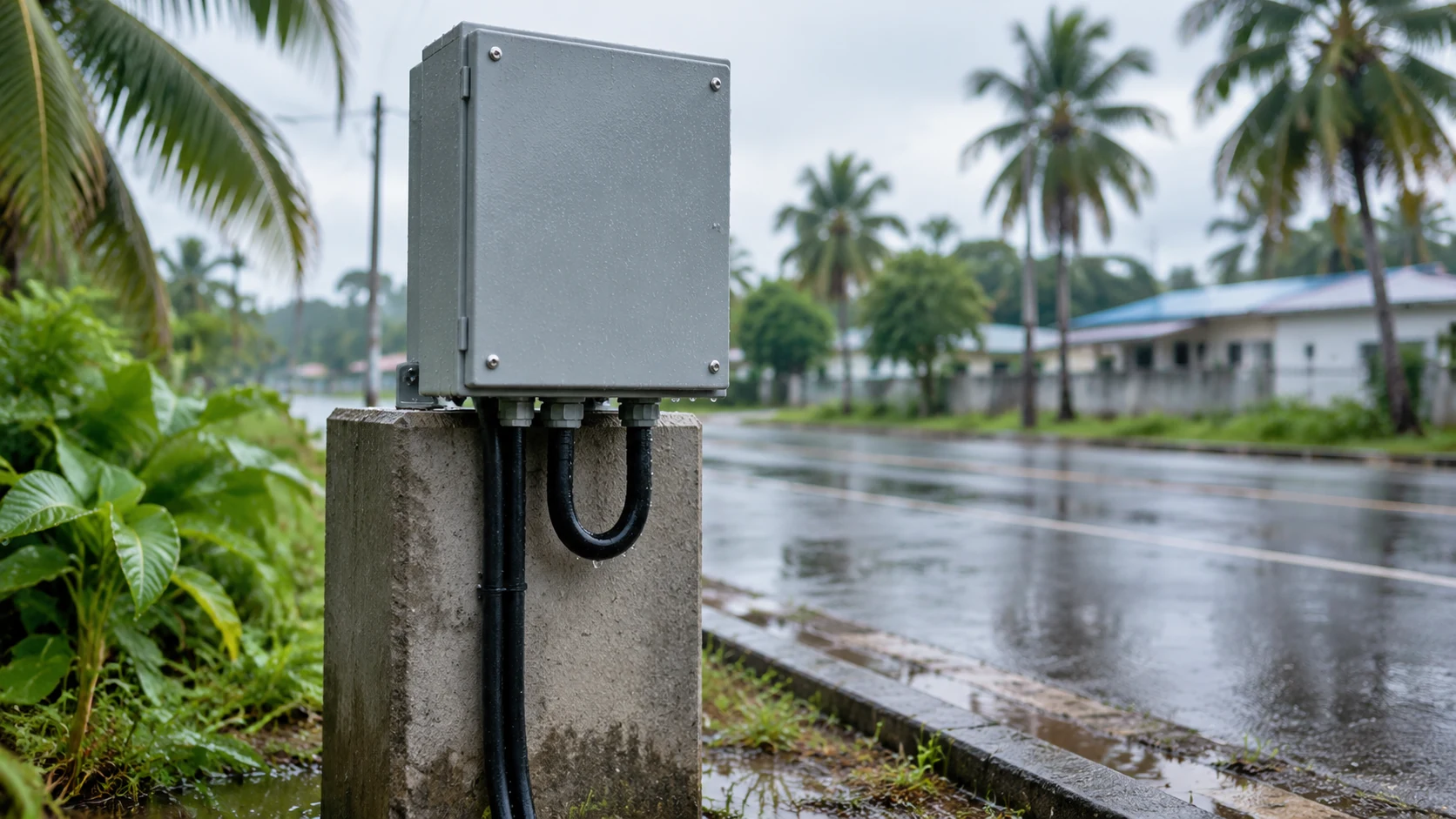
In flood-prone districts the single most effective measure costs almost nothing: mount the enclosure higher. A box at 300 mm above finished floor level is a box that floods. The same box at 1,200 mm usually is not.
Where the mounting height is fixed by the structure, a plinth or bracket raises the box without changing the cable route. This is worth agreeing before the walls are built, because retrofitting height afterwards means re-routing every cable.
The second decision is entry direction. Cables should enter from below, with a drip loop under the gland. Upward-facing entries collect water and, in a storm, admit it.
Materials in a hot, wet, saline climate
Powder-coated steel performs acceptably inland and under cover. On exposed coastal sites it fails at cut edges and fixing points, where the coating is broken and salt air reaches bare metal.
304 stainless handles most industrial exposure but pits under sustained salt spray; 316 is the grade for direct coastal installation. The parts that fail first are not the body: they are hinges, screws, the earthing stud and the gland plate. All of them must match the body grade, and dissimilar fixings should be isolated rather than simply tightened.
Plastic enclosures suit small distribution and instrumentation boxes in sheltered positions. They do not corrode, but they also do not resist impact or fire the way steel does, which matters where the box is accessible to the public.
Commissioning and post-typhoon inspection
An installation that is watertight on the day it is commissioned can lose that property in one storm. Two habits reduce the risk:
- Record the gland sizes and cable diameters at commissioning. When a cable is replaced with a thinner one, the gland no longer seals, and nobody remembers what was there before.
- Inspect after every significant storm. Look for water tracking inside the door, corrosion starting at the bottom edge, and glands that have moved. These are cheap to fix early and expensive to fix after a failure.
The Philippine Electrical Code governs the installation, and the enclosure is only one part of what an inspection covers. Earthing, bonding and labelling are installation responsibilities, but an enclosure that hides the isolators or leaves a door unconnected to earth creates a finding regardless of its IP rating.
Frequently asked questions
Is IP65 enough for a typhoon-exposed wall?
For a sheltered wall under deep eaves, often yes. For an exposed wall or pole, IP66 is the more appropriate specification, because cyclone-driven rain arrives at pressure rather than falling.
Should I specify IP67 because of flooding?
Only if the enclosure can genuinely be immersed — including every gland, breather and blanking plug. In most cases raising the mounting height above the expected flood level is cheaper and more reliable than relying on immersion protection.
Does a rain hood make a difference?
Yes, particularly on an exposed wall. A hood shades the top face and breaks the sheet of water running down the wall, and it reduces the water load on the door gasket. It does not substitute for correct glands.
Why do glands fail first?
Because they are the smallest seal in the assembly and the one most often mismatched to the cable. A gland designed for a 9–12 mm cable, fitted to an 8 mm cable, leaks under pressure even though the enclosure is rated IP66.
Where to go next
For the sealing and entry details that decide whether a storm-exposed box stays dry, the waterproof enclosure buying guide covers gaskets, glands and door design. The IP66 enclosure range lists the bodies used for exposed outdoor mounting.
For coastal sites, stainless steel enclosures sets out the material boundary, and this guide to humid-climate condensation covers the failure that follows the rain.