Enclosures for Southeast Asia: Humidity and Condensation
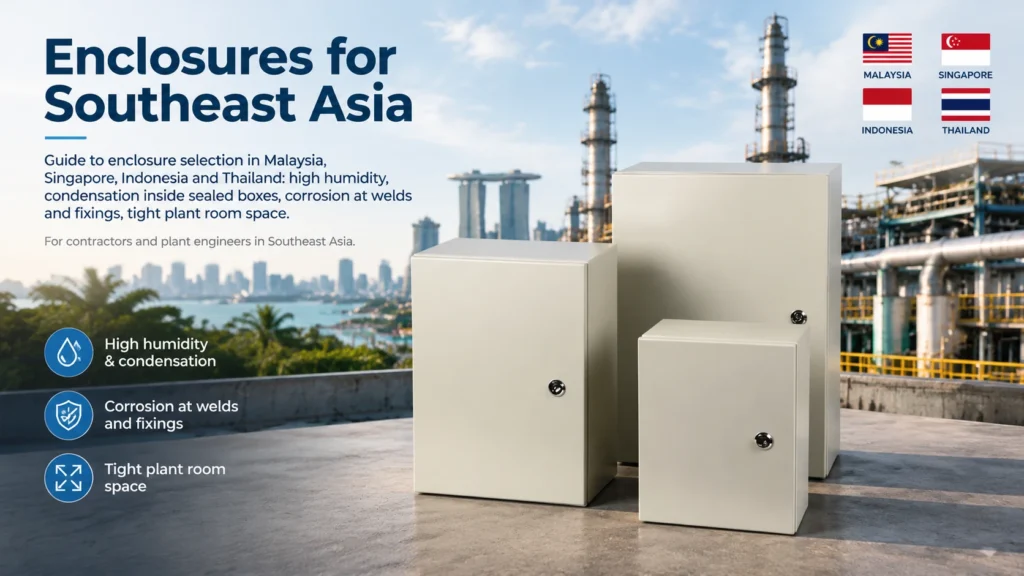
In Malaysia, Singapore, Indonesia and southern Thailand, the enclosure problem is rarely rain. Relative humidity sits above 80% for most of the year, and the failure that shows up in service is corrosion and condensation inside a box that was never actually wet from outside.
That changes the specification: sealing alone does not solve it, and a higher IP rating does not address it.
Why condensation, not rain, is the regional failure mode
Air holds more moisture as it warms. In a tropical climate the daily swing is enough to drive a cycle inside any enclosure: warm humid air during the day, cooler surfaces at night, moisture condensing on the inside of the door and on metalwork below it.
Because the box is closed, that water cannot leave. It sits on terminals, runs down to the lowest point, and starts the corrosion that later looks like a leak. The symptoms mislead: water marks inside a correctly glanded enclosure, white or green deposits on terminals, and an earth bar that rusts while the outside of the box looks fine.
Three measures address the cause rather than the symptom:
- A pressure-equalising breather that lets air move in and out while blocking liquid water.
- A drain element at the lowest point, for enclosures where small amounts of condensate are expected.
- An anti-condensation heater in enclosures with electronics, sized to keep the internal temperature a few degrees above ambient.
What does not work is sealing harder. A perfectly sealed box still contains the humid air trapped during assembly, and that air will condense on the first cool night.
Material: the honest ranking for humid coastal air
| Material | Humid inland | Coastal | Notes |
|---|---|---|---|
| Powder-coated steel | Acceptable if pre-treatment is good | Not recommended | Fails at cut edges and fixing points |
| 304 stainless | Good | Marginal in salt spray | Watch welding quality and passivation |
| 316 stainless | Good | Recommended | Fixings must match the body grade |
| ABS / polycarbonate | Good | Good, if UV-stabilised | Small boxes and instrumentation; check impact requirement |
Two details decide whether stainless actually performs. First, welds must be passivated: a heat-tinted weld is where pitting starts, and it is invisible until the box is two years old. Second, mixed metals must be avoided or isolated — a stainless body with zinc-plated screws creates a galvanic couple, and the screw fails first.
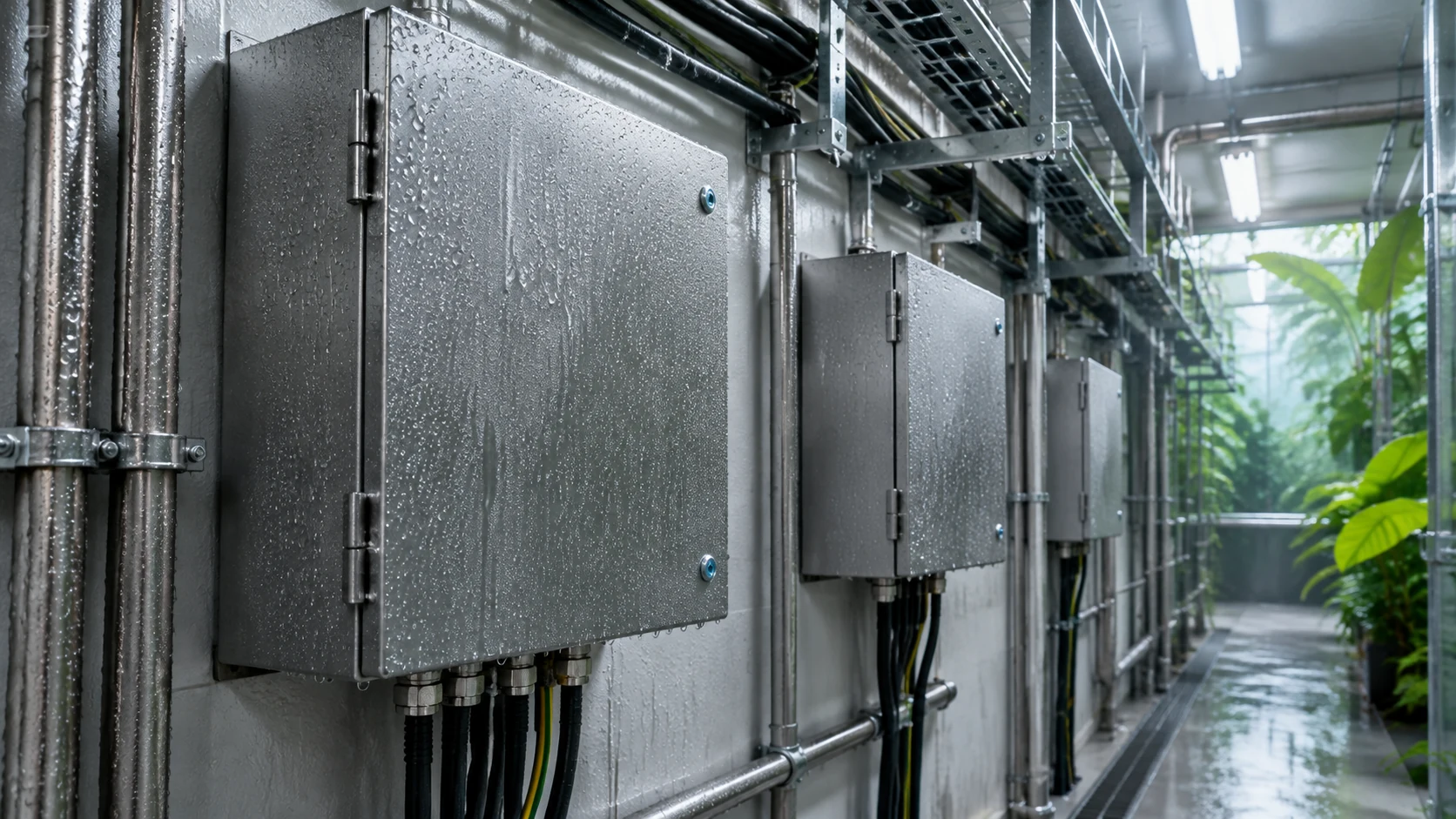
Space, access and the local installation reality
In Singapore and the established industrial areas of Malaysia, enclosures are frequently mounted in plant rooms and service corridors where wall space is tight and access is limited. That has practical consequences for the specification:
- Depth matters more than width. A shallow box on a narrow corridor wall leaves room to open the door; a deep one does not.
- Door swing direction should be chosen to open into available space, not by default.
- Removable gland plates let the installer drill and gland a plate on a bench rather than overhead in a live plant room.
These sound like small items. On a retrofit in an operating plant they determine whether the job takes an afternoon or a shutdown.
Standards, briefly
Malaysian projects typically reference MS IEC 61439 for assemblies and MS IEC 60529 for the IP rating; Singapore works to IEC standards directly. Neither governs the empty enclosure as a product — IEC 62208 is the framework for enclosures supplied for assembly elsewhere.
The distinction matters when a tender asks for a “certified enclosure”: what can be certified is the assembly, or the enclosure against IEC 62208 and an IP type test. A supplier who cannot explain which document they are providing is worth a second question.
Practical checklist for a humid-climate enclosure
- Rating matched to mounting position, not to habit: IP65 for sheltered outdoor, IP66 for exposed and washdown.
- Condensation control specified explicitly — breather, drain or heater — rather than left to the installer.
- Material chosen against the coastal distance, with fixings and hinges in the same grade.
- Gland plate sized for the cable schedule, with spare entries blanked.
- Door swing and depth checked against the actual wall space.
Frequently asked questions
Does IP66 stop condensation?
No. A higher IP rating resists water entering from outside; it does nothing about moisture already inside the box. Condensation is controlled by breathing, draining or heating.
Is 304 stainless good enough near the sea in Malaysia?
It depends on distance and exposure. Sheltered sites several hundred metres inland often perform acceptably with 304. Direct coastal exposure with salt spray is where 316 earns its cost.
Can I just install a heater in every box?
It is the most effective single measure for enclosures containing electronics, but it needs a power supply and a thermostat, and it adds load. For distribution boxes with no electronics, a breather is usually the more sensible choice.
Why do the terminals corrode when the box is sealed?
Because the corrosion is driven by condensation, not by water entering. Warm humid air trapped at installation condenses on cool surfaces overnight, and the moisture stays.
Where to go next
The waterproof enclosure buying guide covers gaskets, glands and door design, and includes the sealing checks that decide whether a humid-climate box performs. For exposed and washdown positions, the IP66 enclosure range lists the bodies we build.
Where the site is coastal, stainless steel enclosures explains the 304 and 316 boundary, and this guide to Gulf conditions covers the heat side of a similar climate problem.