Choosing an Inverter Enclosure for a South African Installation
South Africa’s electricity story changed course. Load-shedding has not been implemented since May 2025, and Eskom reported more than 450 consecutive days without it by mid-2026. Yet the demand for inverter and battery enclosures has not gone away, because the reasons for installing a system have shifted from surviving outages to managing a tariff that keeps climbing.
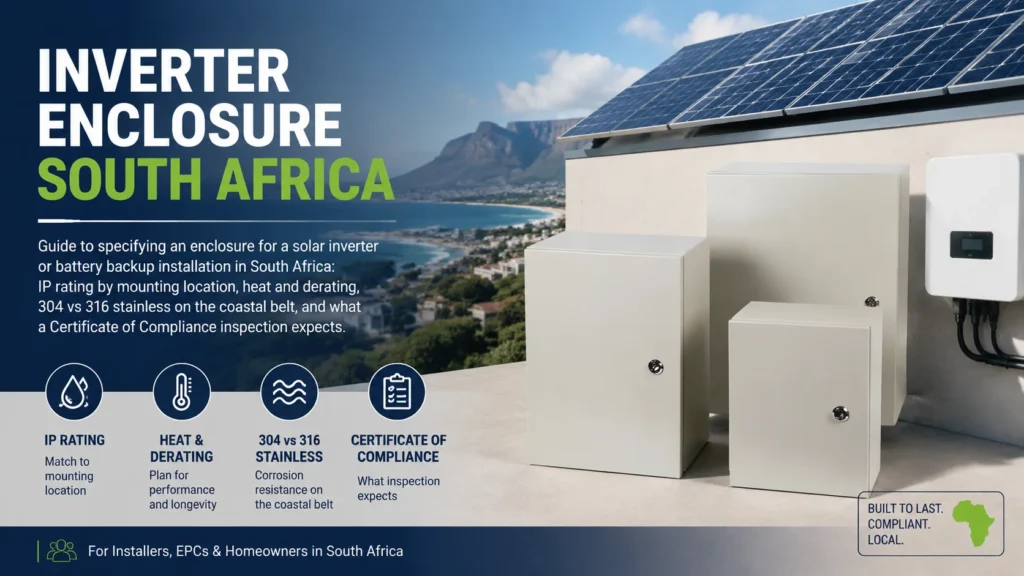
That shift matters when you specify the box. A system designed in 2023 to bridge four-hour outages has different priorities from one installed in 2026 to cut a monthly bill. This guide covers what the enclosure has to do in a South African installation: where it goes, what the climate does to it, and what a Certificate of Compliance inspection will look at before the system can be connected.
Load-shedding, load reduction, and why the distinction matters
Two different things are often called the same thing, and the confusion affects how a system is specified.
- Load-shedding is the national, stage-based mechanism. It has been suspended since May 2025, with Eskom reporting over 450 days without implementation by August 2026.
- Load reduction is a localised measure applied to specific overloaded feeders, commonly in high-loss areas. It continues in parts of Gauteng, KwaZulu-Natal, Limpopo and Mpumalanga, even while the national grid is stable.
If a client says the power “still goes off every evening”, the answer may be load reduction rather than load-shedding. The distinction changes the conversation: a backup system sized for four-hour national stages is oversized for a two-hour local window, and the money is better spent on battery capacity the household will actually cycle.
What has not changed is the installed base. Rooftop solar in South Africa is estimated in the several gigawatts, with hundreds of thousands of households now carrying panels, an inverter and often a battery. Every one of those systems has an enclosure somewhere on the wall, and every retrofit or replacement needs one that suits the site.
What the enclosure actually has to do here
In a South African installation the box is doing three jobs at once, and the third is usually underestimated:
- Keep water and dust out of live parts, at whatever IP rating the mounting location demands.
- Keep the equipment cool enough to deliver rated output. Inverters derate as ambient temperature rises, and a sealed box in direct sun on the Highveld can sit far above shade temperature.
- Stay serviceable. Isolators must be reachable and labelled, because the Certificate of Compliance inspection and every future fault-find depend on it.
A box that seals well but bakes the inverter costs the owner output every afternoon. A box that ventilates well but lets in driven rain costs them a replacement board. The specification has to hold both.
Where the enclosure goes decides most of the specification
| Mounting location | Typical protection grade | Material | What goes wrong |
|---|---|---|---|
| Garage or indoor wall | IP54 to IP65 | Powder-coated steel | Dust build-up and heat, not water |
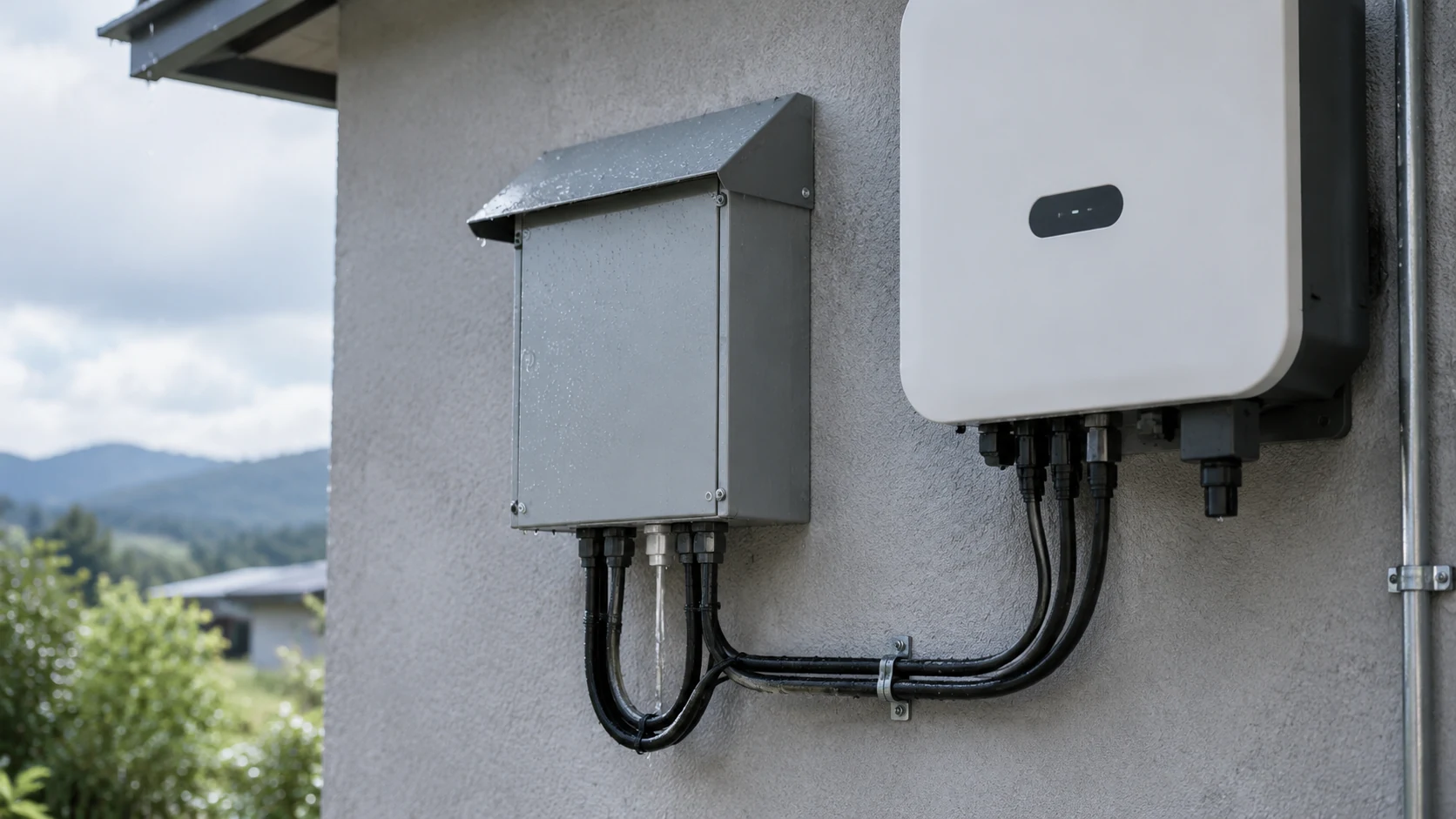
| Outside wall, under eaves | IP65 | Powder-coated steel or 304 | Driven rain in storm season, afternoon sun |
| Exposed wall or pole | IP65 to IP66 | 304 stainless, or coated steel with a rain hood | UV on the coating, water tracking along cables |
| Coastal belt (Cape Town, Durban, Gqeberha) | IP65 to IP66 | 316 stainless | Salt attack at cut edges, hinges and fixings |
The mistake to avoid is treating “outdoor” as one category. A wall in Centurion under a roof overhang and a wall in Bloubergstrand facing the sea are not the same environment, even though both are technically outside.
Heat is the harder problem than rain
Most South African installations fail on temperature before they fail on water. Three things drive it:
- Ambient. Summer temperatures in Gauteng and the Northern Cape routinely pass 32°C, and an unshaded metal box absorbs far more than that.
- Inverter derating. Most inverters reduce output above roughly 40–45°C internal temperature. The number is manufacturer-specific, but the direction is universal.
- Battery chemistry. Lithium batteries age faster in sustained heat, and a sealed cabinet in a hot garage is the worst case.
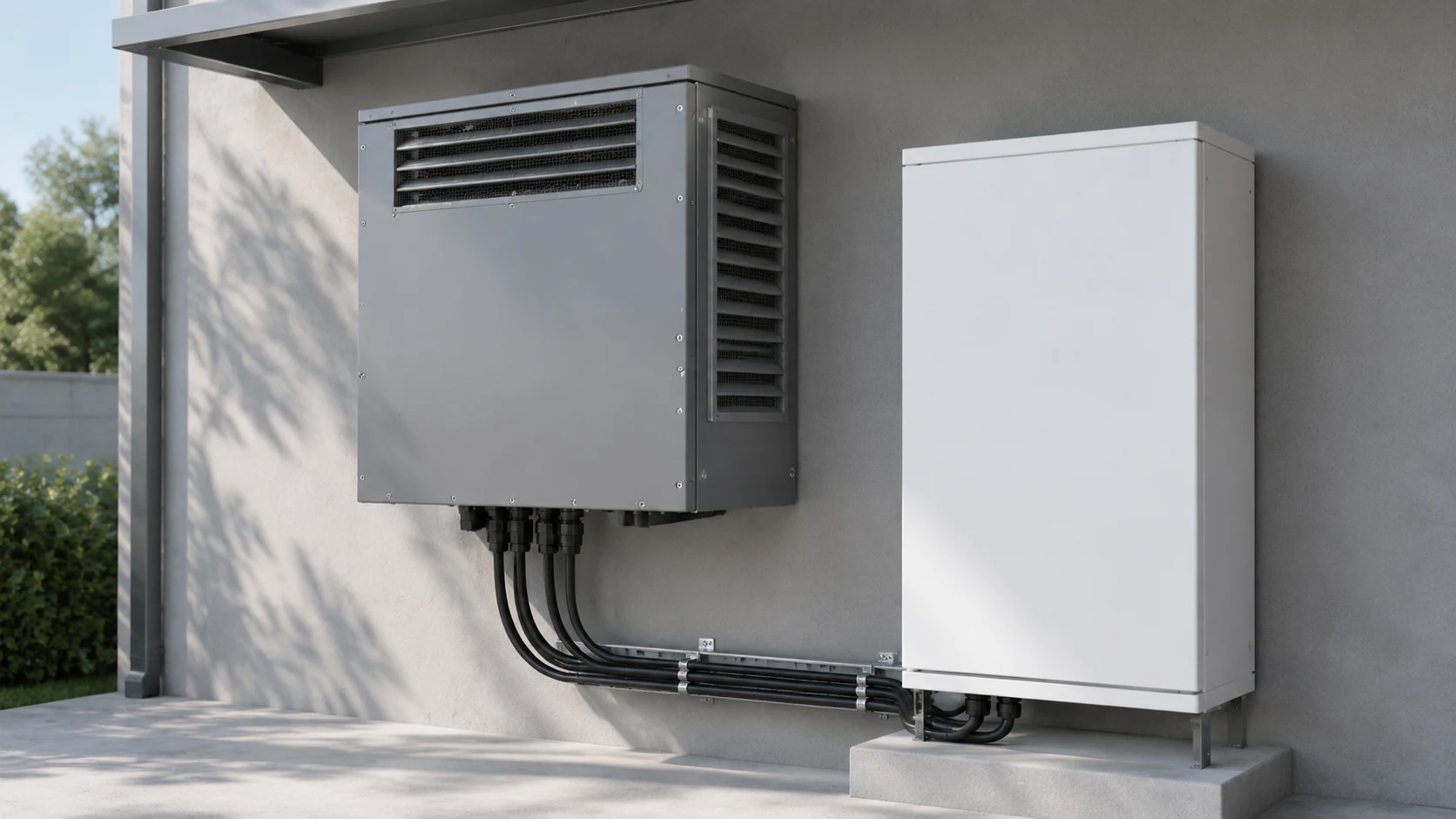
Practical measures, in order of cost effectiveness: mount in shade or on a shaded wall, keep the box out of direct afternoon sun, use louvred vents with insect mesh rather than drilling holes, and separate the battery cabinet from the inverter where the loads are large. Where the site cannot avoid sun, specify a light colour, add a rain hood that also shades the top face, and confirm the derating curve with the inverter supplier rather than assuming full output.
Material: where 304 stops being enough
Powder-coated steel is the sensible default for inland sites: it is the cheapest per square metre, it is strong, and it takes a lock. It fails at cut edges and fixing points where the coating is broken, which is exactly where coastal air does its work.
304 stainless handles most industrial and urban conditions and is the usual upgrade for exposed outdoor mounting. On the coastal belt, 316 is the honest choice: the difference between the two grades is molybdenum, and it is chlorides from sea air that consume it. Hinges, screws and gland plates have to match the grade of the body, or the fixings become the failure point.
For a coastal installation the cost difference between 304 and 316 is small against the labour of replacing a box in five years, and it is the difference between passing and failing a corrosion inspection on a commercial site.
What the CoC inspection looks at, in enclosure terms
Every solar installation in South Africa needs a Certificate of Compliance, issued by a Department of Labour-registered electrical contractor and referencing SANS 10142-1. The document is a legal record that the installation is safe, and it is also what insurers and conveyancers ask for.
The inspection covers the whole installation, but several points land on the enclosure itself:
- Isolators present, labelled and accessible — DC and AC. A box that has to be dismantled to reach an isolator will be flagged.
- Surge protection installed on both DC and AC sides where required by the design, with the devices visible and replaceable.
- Dual supply labelling at the distribution board, so anyone working on the installation knows it can be energised from two directions.
- Cable entry through proper glands , with no unused holes left open and no cables passing through a bare knockout.
- Earthing and bonding of metalwork, including the enclosure door where hinges are the only connection.
None of these is the enclosure manufacturer’s certification. They are installation details, and they are the reason a box specified with a proper gland plate and a lockable, hinged door costs less over the project than one that has to be modified on site.
Grid-tied systems bring one more requirement
Grid-tied and hybrid systems must use an inverter that meets NRS 097-2-1, and registration with Eskom or the municipality is required before connection. That standard is about anti-islanding and protection settings, not about the box, but it affects the layout: the DC isolator has to be locatable and lockable so it can be operated independently, and the labelling has to match the registration drawings.
In practice this means the enclosure should be chosen together with the single-line diagram, not after it. A box that fits the wall but cannot show the isolator to an inspector creates a variation, and variations cost time in a market where approval queues already run for weeks.
Sizing: what has to fit inside
| Component | What it needs | Common mistake |
|---|---|---|
| Inverter | Clearance for airflow above and below, per the manufacturer’s manual | Box sized to the inverter footprint only, no ventilation gap |
| Battery | Its own compartment or cabinet; heat separated from the inverter | Battery and inverter in one small box |
| DC and AC isolators | Reachable without removing devices; label space | Isolator behind the inverter |
| Surge protection | Space to replace a module without rewiring | SPD buried at the back of the box |
| Cable bending | Radius respected for DC cable; room for a drip loop at entry | Depth chosen for the devices only |
As a rule, take the device list, add the manufacturer’s clearance figures, then add wiring depth. If the result falls between two standard sizes, take the larger one: retrofitting an undersized enclosure costs more than the price difference.
Frequently asked questions
Is load-shedding coming back?
Nobody can promise otherwise, and Eskom itself flags the 2029–2030 supply gap as a risk. What can be said accurately is that national load-shedding has not been implemented since May 2025, and that localised load reduction continues in some areas. Systems are increasingly justified on tariff savings rather than outage cover.
Do I need IP66 for a coastal installation?
Not necessarily. IP65 is usually sufficient against rain; the coastal problem is corrosion, not water pressure. Spend the budget on 316 stainless and matched fixings rather than on a higher IP number.
Can the inverter go in a sealed box?
Only if the box can dissipate the heat. A sealed enclosure protects against water and dust but traps heat, and inverters derate as internal temperature climbs. Where a sealed box is required, plan for a larger enclosure and confirm the derating with the inverter supplier.
Does the enclosure affect the Certificate of Compliance?
Indirectly, yes. The CoC certifies the installation under SANS 10142-1, and the inspector needs to see isolators, surge protection, labelling, earthing and proper cable entry. An enclosure that hides or obstructs these creates a finding, even though the box itself is not what is being certified.
What gauge of steel is normal for a wall-mounted inverter box?
For wall-mounted enclosures in this size range, 1.2 mm to 1.5 mm sheet is typical, with a 1.5 mm mounting plate. Thinner bodies deform when a door is slammed or a heavy inverter is mounted on the plate, and the gasket stops sealing once the frame is out of shape.
Where to go next
If you are specifying the enclosure around a solar or backup installation, the decisions that matter are the mounting location, the material and the internal layout. The waterproof enclosure buying guide works through IP rating and sealing in the order a project makes them, and stainless steel enclosures covers the 304 and 316 difference in more detail.
For the distribution side of the same installation, distribution box enclosures covers standard sizes and gland arrangements, and IP65 enclosures lists the range we build for outdoor wall mounting.