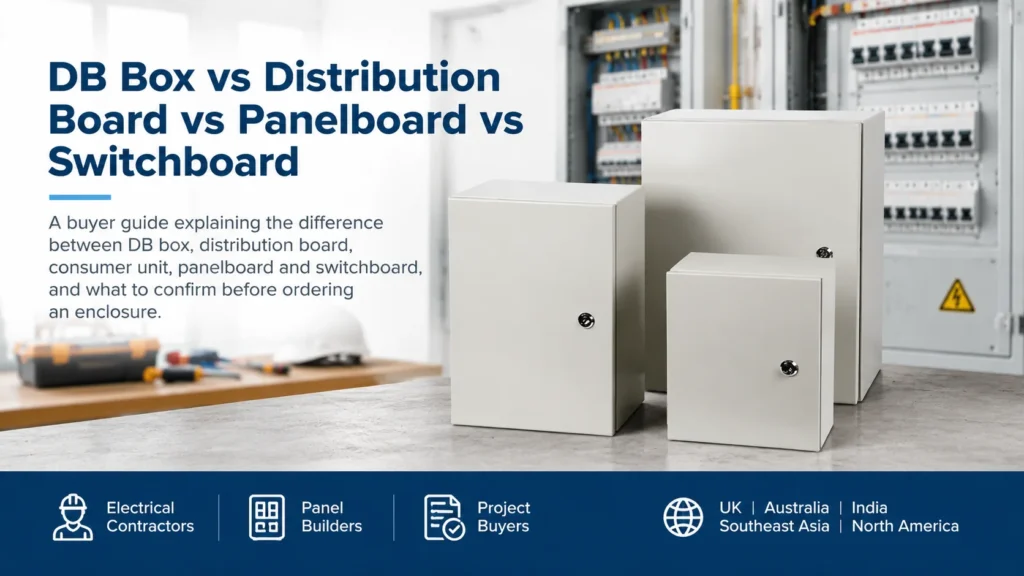
DB Box vs Distribution Board vs Panelboard vs Switchboard
A buyer in Manchester asks for a DB box. A buyer in Texas asks for a panelboard. A buyer in Brisbane asks for a distribution board, and a homeowner in Leeds asks for a consumer unit. In most cases they are describing the same object: a steel enclosure with breakers inside, splitting one supply into several outgoing circuits.
The names are not interchangeable, though. Each one carries a different standard, a different form factor and, most importantly for anyone ordering, a different expectation about what arrives in the crate. This guide sets out what each term means in the market that uses it, and what to confirm before you send a purchase order.
The short answer: five names, two standards families
| Term | Where it is used | What it usually means | Standard behind it |
|---|---|---|---|
| DB box | UK, Ireland, Australia, New Zealand, South Africa, India, Singapore, Malaysia, Philippines | Trade shorthand for a distribution board; often the empty enclosure | IEC 61439 / national wiring rules |
| Distribution board | IEC countries, UK, Australia, Middle East | The formal product: enclosure, busbar, breakers, outgoing ways | IEC 61439 |
| Consumer unit | UK and Ireland, domestic only | Small distribution board for a single dwelling | BS 7671 |
| Panelboard | United States, Canada | Enclosure with two columns of bolt-on breakers on busbars | UL 67 |
| Switchboard | United States, Canada, also used loosely elsewhere | Larger assembly, often floor-standing, service-entrance scale | UL 891 |
The split behind the terminology is simpler than the list suggests: IEC 61439 and its national adoptions on one side, the UL framework on the other. Everything else is regional vocabulary layered on top.
Why “DB box” is the term that dominates search
Strictly speaking, a DB box is not a product name in any standard. It is trade shorthand for distribution board box, and it is what a large share of buyers actually type into a search box or write in an enquiry. It is used across the UK, Ireland, Australia, New Zealand, South Africa, India and most of Southeast Asia.
What matters commercially is what the buyer expects to receive. When someone asks for a DB box, they usually mean the enclosure only, not the assembled board. They intend to fit their own breakers, busbar and wiring. Get that wrong and you ship a fully populated board to someone who wanted an empty shell, or the reverse.
Ask this before quoting: “Do you need the empty enclosure, or the enclosure fitted with breakers and busbar?” That single question prevents more re-quotes on this product than any other.
Distribution board: the formal IEC term
In IEC terminology, a distribution board is an assembly that receives energy from one incoming source and distributes it to several outgoing circuits, with protective devices for each. In the markets above, in practice, it means a steel or plastic enclosure containing:
- an incoming device such as a main switch or main breaker
- one or more rows of DIN-rail devices, usually MCBs, RCDs or RCBOs
- a neutral bar and an earth bar
- numbered ways, so each circuit can be identified against a schedule
The governing standard is the IEC 61439 series for low-voltage switchgear and controlgear assemblies. National adoptions follow it closely: AS/NZS 61439 in Australia and New Zealand, MS IEC 61439 in Malaysia, IS 8623 in India, and equivalent adoptions across the Gulf. The UK’s wiring regulations, BS 7671, tell the installer how the board must be selected and installed, while the assembly itself is built to IEC 61439.
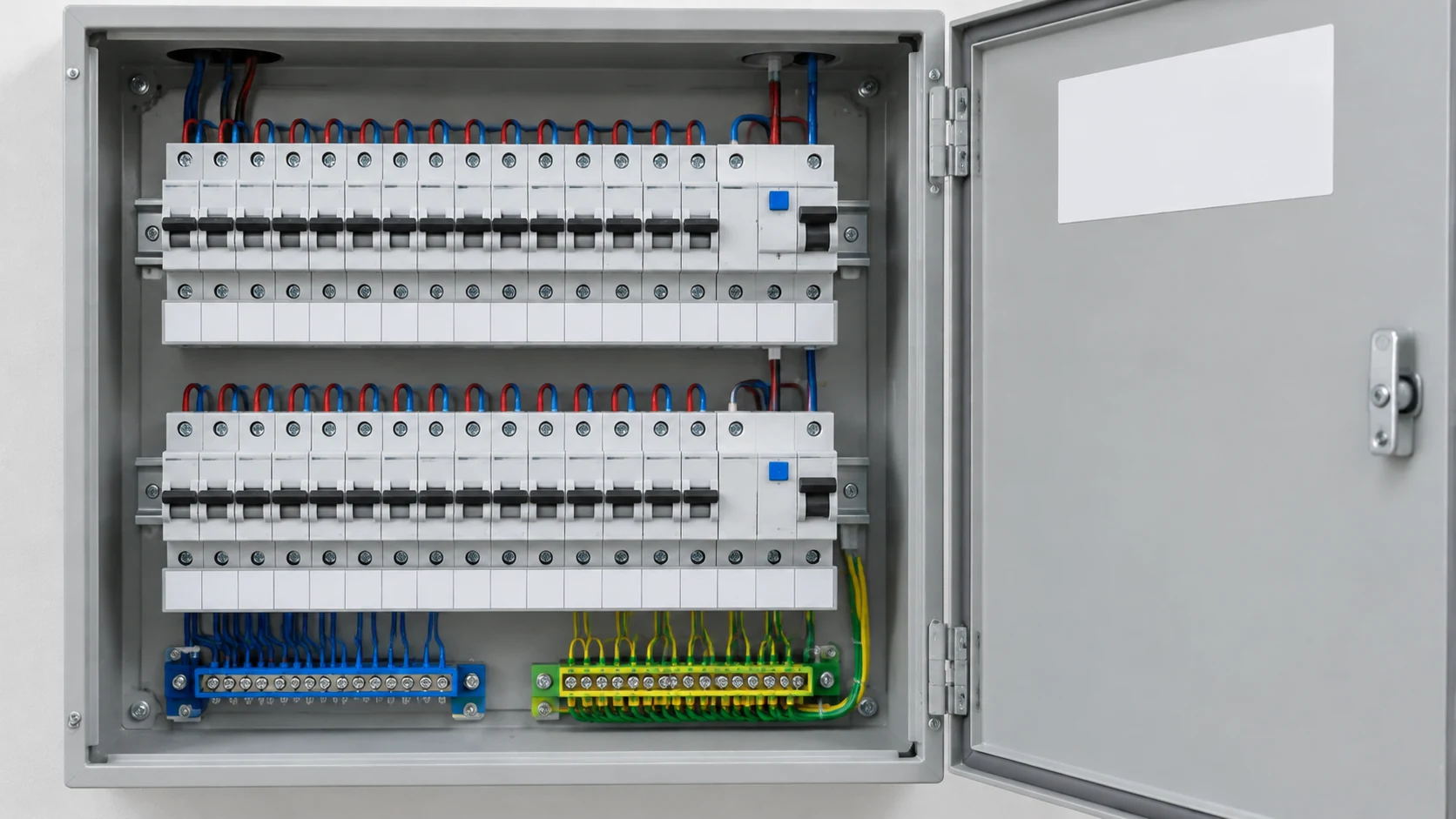
Note what that definition covers and what it does not. IEC 61439 applies to the assembly, which means the verification behind it depends on the devices fitted and how they are arranged. That point decides who is responsible for what, and it is covered below.
Consumer unit: a UK domestic subset
A consumer unit is the small distribution board at the origin of a domestic installation. Typically it has one or two rows, an RCD or RCBO protection arrangement, and a metal enclosure, because the 18th Edition of BS 7671 tightened the requirements on non-combustible enclosures.
The practical difference is scale and application, not construction. If a UK buyer asks for a consumer unit, they mean a domestic board with domestic ways and domestic accessories. If they ask for a distribution board, they usually mean something larger: three-phase, industrial, or a sub-main board. Quoting one for the other produces a size and price that neither side expects.
Panelboard: the North American equivalent, but not the same object
In the United States and Canada, the equivalent product is a panelboard, built and listed to UL 67. The differences from a DIN-rail board are not cosmetic:
- Breakers mount differently. North American breakers bolt or clip onto busbars in two vertical columns, rather than clipping onto a horizontal DIN rail.
- The cover is a deadfront. A separate deadfront sits over the live parts with the breaker handles protruding, and the door covers the whole cabinet.
- The schedule is on the door. A circuit directory card is standard, because a two-column layout is read differently from numbered ways in rows.
- Ratings follow a different framework. UL 67 for panelboards, UL 891 for switchboards, with short-circuit current ratings stated in kA at a given voltage.
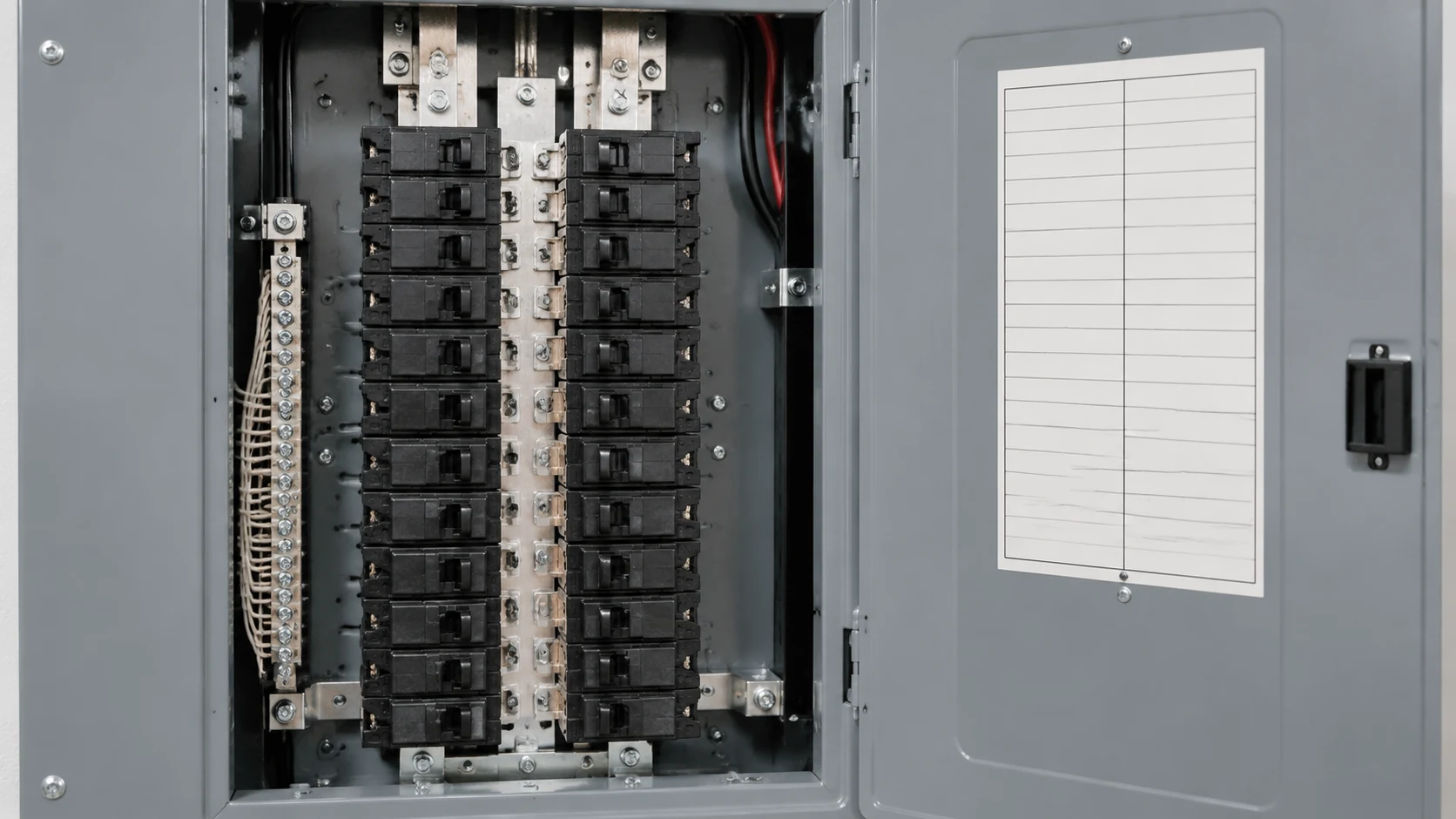
This is where most cross-market sourcing misunderstandings begin. A DIN-rail board and a panelboard do the same job in a building, but they use different hardware, different covers and different listing routes. Dimensions matching is not the same as equivalence.
Empty enclosure or assembled board: who is responsible for what
This distinction decides which standard applies to what you are buying. It is also where sourcing conversations most often go wrong, because the word used in the enquiry does not settle it.
| What you are buying | Framework that applies | Who takes responsibility |
|---|---|---|
| Empty enclosure: sheet, door, gasket, gland plate, no devices | IEC 62208 for empty enclosures, plus IEC 60529 for the IP rating | The enclosure manufacturer: wall thickness, impact resistance, gasket, IP rating of the empty box |
| Enclosure with devices fitted and wired | IEC 61439, or UL 67 and UL 891 in North America | The panel builder or assembler: temperature rise, short-circuit withstand, internal separation, routine tests |
An enclosure manufacturer supplies the first. The second is the work of a panel builder, and the design verification behind it, covering temperature rise, short-circuit withstand and internal separation, depends on which devices are fitted and how they are arranged. That verification cannot be completed before the device list is known, which is why a supplier quoting only the enclosure cannot certify an assembly.
For buyers comparing quotes, this is worth settling early. A supplier quoting the enclosure is not pricing devices, wiring or type testing. A supplier quoting a fully assembled board is pricing devices and labour you may already have in-house. Ask which of the two is being quoted, and the numbers become comparable.
Switchboard: the larger assembly
Above the panelboard sits the switchboard, UL 891 in North America: a larger assembly, frequently floor-standing and often fed directly from the service entrance, with main devices and multiple distribution sections.
Outside North America, the word is used more loosely. Main switchboard is common in the UK and Australia for a large main board, even when the product is an IEC 61439 assembly rather than a UL one. If a buyer says switchboard, confirm the scale and the standard before pricing. The word tells you it is bigger than a panelboard; it does not tell you which certification framework applies.
What to confirm before you send a purchase order
| If the buyer says | They probably expect | Confirm before quoting |
|---|---|---|
| DB box | Empty enclosure, or enclosure plus busbar | Empty or populated; IP rating; single or double door |
| Distribution board | IEC 61439 assembly, DIN rail, numbered ways | Ways and phases; incoming device type; form of separation if specified |
| Consumer unit | Domestic board, single phase, one or two rows | Ways; RCD or RCBO arrangement; metal enclosure required by BS 7671 |
| Panelboard | UL 67, bolt-on breakers, deadfront | Bus rating; kA rating; single or three phase; NEMA enclosure type |
| Switchboard | UL 891 or a large main board | Which standard; service entrance or downstream; sections required |
How to brief a supplier in one message
Whichever word you use, five details remove almost all ambiguity. A message containing these gets an accurate quote the first time:
- Term and standard: “DB box to IEC 61439” or “panelboard to UL 67”, not just “distribution box”.
- Configuration: phases, ways, incoming device rating, and whether you need the enclosure empty.
- Environment: indoor, outdoor, coastal or washdown, because this sets the IP rating and the material.
- Size or device list: the largest breaker plus the number of outgoing circuits, or a drawing.
- Documents required: which test reports or declarations the project file needs.
If the drawing is not ready, a marked-up photo of a similar installation is enough to start. Sizing an enclosure from a device list takes less time than correcting one that arrives too small.
Frequently asked questions
Is a DB box the same as a distribution board?
In everyday trade use, yes. DB box is shorthand for distribution board in the UK, Ireland, Australia, New Zealand, South Africa, India and much of Southeast Asia. The practical difference is what is included: a DB box often means the empty enclosure, while a distribution board usually means the assembled product with breakers and busbar.
Can I use a distribution board instead of a panelboard?
Not where a UL-listed panelboard is required. A board built to IEC 61439 is a different product from a UL 67 panelboard: different breaker mounting, different cover arrangement and a different listing. Where the project specifies UL 67, the assembly has to be built and listed to that standard.
What is the difference between a consumer unit and a distribution board?
A consumer unit is a small domestic distribution board at the origin of a single dwelling, used mainly in the UK and Ireland and covered by BS 7671. A distribution board is the broader term, usually a larger board for industrial or commercial distribution.
Does IP65 mean the same as NEMA 4X?
No, and there is no conversion table. IP ratings defined in IEC 60529 test against dust and water ingress. NEMA 250 types test against a wider set of conditions that can include corrosion resistance, hose-down and ice. A product can meet IP65 and still not be NEMA 4X, because the tests and the standards behind them differ.
How many ways does a distribution board need?
Count the outgoing circuits, then add spare ways for future load, typically 20 to 25 percent on commercial work. Check whether each device needs more than one way: a three-phase breaker occupies three single-phase ways on a DIN rail.
Where to go next
If you are specifying the enclosure around these boards rather than the assembly inside them, the environment decides most of the remaining choices: protection grade, material, cable entry and door design. The waterproof enclosure buying guide works through those decisions in the order a project makes them, and the distribution box enclosures range covers the standard sizes from 300 × 200 mm upward.
For three-phase installations, three-phase distribution box enclosures covers the larger bodies and gland arrangements. If the board is on the DC side of a solar installation, PV combiner boxes follows the same enclosure logic with string-count sizing.