Enclosures for Indian Sites: Monsoon, Dust and Coast
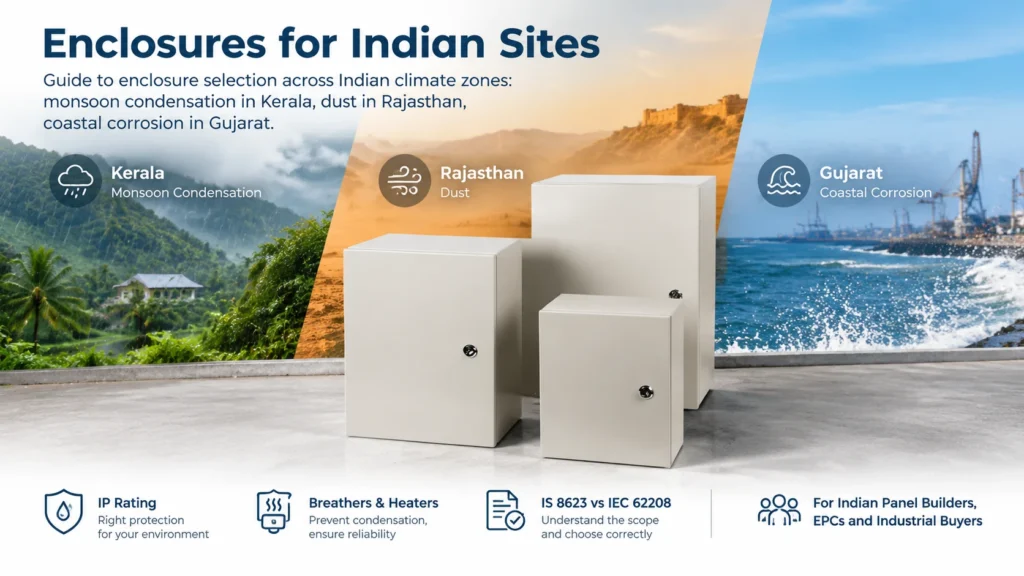
India is usually described as one market, but for an enclosure it behaves like at least three. A box specified for Kerala’s monsoon is not the right box for Rajasthan’s dust season, and neither is the right box for a coastal chemical plant in Gujarat. The IP rating that gets written into a tender often ignores this.
This guide sets out how the climate splits the specification, what the standards behind the tender actually require, and the details that fail in service rather than on paper.
One country, three enclosure problems
| Region | Dominant condition | What fails first | Practical emphasis |
|---|---|---|---|
| Kerala, coastal Karnataka, Goa, West Bengal | Monsoon rain, humidity above 80% for months | Condensation inside a sealed box; corroded terminals | Sealing plus drainage or breathing |
| Rajasthan, Gujarat interior, parts of Madhya Pradesh | Dust, 45°C+ summer, low humidity | Dust ingress at cable entries; gasket hardening | Dust-tightness and heat |
| Coastal industrial belts (Gujarat, Maharashtra, Tamil Nadu) | Salt air plus chemical atmospheres | Corrosion at cut edges, hinges and fixings | Material grade |
The mistake is to apply one spec across a multi-site project. A tender that says “IP65, powder-coated steel” will produce complaints in Kerala and corrosion claims in Gujarat, for different reasons.
Monsoon: water arrives, but condensation does the damage
During the southwest monsoon, relative humidity stays above 80% for weeks. A sealed enclosure on a wall goes through a daily cycle: air inside warms and expands during the day, then cools at night. Moisture that entered during installation, or that diffuses through a gasket, condenses on the coolest surface — usually the inside of the door and the metalwork below it.
The result looks like a leak but is not one. Boards show water marks, terminals corrode, and the installer is blamed for a gland that was correctly fitted. Three measures address it:
- A breather or drain element that equalises pressure while blocking liquid water.
- An anti-condensation heater in enclosures holding electronics, where the duty cycle justifies it.
- Correct gasket compression , so the box is sealed rather than merely closed — a door that is not compressing evenly lets vapour in continuously.
Where a box must be fully sealed and no heater is available, specifying a slightly larger enclosure reduces the temperature swing per unit volume and therefore the amount of condensate.
Dust season: the opposite problem, same failure point
In Rajasthan and interior Gujarat, wind-borne dust is fine enough to behave like a fluid. It enters where the IP rating is weakest in practice: cable entries and door seals.
Two specification habits help. First, size glands to the actual cable diameter and blank every spare entry with a proper plug rather than tape. Second, prefer a hinged door with a captive gasket over a lift-off cover, because covers are routinely refitted unevenly during maintenance and never reseal properly afterwards.
Dust also raises the internal temperature of the box: a layer on the inside of a door acts as insulation, and on the outside it reduces heat rejection. In a 45°C summer this compounds the derating of any device inside.
What the standards behind the tender actually say
Indian projects reference a mix of standards, and the enclosure sits inside that framework rather than being certified to it on its own.
- IS/IEC 60529 defines the IP code that the tender’s “IP65” refers to. The test is a type test; it says nothing about how the box performs after two monsoons of thermal cycling.
- IS 8623 covers low-voltage switchgear and controlgear assemblies, aligned with IEC 61439. This applies to the assembled board, not to an empty enclosure.
- IEC 62208 is the framework for empty enclosures supplied for assembly elsewhere — the category most enclosure-only purchases fall into.
That distinction matters in procurement: an enclosure supplier cannot certify an assembly built by someone else, and a tender that asks for “IS 8623 certified box” is conflating two scopes. Clarifying it early avoids a variation later.
Material and finish: where the budget should go
Powder-coated steel covers most inland applications and is the cheapest per square metre. What matters more than the colour is the pre-treatment: coating over inadequately cleaned steel fails at the edges within a few years, particularly in humid coastal air.
For coastal and chemical sites, stainless steel is the honest answer. 304 handles most urban and industrial exposure; 316 is appropriate where chlorides are concentrated, such as a plant near the Gujarat coast or a site handling chlorine compounds. As always, hinges, screws and gland plates have to match the body grade, or the fixings fail first.
Plastic enclosures deserve a mention for small distribution and instrumentation boxes in humid regions: they do not corrode, they are lighter on a wall, and they suit indoor and sheltered outdoor positions. They are not the right choice where mechanical impact or fire resistance governs.
Frequently asked questions
Is IP65 enough for monsoon areas?
For rain, usually yes. IP65 is dust-tight and protected against water jets. The monsoon failure is more often condensation than rain ingress, so the specification should include a breather, a drain or a heater as appropriate, not a higher IP number.
Should I use IP66 instead of IP65 in India?
IP66 adds resistance to powerful water jets, which matters for washdown areas and exposed coastal sites. For most monsoon locations IP65 with correct gland sizing performs better than an IP66 box with oversized entries.
Does an empty enclosure need IS 8623?
No. IS 8623 addresses assemblies. An empty enclosure is better described against IEC 62208, with the IP rating verified to IS/IEC 60529. The distinction is worth raising at tender stage.
Why do terminals corrode inside a sealed box?
Condensation, not leakage. Warm humid air enters during installation or diffuses slowly through the seal, then condenses when the box cools at night. A breather or heater addresses the cause; drying the terminals treats the symptom.
Where to go next
For the sealing and gasket decisions that determine whether an Indian installation stays dry, the waterproof enclosure buying guide covers them in project order. The IP65 enclosure range lists the standard bodies used for outdoor wall mounting.
For coastal and chemical sites, stainless steel enclosures covers the 304 to 316 decision, and this guide to board terminology explains why “IS 8623 box” and “empty enclosure” are different purchases.