Fiberglass vs Stainless Steel Enclosures: How to Choose the Right Material
Selecting an electrical enclosure is not only about choosing a box that fits the components inside. The enclosure material directly affects corrosion resistance, electrical safety, maintenance needs, installation cost, service life, and suitability for the application environment.
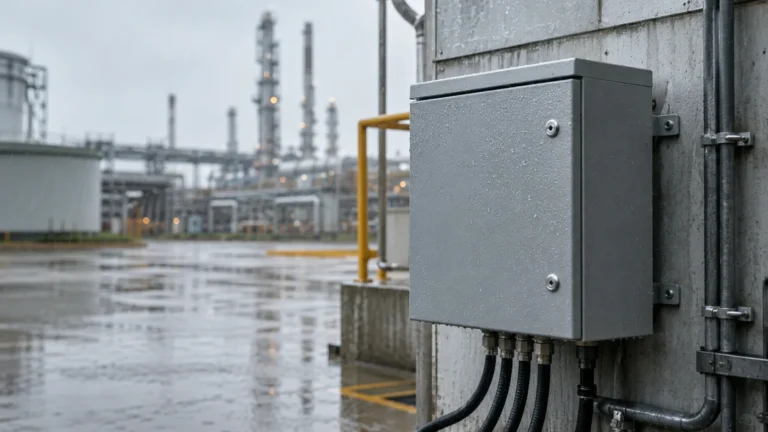
Fiberglass and stainless steel are both widely used for industrial electrical enclosures. Both can be configured to meet demanding protection requirements, including IP66 or NEMA 4X in suitable designs. However, they solve different problems.
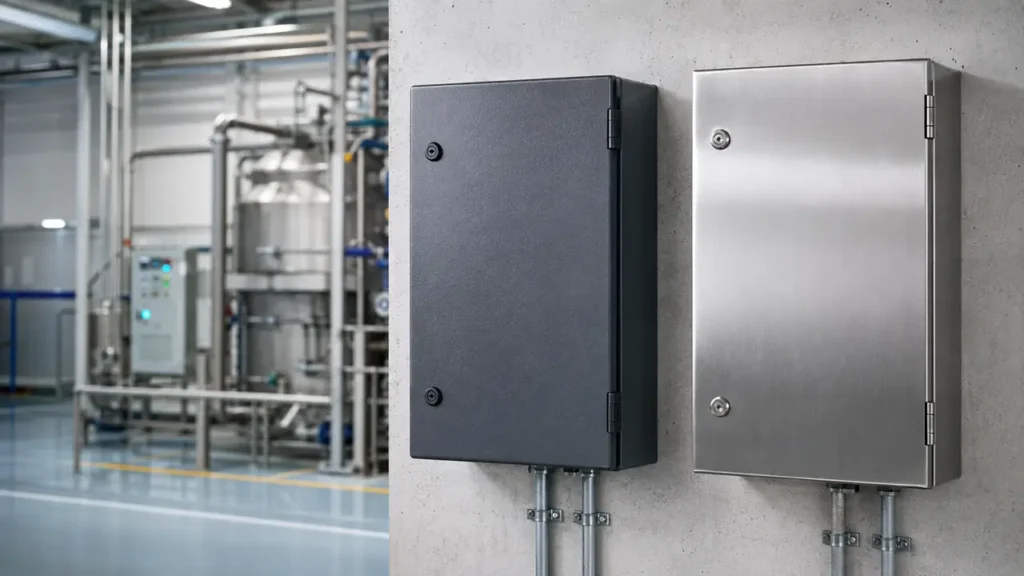
Fiberglass enclosures are non-conductive, lightweight, and highly resistant to many chemicals. Stainless steel enclosures offer superior mechanical strength, cleanability, security, and long-term performance in washdown, food, pharmaceutical, marine, and heavy-duty industrial environments.
This guide compares fiberglass vs stainless steel enclosures in practical terms, helping OEMs, panel builders, contractors, and procurement teams make the right choice.
Quick Comparison: Fiberglass vs Stainless Steel Enclosures
| Selection Factor | Fiberglass Enclosure | Stainless Steel Enclosure |
|---|---|---|
| Material | Fiber-reinforced polyester or other reinforced composite | Usually 304, 304L, 316, or 316L stainless steel |
| Electrical conductivity | Non-conductive | Conductive; grounding and bonding are required |
| Weight | Lightweight | Heavier |
| Corrosion resistance | Excellent against many chemicals and moisture | Excellent; 316/316L performs especially well in chloride-rich environments |
| Mechanical strength | Good impact resistance, but may crack under severe impact | Very high strength and resistance to deformation |
| UV performance | Good when UV-stabilized; verify outdoor rating | Excellent long-term outdoor durability |
| Hygienic applications | Suitable in some applications | Preferred for food, beverage, pharmaceutical, and frequent washdown |
| Cleaning | Can be cleaned, but surface aging may occur | Smooth and easy to clean; ideal for sanitation-sensitive areas |
| EMI/RFI shielding | Limited without special conductive treatment | Better natural shielding than non-metallic materials |
| Custom machining | Easy for standard holes and cable entries | More difficult; factory machining is recommended |
| Typical use | Water treatment, telecom, utility, outdoor controls | Food processing, marine, chemical, industrial automation, OEM machinery |
What Is a Fiberglass Electrical Enclosure?
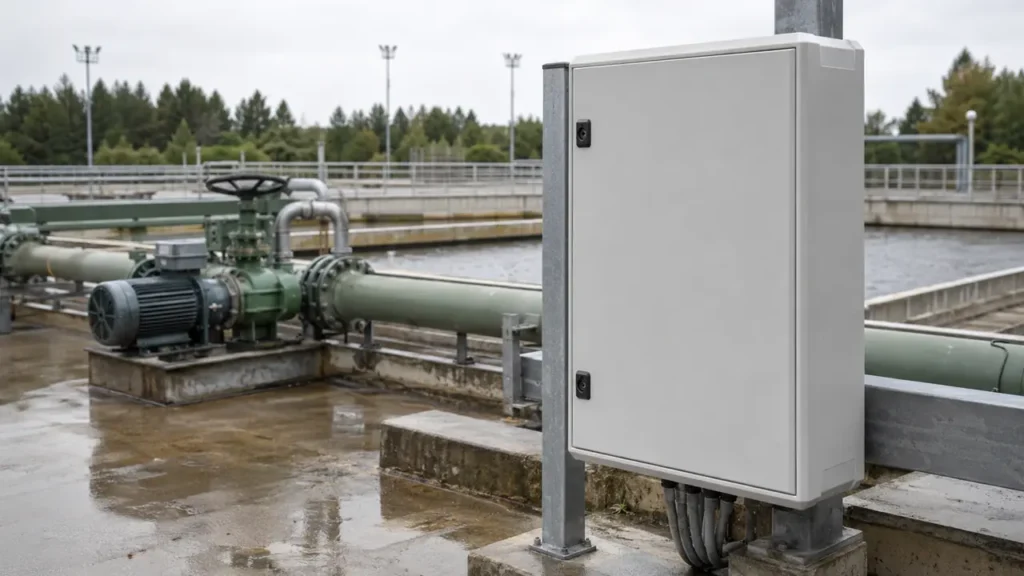
A fiberglass electrical enclosure is generally made from fiberglass-reinforced polyester, often called FRP. The glass fibers strengthen the polymer body, producing a rigid non-metallic enclosure that is lighter than steel and more resistant to corrosion than ordinary metal cabinets.
One major advantage of fiberglass is electrical insulation. Since the enclosure body is non-conductive, it can help reduce the risk of accidental contact with energized metal surfaces. This makes fiberglass a practical option for outdoor electrical controls, remote monitoring equipment, utility installations, telecom systems, and wastewater facilities.
Fiberglass enclosures can also provide strong resistance to moisture, chemicals, and salt-laden air. For example, fiberglass-reinforced polyester enclosure systems are available with high UV resistance, UL Type 4X, and IP66 protection when designed and tested as a complete assembly. Rittal’s fiberglass enclosure range also highlights the importance of UV performance, fire resistance, and maintaining the protection rating after internal installation.
However, “fiberglass” is not automatically equal to outdoor durability. Resin quality, wall thickness, UV stabilizers, gasket design, hardware, and the actual IP or NEMA certification all matter. A low-quality fiberglass box may fade, develop fiber bloom, or lose surface quality after long UV exposure.
What Is a Stainless Steel Electrical Enclosure?
A stainless steel enclosure is a metal housing designed to protect electrical, control, instrumentation, or automation components in harsh conditions. The most common grades are 304/304L and 316/316L stainless steel.
Grade 304 stainless steel is suitable for many industrial indoor and outdoor environments. Grade 316 or 316L contains molybdenum, which improves resistance to chloride exposure, seawater, cleaning chemicals, and corrosive agents. This makes 316 stainless steel a better choice for coastal installations, marine equipment, chemical plants, and high-hygiene washdown areas. Rittal’s material-selection guidance specifically identifies 316 stainless steel as more resistant to substances such as chlorides, seawater, bromides, and high-temperature environments.
Stainless steel is electrically conductive, so correct grounding and bonding must be considered during panel design and installation. In return, it delivers a strong, secure, and durable enclosure body that can tolerate demanding industrial use.
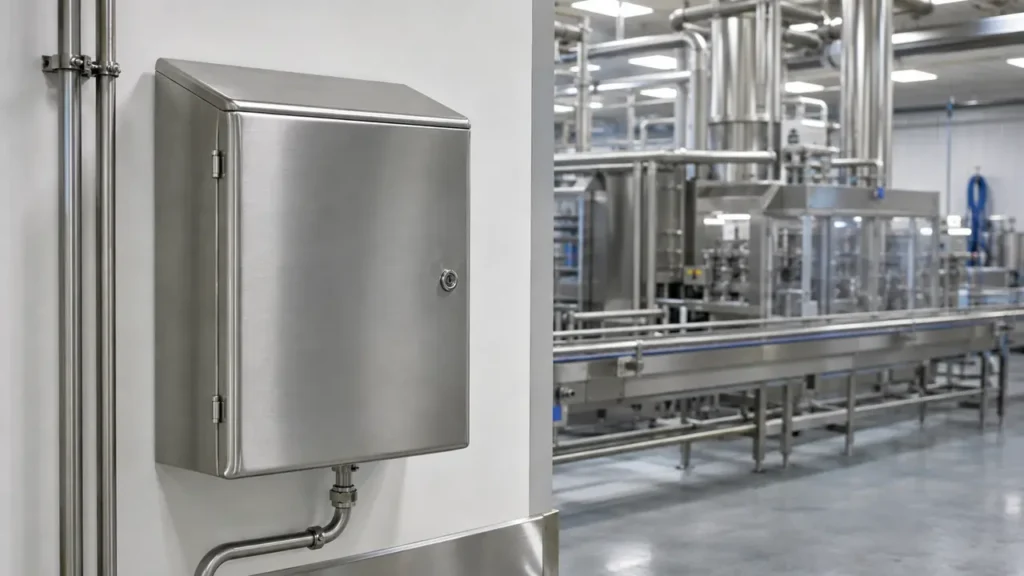
For applications that require frequent cleaning, stainless steel also has a major advantage. Its smooth surface is easier to wash, inspect, and maintain. In food and pharmaceutical environments, a hygienic enclosure may also require sloped surfaces, rounded edges, suitable gaskets, and designs that prevent standing water and dirt accumulation.
Corrosion Resistance: Which Material Performs Better?
Both fiberglass and stainless steel offer strong corrosion resistance, but the correct answer depends on the chemicals and environment involved.
Fiberglass performs very well in many highly corrosive environments because it does not rust. It is frequently selected for wastewater treatment, chemical processing, irrigation systems, outdoor utilities, and corrosive industrial atmospheres. It is particularly useful where a non-metallic enclosure is preferred.
Stainless steel also provides excellent corrosion resistance, but material grade matters. A 304 stainless steel enclosure may be suitable for general industrial applications, while 316 or 316L is usually the safer choice where chloride exposure, salt spray, marine air, aggressive cleaning agents, or coastal conditions are involved.
Do not select material based on the word “corrosion” alone. Ask these questions first:
- Is the enclosure exposed to salt air, seawater, or de-icing chemicals?
- Are there acids, alkalis, solvents, oils, or cleaning agents nearby?
- Will the enclosure be frequently hosed down?
- Is the location outdoor, coastal, underground, or inside a chemical facility?
- Does the project specification require 304, 316, NEMA 4X, IP66, or another standard?
A stainless steel enclosure in the wrong grade can corrode prematurely. A fiberglass enclosure with poor UV protection can age quickly outdoors. The material and the enclosure design must work together.
Mechanical Strength and Impact Resistance
Stainless steel is generally the stronger choice when mechanical protection is the priority.
It is better suited for heavy industrial environments where the enclosure may be exposed to impact, vibration, forced access, tooling, forklift traffic, or repeated maintenance. Stainless steel doors, hinges, locks, mounting panels, and welded seams can provide a rigid structure for larger control cabinets and demanding OEM equipment.
Fiberglass is durable and impact-resistant for its weight, but it is not the best choice for every high-impact environment. Under severe impact, it may crack rather than bend. This is especially important for exposed installations where vandalism, heavy equipment, or accidental impacts are realistic risks.
Choose stainless steel when the enclosure must support heavy internal components, withstand harsh mechanical conditions, or offer high physical security.
Choose fiberglass when low weight, corrosion resistance, and electrical insulation are more important than maximum structural strength.
Electrical Safety and Grounding
This is one of the clearest differences between the two materials.
Fiberglass is non-conductive. It does not create a conductive external path, which can be useful in electrical and utility applications. It is also naturally resistant to many corrosion-related grounding concerns.
Stainless steel is conductive. The enclosure, door, mounting plate, cable glands, and related metal parts should be correctly bonded and grounded according to the applicable electrical code and project requirements.
However, stainless steel can offer an advantage where electromagnetic interference or radio-frequency interference needs to be controlled. A properly designed metal enclosure can provide better natural shielding than a standard non-metallic enclosure. If EMI/RFI performance is important, confirm the required level of shielding with the equipment designer rather than assuming that any metal enclosure will meet the requirement.
Weight, Installation, and Customization
Fiberglass is much lighter than stainless steel. This can reduce shipping costs, simplify wall mounting, and make field installation easier, especially for compact outdoor control boxes.
It is also usually easier to machine in the field. Contractors can often add cable entry holes, gland locations, or small cutouts more easily than with stainless steel.
Stainless steel is heavier and requires more care during fabrication. Field drilling can create sharp edges, contamination risks, and sealing problems if done poorly. For that reason, cutouts for cable glands, HMIs, push buttons, ventilation, viewing windows, and mounting hardware should ideally be completed at the factory.
Factory machining provides cleaner cutouts, more accurate positioning, and better protection-rating control. It also reduces on-site labor and avoids compromising the gasketed structure.
For OEM projects, request these details before quotation:
- Overall dimensions and usable internal space
- Material grade and sheet thickness
- Required IP or NEMA rating
- Door type: screw cover, hinged cover, single door, double door, or inner door
- Lock, hinge, and handle requirements
- Mounting plate material and thickness
- Cable entry location and gland plate requirements
- Required cutouts, labels, engraving, or logo marking
- Ground studs, bonding points, and internal accessories
- Expected quantity, prototype needs, and lead time
Hygiene, Washdown, and Food Processing Applications
For food processing, beverage, dairy, pharmaceutical, and clean manufacturing areas, stainless steel is typically the stronger choice.
The reason is not only material strength. Hygienic projects require surfaces that are easy to clean and less likely to trap dirt, liquids, or bacteria. A proper hygienic enclosure may include a sloped roof, rounded corners, smooth welds, sealed joints, and specially selected gaskets.
Rittal’s hygienic-design guidance notes that hygienic enclosures are designed to minimize gaps, dirt accumulation, and retained liquids. This is a different requirement from simply using a standard stainless steel box.
Fiberglass can still be useful in some wet or corrosive facilities, but stainless steel is usually preferred where frequent washdown, sanitation audits, and long-term cleanability are critical.
IP Ratings and NEMA Ratings: Material Alone Is Not Enough
A common mistake is to assume that fiberglass is always waterproof or that stainless steel always meets NEMA 4X. Neither statement is correct.
The protection rating applies to the complete enclosure design, including:
- Door and cover structure
- Gasket material and compression
- Hinges, locks, and fasteners
- Cable entries and installed accessories
- Mounting holes and cutouts
- Seams, welds, and assembly quality
NEMA explains that enclosures are rated to indicate protection against specific environmental conditions and are used to protect electrical equipment in industrial, building, and utility applications. See NEMA’s enclosure overview.
Always specify the exact required rating. For example, an outdoor enclosure may need IP65, IP66, IP67, NEMA 3R, NEMA 4, or NEMA 4X depending on dust, rain, washdown, immersion, corrosion, and regional specification requirements.
If you add field-drilled holes or unapproved accessories after delivery, the original protection rating may no longer apply.
When Should You Choose Fiberglass Enclosures?
Fiberglass enclosures are a strong choice when your application requires:
- A lightweight enclosure for wall-mounted or pole-mounted installation
- Electrical insulation and a non-conductive housing
- Resistance to moisture, chemicals, and corrosion
- Outdoor utility, telecom, wastewater, or remote-control applications
- Easier field modification for cable entries or small cutouts
- A cost-effective enclosure for compact or medium-sized installations
Typical applications include pump controls, water treatment systems, irrigation equipment, telecom cabinets, traffic systems, solar monitoring equipment, and outdoor utility controls.
When Should You Choose Stainless Steel Enclosures?
Stainless steel enclosures are usually the better solution when your project requires:
- High mechanical strength and long service life
- Strong security and resistance to forced access
- Hygienic, food-grade, pharmaceutical, or washdown-ready design
- A 304 or 316 material specification
- Marine, coastal, or chloride-rich environmental performance
- Heavy-duty industrial automation or machinery protection
- Large custom cabinets, floor-standing enclosures, or integrated control panels
- Better suitability for EMI/RFI shielding requirements
Typical applications include food processing lines, packaging equipment, pharmaceutical machinery, chemical plants, marine systems, industrial automation, power distribution, process control, and outdoor control panels.
Final Recommendation
There is no universal winner between fiberglass and stainless steel enclosures.
Choose fiberglass when electrical insulation, low weight, chemical resistance, and outdoor corrosion performance are the main priorities.
Choose stainless steel when you need maximum mechanical strength, easy cleaning, high security, hygienic design, long-term durability, or a robust custom enclosure for demanding industrial conditions.
For the best result, do not begin with material alone. Begin with the installation environment, protection rating, internal components, mounting method, chemical exposure, maintenance expectations, and project standards. The right enclosure is the one that protects your equipment reliably throughout its expected service life.
Frequently Asked Questions
Is fiberglass better than stainless steel for outdoor electrical enclosures?
Not always. Fiberglass is lightweight, non-conductive, and resistant to many corrosive environments. Stainless steel is stronger and often offers better long-term durability in heavy-duty, washdown, or high-security outdoor applications. Confirm the required UV, IP, or NEMA rating before selecting either material.
Is stainless steel better for food processing equipment?
Yes, in most cases. Stainless steel is easier to clean and is widely used in food, beverage, pharmaceutical, and hygienic manufacturing environments. For frequent washdown areas, consider a hygienic design with smooth surfaces, suitable seals, and sloped surfaces.
Do fiberglass enclosures rust?
No. Fiberglass is non-metallic and does not rust. However, outdoor fiberglass enclosures should still be selected with suitable UV resistance, gasket quality, and environmental ratings.
Should I select 304 or 316 stainless steel?
304 stainless steel is suitable for many general industrial environments. Choose 316 or 316L when the enclosure will be exposed to salt spray, coastal air, chloride-containing chemicals, aggressive washdown agents, or marine conditions.
Can fiberglass and stainless steel enclosures both achieve IP66 or NEMA 4X?
Yes, depending on the specific enclosure design and certification. The rating depends on the full assembly, including seals, doors, cable entries, fasteners, and installed accessories—not only the enclosure material.
Need Help Selecting the Right Enclosure?
EWJ provides custom stainless steel electrical enclosures, fiberglass-ready enclosure solutions, and OEM metal fabrication based on your drawings and project requirements.
Send us your dimensions, material preference, protection rating, internal layout, cable entry requirements, and quantity. Our engineering team can help you evaluate the right enclosure solution for your application.