Electrical Enclosure Gaskets: How Door Seals and Cable Entries Affect Protection
An electrical enclosure gasket sits between mating surfaces, commonly the door and body, to help limit the entry of dust and water. It looks like a small component, but its performance depends on the entire enclosure: flange geometry, door flatness, hinge alignment, latch positions and gasket compression. Cable entries and gland plates create separate sealing paths that need their own attention.
For OEM buyers and panel builders, the useful question is not simply “Which electrical enclosure gasket is best?” It is “Will the completed enclosure stay sealed after assembly, cable installation and repeated access?” This guide explains the design details to review before specifying a custom metal enclosure.
How an electrical enclosure gasket seals the door
When the door closes, the gasket compresses against a continuous mating surface. The compression needs to be even enough around the perimeter to maintain contact. A gap at a corner, a warped door, or insufficient latch pressure can leave a water path even when the gasket material itself is suitable.
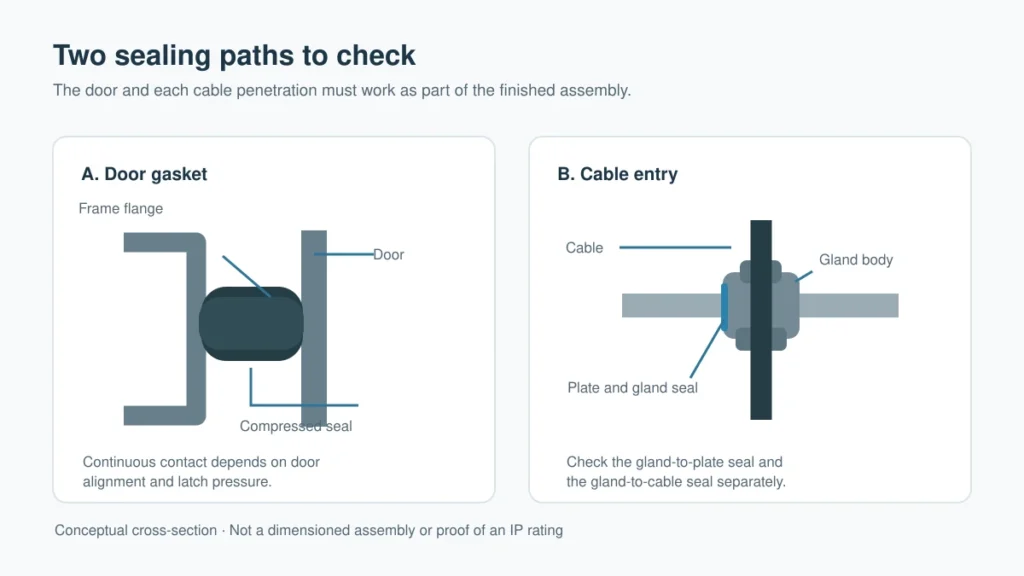
Think of the seal as a chain of interfaces:
| Interface | Design question |
|---|---|
| Door and frame | Are the mating surfaces continuous and suitably flat? |
| Gasket profile | Does it fit the available groove or flange and the intended compression range? |
| Hinges and latches | Do they close the door consistently across the entire perimeter? |
| Corners and joints | Is the seal continuous, including any joined or formed sections? |
| Maintenance | Can a worn or damaged gasket be inspected and replaced? |
A thick seal cannot reliably compensate for poor door geometry. Likewise, more latch force is not necessarily better: excessive compression can damage some gasket profiles or make door operation difficult. The correct profile and compression should be established for the actual enclosure construction.
Which gasket material should you consider?
Common enclosure designs use elastomeric or foam gasket systems, but the correct choice depends on temperature, chemicals, cleaning methods, UV exposure where relevant, compression behavior and the service environment. EPDM and silicone are two possible material families; neither should be treated as suitable for every oil, solvent or washdown chemical.
Ask the gasket supplier for the material’s compatibility and temperature data. For a corrosive or hygiene-sensitive site, specify the actual cleaning chemicals and frequency. For outdoor projects, consider the complete exposure of the enclosure, including whether the seal sees sunlight, standing water or repeated temperature cycling. The purchasing specification should identify the selected material and profile rather than saying only “rubber gasket.”
Cable entries are part of the sealing system
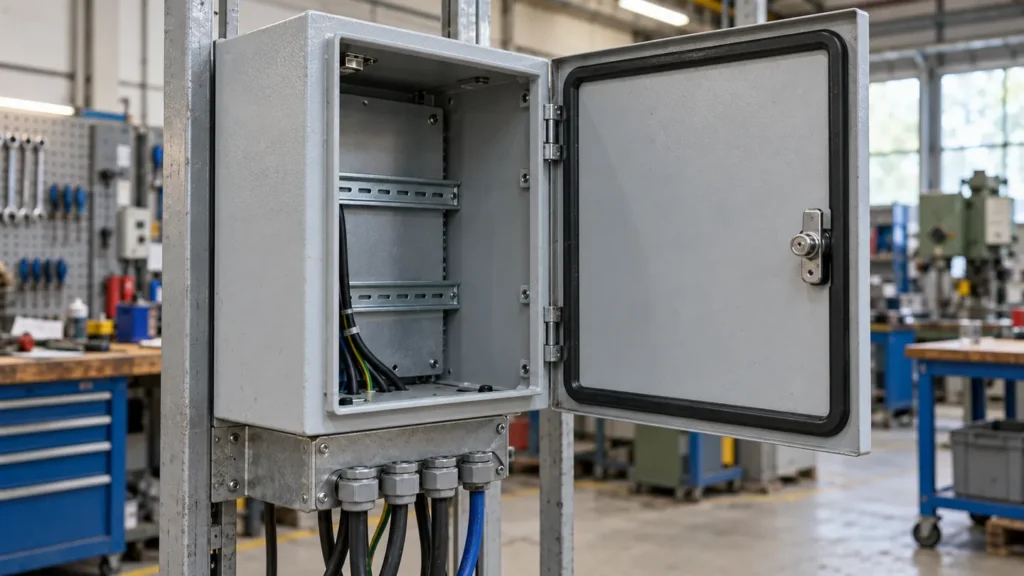
Even a well-sealed door cannot protect an enclosure if the cable-entry openings are poorly planned. Each cable gland should match its cable diameter and mounting hole, with the appropriate sealing components installed as specified by its manufacturer. A removable gland plate also needs a seal where it meets the enclosure body. Unused knockouts and field-drilled openings require suitable closure.
This is why cable-entry positions belong in the enclosure drawing, not as a last-minute installation detail. The designer must leave space for gland bodies, locknuts, cable bend paths and service access. Cutouts placed too close to a seam or mounting point can make the sealing and installation work harder.
Do not assume that a gland’s individual rating automatically determines the rating of a modified cabinet. Review the finished assembly, including the hole, seal, gland plate and installation method, against the project’s protection requirement.
IP rating: evaluate the complete enclosure
IP65 and IP66 are commonly discussed when selecting industrial and outdoor enclosures. The rating relates to tested protection against dust and water under defined conditions. In practice, the door, gasket, latches, welded seams, gland plate and cable penetrations all matter. A gasket alone cannot certify an enclosure.
If a customer requests a specific rating, ask which enclosure configuration was tested and whether the planned modifications are covered. The installation arrangement matters: adding a window, vent, cable entry or different latch can alter the completed design. Document the intended configuration and request the relevant test information for the applicable product where needed.
Common electrical enclosure gasket mistakes
Selecting by appearance alone. Two gaskets of similar size may behave differently under compression, temperature or chemical exposure. Confirm the material and profile requirements.
Ignoring door deflection. A large door can lose uniform contact without suitable stiffness and latch placement. Review the closed door as an assembly.
Forgetting the gland plate. The door may be tight while the removable cable-entry plate remains an unsealed path.
Modifying a tested enclosure without review. New cutouts and accessories can change the finished assembly. Include them in the design and verification plan.
Neglecting replacement. Gaskets can age or be damaged during service. Make inspection and replacement practical for the end user.
What to specify when ordering a custom sealed enclosure
Send the supplier the target protection level, enclosure dimensions, door size and opening direction, expected access frequency, installation environment and cable-entry layout. If you already have a gasket or gland specification, include its drawing and supplier data. If you do not, describe the exposure conditions and ask the custom enclosure team to review possible sealing details with you.
For a custom project, include the latch arrangement and any window or accessory cutouts in the same drawing package. This gives the fabricator a chance to identify seal interruptions before the metal is cut and formed.
Conclusion
The right electrical enclosure gasket is one element of a reliable sealing design. Door geometry, controlled compression, hardware and cable entries must work together. Specify and review the completed configuration to choose a design that fits the actual installation conditions.
Need a custom enclosure with planned door sealing and cable entries? Share your drawing and environment requirements with EWJ for a housing design review.
Frequently Asked Questions
Does a gasket make an electrical enclosure waterproof?
No. Its performance depends on the door, mating surfaces, latches and all other openings. The protection of the completed enclosure must be assessed as a whole.
Is a thicker enclosure gasket always better?
No. The profile must match the available space and designed compression. Excess thickness can interfere with closing, while insufficient contact can leave gaps.
Can I drill new cable holes in an IP-rated enclosure?
Additional holes need suitable glands or closures and should be reviewed against the intended protection. Do not assume the original test result automatically applies to the modified configuration.
How often should a cabinet door gasket be inspected?
Set the interval according to the environment and access frequency. Inspect sooner if the seal is torn, displaced, hardened, compressed unevenly or exposed to unexpected water or chemicals.