Enclosures for Australian Coastal and High-UV Sites
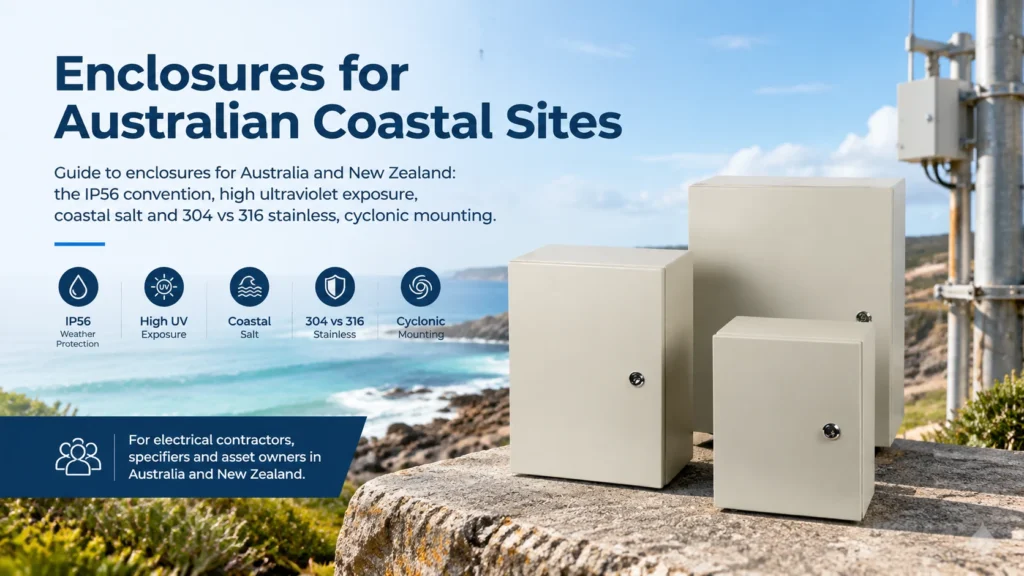
Australian and New Zealand specifications read differently from European or Asian ones, and the difference is not just terminology. Outdoor enclosures here are frequently specified to IP56 rather than IP65, salt air destroys the wrong grade of stainless within a few years, and ultraviolet levels are high enough to make coating choice a maintenance decision.
This guide covers what actually governs an enclosure on an AU or NZ site: the rating convention, the material boundary, and the installation details that local inspectors and asset owners expect.
The IP56 convention, and why it appears so often
IP ratings have two digits. The first covers solids, the second covers water. In many Australian specifications the requirement is written as IP56: dust-protected rather than dust-tight, plus protection against powerful water jets.
| Rating | Solids | Water | Common local use |
|---|---|---|---|
| IP54 | Dust-protected | Splashing | Sheltered indoor and covered areas |
| IP56 | Dust-protected | Powerful jets | Frequently specified outdoors, especially where washdown occurs |
| IP65 | Dust-tight | Water jets | Outdoor wall mounting, exposed positions |
| IP66 | Dust-tight | Powerful jets | Exposed coastal and industrial washdown |
The distinction that catches people out is the first digit. IP56 permits some dust ingress; IP65 and IP66 do not. In a dusty inland site, or where fine dust combines with humidity to form a conductive film, dust-tightness matters more than jet pressure. Where the requirement comes from a washdown regime, IP56 may be entirely correct.
Both conventions exist in the market, so the useful question is not “which is better” but “which risk is this site actually managing”.
Ultraviolet: the failure nobody inspects for
Australian UV levels are among the highest in the world, and they degrade two parts of an enclosure that are rarely considered together: the coating and the plastic components.
Standard polyester powder coatings chalk and fade under sustained UV. The colour change is cosmetic; the loss of film integrity is not, because a chalked coating holds dirt and eventually admits moisture at the surface. A fluoropolymer coating system costs more and holds gloss and colour far longer, which matters where the asset is expected to stay in service for twenty years without repainting.
Plastic enclosures need UV stabilisation to survive the same exposure. A non-stabilised ABS box will go brittle and crack at the corners within a few summers. If a plastic enclosure is specified for an exposed position, the datasheet should state UV resistance, not just the IP rating.
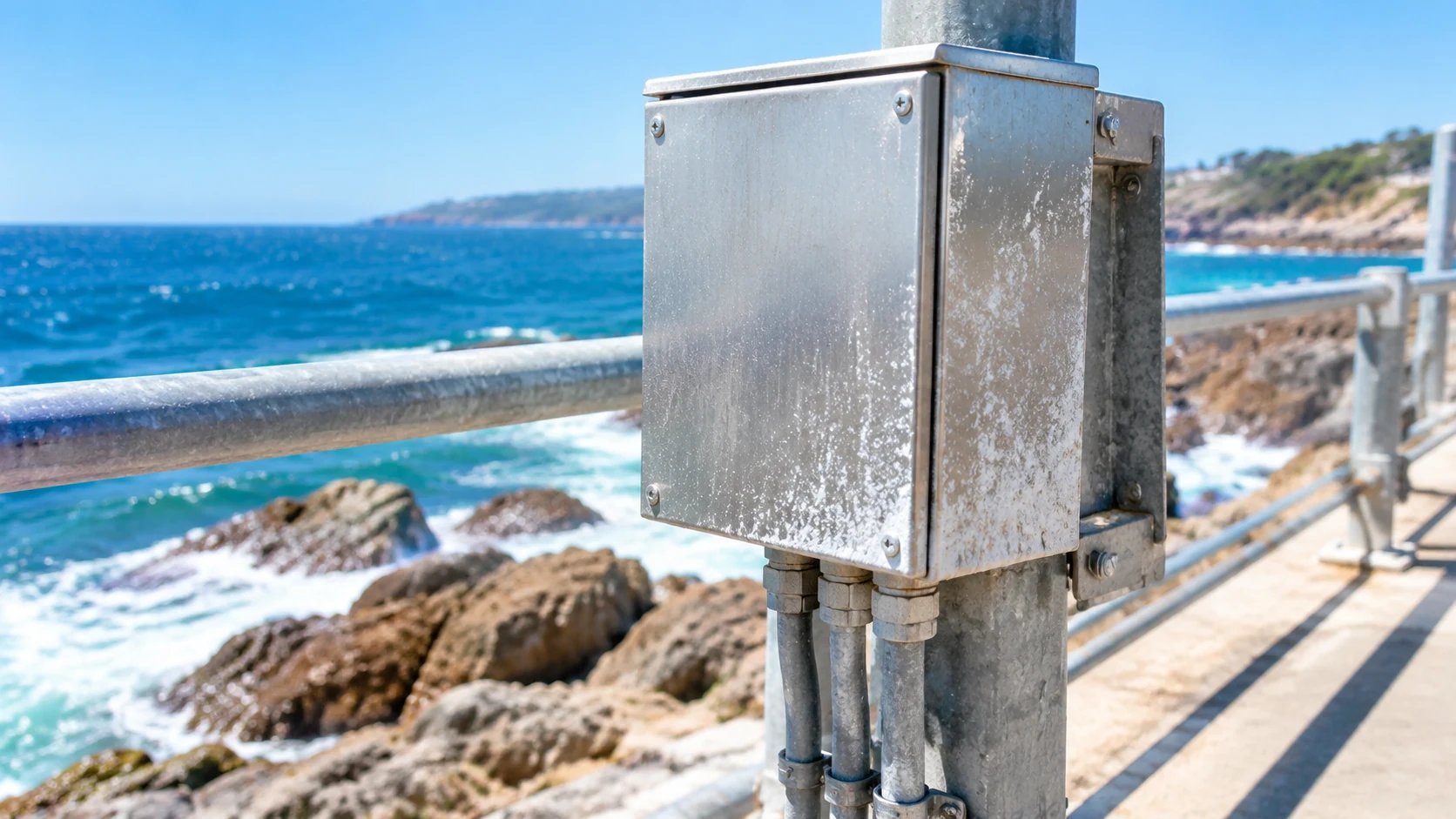
Coastal and marine: where 304 stops working
Australia’s population sits largely on the coast, and much of its industrial plant does too. In marine and near-marine locations, 304 stainless is a compromise that often disappoints: it resists general corrosion but pits under sustained chloride exposure, especially at welds and cut edges.
316 is the appropriate grade for direct coastal installation, and in heavy splash zones marine-grade 316 with proper passivation is the baseline rather than an upgrade. Three details decide whether it performs:
- Passivation of welds. A heat-tinted weld is a corrosion initiation site. Weld quality and post-weld treatment matter as much as the plate grade.
- Matched fixings. Zinc-plated screws in a stainless body create a galvanic couple, and the screw fails before the panel does.
- Drainage. Trapped water at the bottom flange is where pitting starts, so a box that drains is worth more than one that is slightly thicker.
Inland and in shaded industrial areas, powder-coated steel remains the sensible default, provided the pre-treatment is adequate.
Cyclonic regions and mechanical load
In northern Queensland, the Northern Territory and parts of Western Australia, enclosures are mounted on structures designed for cyclonic wind loading. The enclosure itself is rarely the governing element, but its mounting is: brackets, fixings and the wall or frame it attaches to all have to suit the design wind pressure.
Two practical points come out of post-cyclone inspections. Cables should enter from below with a drip loop so that water running down the conduit does not enter the gland, and conduits should be independently supported so that enclosure glands are not carrying mechanical load.
Standards and what they cover
AS/NZS 61439 covers low-voltage switchgear and controlgear assemblies, and AS/NZS 3000 (the wiring rules) governs installation. The IP rating itself follows AS 60529, aligned with IEC 60529, and the enclosure as an empty product sits in the IEC 62208 framework.
The scope question comes up in procurement as often here as anywhere: a supplier of empty enclosures cannot certify an assembly someone else builds, and a tender that asks for an “AS/NZS 61439 certified box” is asking for something that belongs to the assembled product. Clarifying this early prevents a variation.
Frequently asked questions
Should I specify IP56 or IP65 outdoors in Australia?
Both are used. IP56 appears where washdown is the design case; IP65 and IP66 appear where dust-tightness matters, such as inland sites with fine dust or equipment that must not admit any particulate. Decide which risk governs, then pick the rating.
Is 304 stainless acceptable near the coast?
In sheltered positions set back from the water, sometimes. Direct coastal exposure is where 316 earns its cost, particularly at welds, cut edges and fixings.
Why do plastic enclosures crack after a few years?
Ultraviolet degradation. Polymers without UV stabilisation become brittle and fail at stress points such as corners and screw bosses. If a plastic box is used outdoors, UV resistance should be stated in the datasheet.
Does the enclosure need to be rated for cyclonic wind?
The enclosure itself normally is not, but its mounting is. Brackets, fixings and the supporting structure must suit the design wind pressure for the region, and conduits should be supported independently of the glands.
Where to go next
The waterproof enclosure buying guide covers the sealing and material decisions in project order, and it explains how the two IP digits work independently. For exposed outdoor positions, the IP66 enclosure range lists the bodies we build.
For coastal installations, stainless steel enclosures sets out the 304 to 316 boundary, and this guide to storm-exposed installations covers driven rain and flood mounting.