Enclosures for West African Solar and Backup Systems
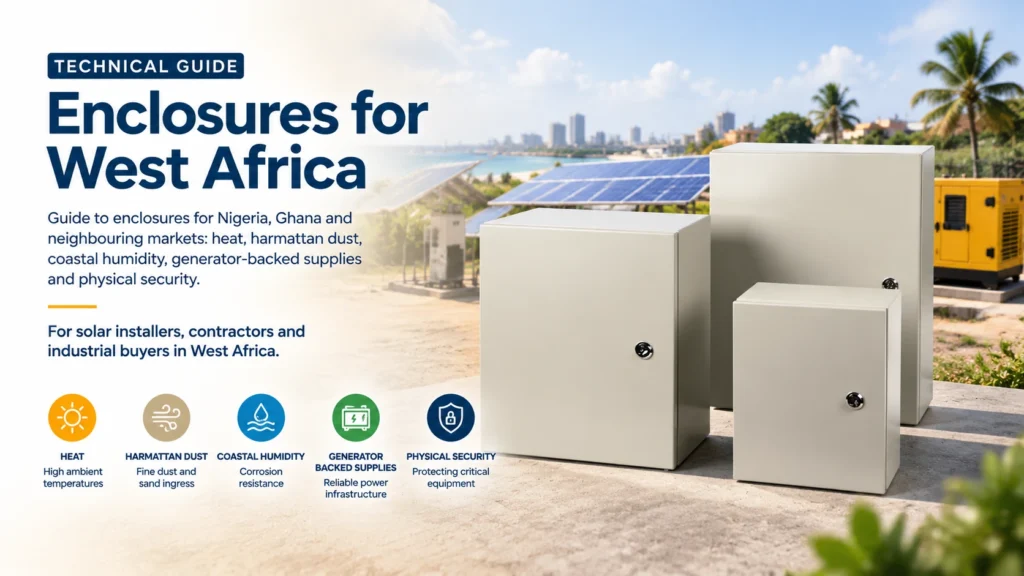
In Nigeria, Ghana and neighbouring markets, an enclosure rarely fails because of one condition. It fails because heat, dust, humidity, an unstable supply and physical security all arrive at the same box, and the specification only addressed one of them.
This guide covers what to specify for West African installations, where the priorities differ from the Gulf or Southeast Asia, and which details are worth paying for.
Five conditions, one enclosure
| Condition | Where it bites | What it changes |
|---|---|---|
| Heat | Inland north (Kano, Kaduna), and any unshaded metal box | Gasket compound, coating system, ventilation |
| Harmattan dust | December to February across the north and middle belt | Dust-tight entries, sealed spare knockouts, breather filtration |
| Humidity and rain | Coastal Lagos, Port Harcourt, Accra | Gaskets, corrosion resistance, condensation control |
| Unstable supply | Nationwide, especially where generators back up the grid | Space for changeover and surge protection; accessibility |
| Physical security | Public and semi-public sites | Lock type, hinge design, mounting height, tamper resistance |
Most enquiries describe two of these five. The other three are what generate the call twelve months later.
The harmattan is the detail most specifications miss
Between December and February, dry dusty wind carries fine particles across West Africa. The dust behaves like a fluid: it enters through any gap with a pressure difference across it, including an oversized gland and a spare entry that was taped shut on site.
Two habits matter. First, size every gland to the actual cable and blank every spare entry with a proper plug. Second, if the box is ventilated, use louvres with insect and dust mesh rather than open slots — and accept that a filtered vent will need cleaning, which is a maintenance commitment rather than a one-off installation detail.
Dust also raises internal temperature. A layer on the inside of a door insulates, and a layer on the outside reduces heat rejection, so a dusty box in 40°C ambient runs hotter than the ambient figure suggests.
Heat and the generator-backed installation
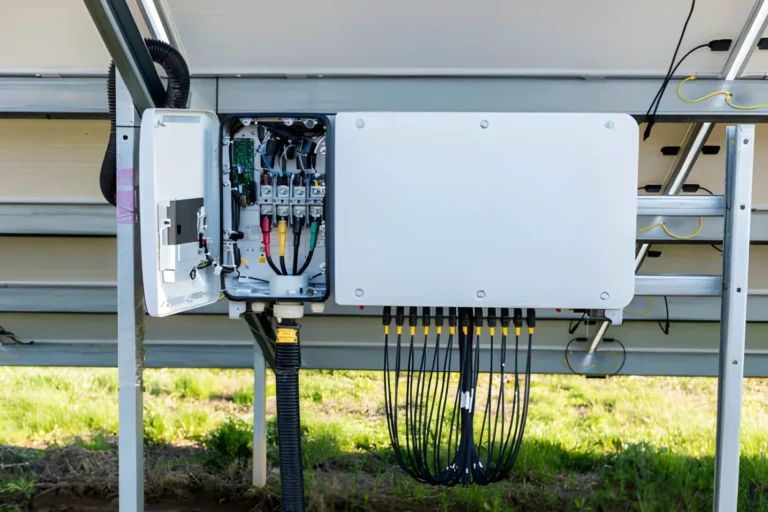
Where a site runs on a mix of grid and generator, the enclosure usually holds a changeover arrangement as well as distribution. That has two consequences.
First, the box is busier than a comparable European installation, so sizing has to account for more devices and more cable. Second, generator supply is not always clean, which makes surge protection worth specifying rather than optional. Surge devices need space to be replaced without rewiring, which is a sizing decision made at order stage.
For heat, the practical measures are the same as anywhere hot: shade the box, choose a light colour, and avoid sealing an enclosure that contains equipment which derates. Where the site can support it, a fan or louvred ventilation with filtration is more effective than hoping the equipment tolerates the temperature.
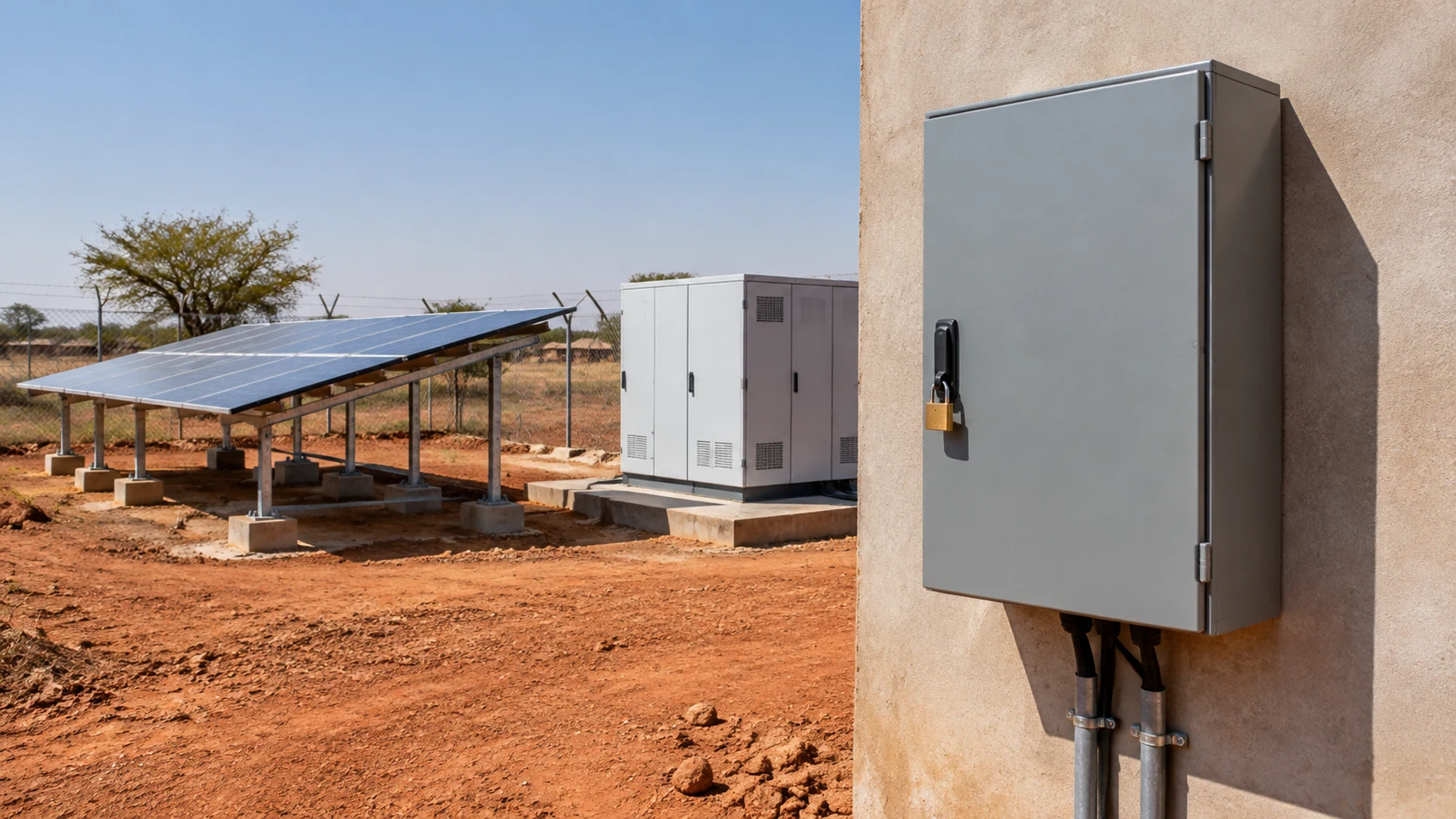
Security: the specification item nobody puts in the tender
On accessible sites, the lock is a functional component, not a formality. Three details are worth agreeing explicitly:
- Lock type. A quarter-turn latch is convenient and easy to defeat. A three-point lock or a padlockable handle with a shrouded hasp is appropriate where vandalism is a real risk.
- Hinge design. Concealed or welded hinges resist levering better than surface-mounted hinges with exposed pins.
- Mounting height and fixings. A box at head height with accessible fixings can be removed with a spanner. Security bolts or a mounting plate that is only reachable with the door open change that calculation.
None of these adds much to the unit price. All of them are difficult to add after installation.
Standards and documents
Nigeria uses NIS standards administered through SON, with IEC adoptions for enclosures and IP ratings; Ghana works through GS/IEC standards. In practice, project specifications often reference IEC 60529 for the IP rating and IEC 61439 for assemblies, and the enclosure itself sits in the IEC 62208 category when supplied empty for local assembly.
What a buyer should ask for is specific: the IP type test report for the rating claimed, the material certificate for stainless grades, and a drawing showing sheet thickness and gland plate arrangement. Vague assurances about “international standards” do not survive a site inspection.
Sizing for the way the site actually runs
West African installations often grow. A box sized exactly for today’s device list tends to be re-entered within two years when a second inverter, an extra distribution way or a monitoring unit is added.
Leaving 20 to 25 percent spare ways, and one spare gland entry of each size, costs little at order stage. Retrofitting a larger enclosure onto a live wall costs a day of labour and a shutdown.
Frequently asked questions
Is IP65 enough for Lagos?
For sheltered outdoor mounting it is usually adequate. Coastal Lagos and Port Harcourt bring salt and sustained humidity, so the material choice matters more than pushing the IP number higher.
Do I need 316 stainless in West Africa?
Inland, no: powder-coated steel is normally sufficient. On the coast, 304 is often adequate in sheltered positions and 316 is the safer choice for exposed salt-spray locations.
How do I keep dust out during harmattan?
Correct gland sizing, blanked spare entries and filtered ventilation rather than open slots. A dust-tight box that is opened monthly for maintenance should also have a hinged door with a captive gasket, which reseats more reliably than a lift-off cover.
What lock should I specify?
Match it to the exposure. Indoor plant rooms are fine with a standard latch. Public or semi-public sites warrant a three-point lock or a padlockable handle with a shrouded hasp, plus fixings that cannot be removed from outside.
Where to go next
The waterproof enclosure buying guide covers the sealing and entry decisions that matter most in dusty, humid conditions. For solar and backup installations, this guide to inverter enclosures covers heat, derating and battery separation.
Where the box holds distribution rather than only inverters, distribution box enclosures lists the standard sizes, and stainless steel enclosures sets out the coastal material boundary.