Dissipation thermique des armoires électriques : guide de conception et de refroidissement
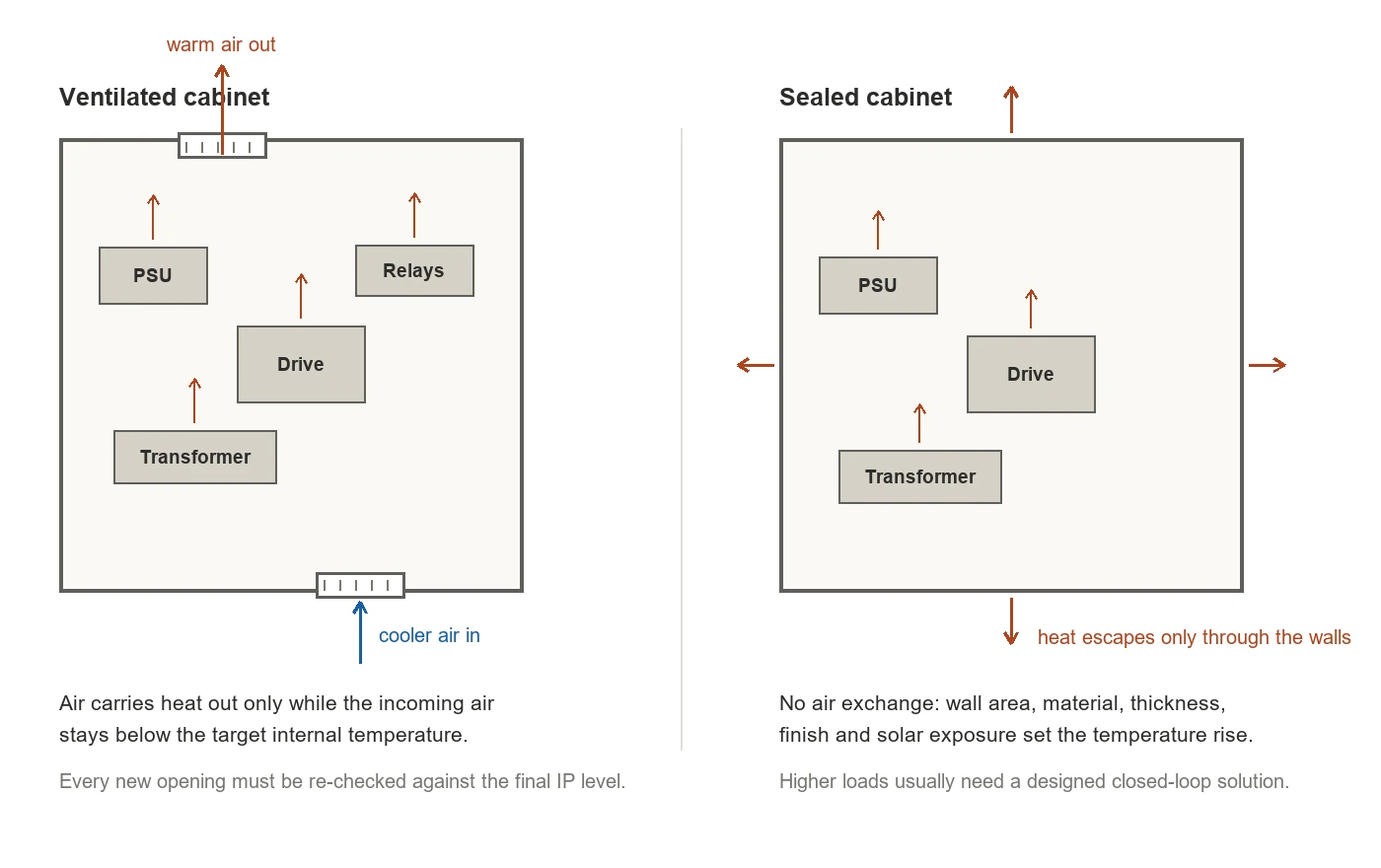
Electrical enclosure heat dissipation is an essential design consideration when electrical components generate heat inside a metal cabinet. Power supplies, drives, transformers, relays, and other devices can raise the internal temperature, especially when the enclosure is sealed or installed in direct sunlight.
Overheating may shorten component life, trigger thermal derating, or cause unwanted shutdowns. But drilling ventilation holes into every enclosure is not a reliable solution: openings can compromise dust and water protection and may introduce new maintenance problems.
This guide explains how to evaluate heat sources, compare cooling methods, and plan electrical enclosure heat dissipation around the enclosure structure. It focuses on the practical choices that electrical designers and OEM buyers should discuss with a metal enclosure manufacturer.
1. Why Does Heat Build Up Inside an Electrical Enclosure?
Heat is created when electrical components convert part of their input energy into losses. Typical contributors include power supplies, variable-frequency drives, contactors, transformers, and wiring connections. Heat can also enter from the surroundings when a metal enclosure stands in direct sunlight or near a hot machine.
A cabinet’s final temperature depends on several interacting factors:
- Total power dissipated by equipment inside the enclosure
- Maximum expected ambient temperature and solar exposure
- Enclosure dimensions, exposed surface area, and mounting position
- Material, construction, surface finish, and internal airflow paths
- Ingress protection requirements and the chosen cooling method
A sealed enclosure can lose heat through its walls, but passive heat transfer may not be sufficient for every load. Similarly, a larger box does not automatically solve overheating: its heat rejection and the allowable equipment temperature must still be checked.
2. What Information Is Needed to Evaluate Enclosure Heat Dissipation?
Before choosing vents, fans, or cooling units, establish the thermal design conditions. The electrical designer or panel builder should collect the expected equipment losses and determine the hottest realistic operating environment.
| Design Input | Pourquoi c'est important |
|---|---|
| Internal heat loss (W) | Indicates how much heat the installed equipment releases |
| Maximum ambient temperature | Determines how much temperature difference is available for cooling |
| Maximum allowable internal temperature | Sets the target based on the most temperature-sensitive components |
| Enclosure size and mounting | Affects exposed surface area and available airflow |
| Environnement d'installation | Determines dust, rain, washdown, corrosion, and sun exposure |
| Required protection level | Limits which ventilation openings or accessories are acceptable |
| Operating cycle | Distinguishes intermittent peaks from continuous heat loading |
Estimate the Internal Heat Load
Use equipment manufacturer loss data at the intended operating point whenever available. Do not simply add all nameplate input powers: rated electrical consumption is not the same as the heat released inside the cabinet. Include the heat generated by relevant devices, connections, and accessories, and consider continuous operation and worst-case loading.
Define the Temperature Limit
The maximum permitted internal air temperature must be compatible with the components installed inside the cabinet. Also check local hot spots: a sensor mounted near the cabinet roof may read differently from one next to a drive or power supply.
Check Ambient Conditions and Solar Gain
For an outdoor installation, a high ambient temperature may leave very little margin for ventilation-based cooling. Direct sunlight can add heat even when the internal electrical losses are modest. Include installation orientation, shade, nearby equipment, and mounting clearance in the assessment.
Engineering note: A thermal calculation or enclosure cooling selection tool should be used for final sizing. These inputs support preliminary design, not a guaranteed temperature prediction.
3. Passive Cooling: Improving Heat Dissipation Without Powered Equipment
Passive cooling relies on heat moving from inside the enclosure to the surrounding environment through its structure and natural air movement. It may suit relatively low heat loads when the outdoor or room temperature is below the target internal temperature.
Allow Heat to Transfer Through Exposed Surfaces
Heat transfer depends on the exposed metal surfaces, the enclosure’s geometry, and the conditions surrounding it. A cabinet installed tightly against a wall or beside another machine has a different cooling situation from one with more free surfaces and clearance.
Where practical, avoid blocking relevant exterior surfaces or restricting the air around the enclosure. Account for manufacturer-required clearances when mounting equipment inside and around the cabinet.
Improve Internal Layout and Air Movement
Keep heat-producing devices from unnecessarily crowding temperature-sensitive components. Follow the component manufacturers’ spacing instructions, and avoid routing cable bundles or mounting plates in ways that obstruct intended airflow paths.
Internal circulation fans can help reduce temperature differences within the cabinet, but a fan that only recirculates air does not remove heat from the enclosure by itself.
Reduce Solar Heating
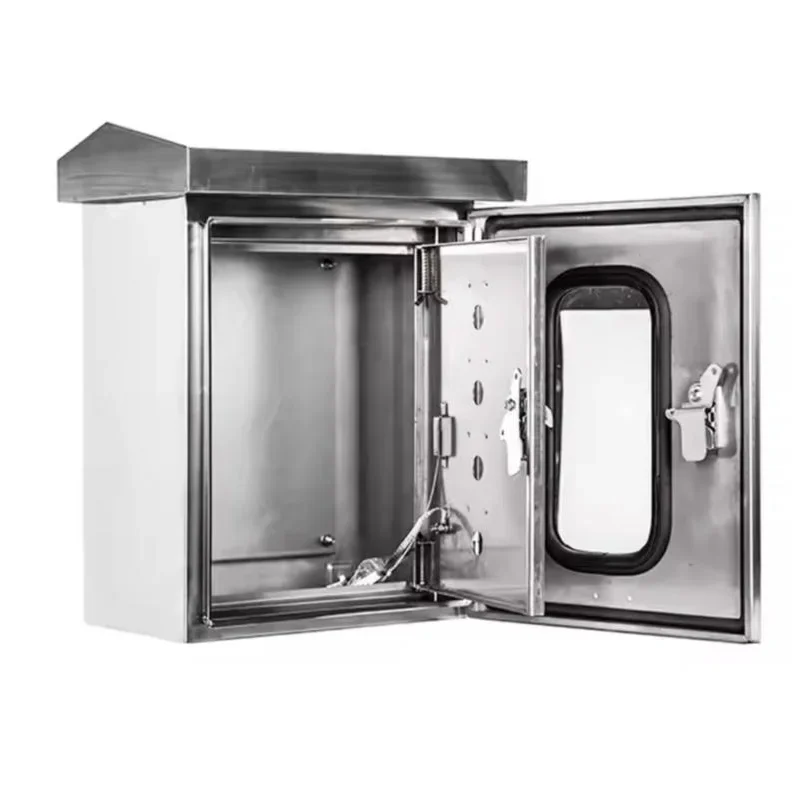
For outdoor cabinets, shading, appropriate surface finishes, and carefully designed sun shields can reduce solar heat input. A separate canopy or shield may be useful where the installation allows it. Its mounting and wind resistance must be engineered for the site. For cabinet construction on exposed sites, see our outdoor electrical enclosures.
Do not assume an aluminum enclosure, a light-colored finish, or a larger cabinet alone will guarantee acceptable operating temperatures. Material properties and overall thermal design must be considered together.
4. Ventilation and Fans: When Is Open-Air Cooling Appropriate?
Ventilation exchanges enclosure air with the surrounding atmosphere. Natural vents or fan-and-filter assemblies can remove heat when the surrounding air is cool enough and clean enough for the application.
Natural Ventilation
Carefully located inlet and outlet openings may support natural convection. Their effectiveness depends on opening area, enclosure height, obstructions, wind, and the temperature difference between internal and external air.
Fan-Assisted Ventilation
A filter fan can increase airflow through the enclosure, but airflow must be selected using the required heat removal, acceptable temperature rise, and the resistance of filters and openings. Manufacturer-rated free-airflow values are not necessarily the airflow delivered after installation.
Ventilation is not a substitute for refrigeration. It generally cannot cool internal air below the temperature of the incoming ambient air.
The IP Rating Trade-Off
An ordinary open vent can allow dust, water, and insects to enter a previously sealed enclosure. Filters and weather hoods may reduce some risks, but the ingress protection of the complete assembled enclosure must be evaluated with the selected accessories installed.
For installations with rain, washdown, fine dust, or corrosive atmospheres, open ventilation may be unsuitable even if it would remove enough heat. Never assume that adding a fan or louver leaves an IP65 or IP66 claim unchanged.
For moisture-related issues, see our guide to condensation in electrical enclosures.
5. How Can a Sealed Electrical Enclosure Be Cooled?
When external air must be kept separate from internal air, an enclosure may require a closed-loop thermal solution selected by the system designer.
Air-to-Air Heat Exchangers
An air-to-air heat exchanger transfers heat between separate internal and external air circuits without deliberately mixing them. Its capacity depends on the temperature difference and operating conditions. It generally cannot cool enclosure air below the external air temperature.
Enclosure Air Conditioners
A properly specified enclosure air conditioner can provide active cooling where internal temperatures must be controlled below ambient. Capacity, mounting location, condensate handling, power supply, operating environment, and service access all require review.
Air-to-Water Heat Exchangers
Where an appropriate cooling-water system is available, a closed-loop air-to-water exchanger may be considered. This choice depends on site infrastructure and should be assessed by the electrical and thermal system designer.
Important: EWJ supplies custom metal housings, not a guaranteed complete thermal management system. Cooling devices, their capacity, control wiring, installation, and compliance must be confirmed by the equipment supplier or system integrator. EWJ can review enclosure dimensions, mounting positions, mounting plates, and specified openings against approved drawings.
Planning a Heat-Sensitive Enclosure Project?
Share your enclosure dimensions and planned cooling accessory layout. EWJ can review the metal housing design and required cutouts against your approved drawings.
6. Metal Enclosure Design Details That Affect Thermal Performance
For OEM projects, early coordination between the enclosure fabricator and panel designer can prevent expensive design changes after tooling or production planning.
Plan Cutouts Before Fabrication
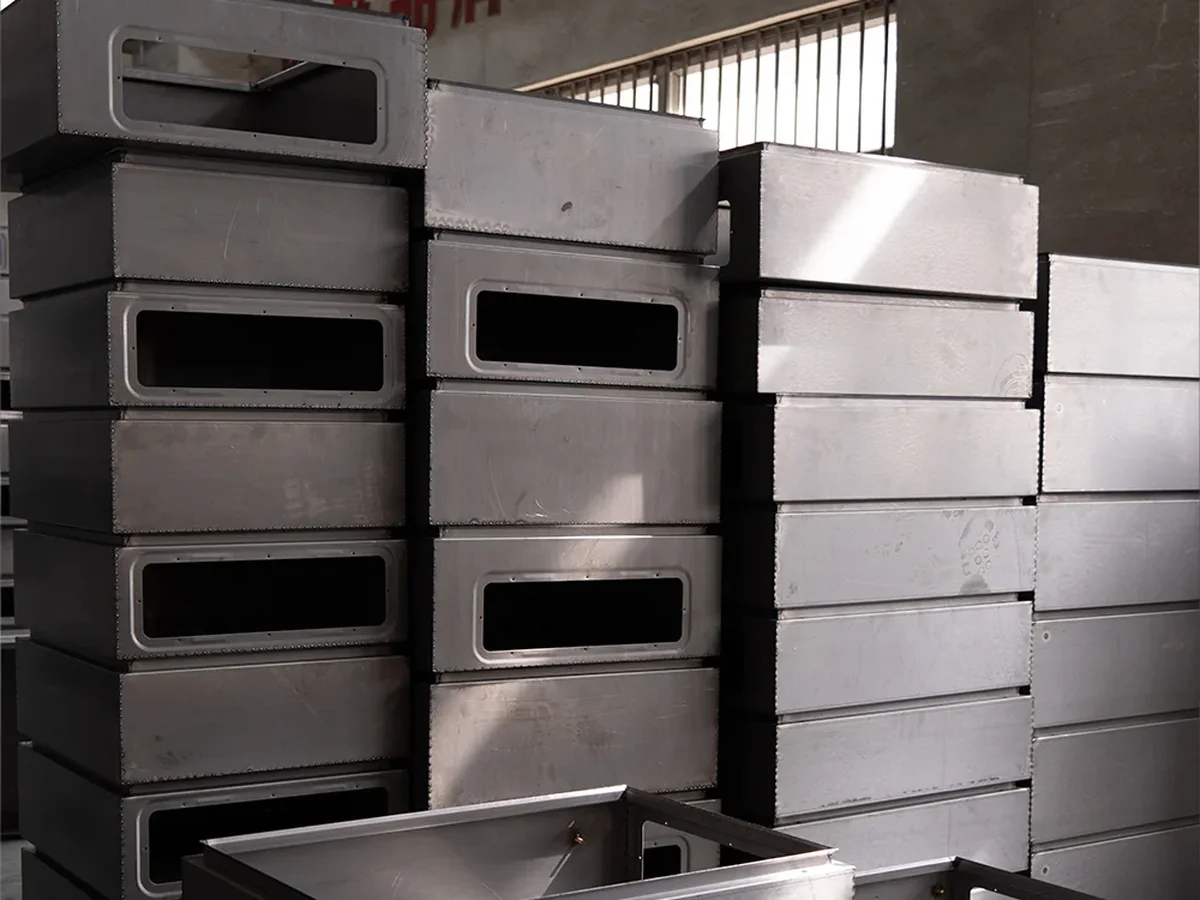
Specify the exact position and dimensions of fan, vent, heat exchanger, or air-conditioner cutouts. Include mounting-hole patterns, reinforcement requirements, gasket interfaces, cable routing, and clearance for replacing or cleaning accessories.
Large cutouts can reduce local panel stiffness. Reinforcement may be needed, particularly on doors or wide unsupported surfaces.
Select Materials for the Whole Application
Carbon steel, stainless steel, and aluminum offer different weights, corrosion properties, and thermal behavior. Aluminum conducts heat well, but total cooling performance depends on wall thickness, panel area, surface finish, and airflow. Stainless steel may be selected primarily for its corrosion resistance rather than for superior heat transfer.
If heat transfer is critical, the designer should evaluate the complete assembly rather than choosing a metal based on one material property. Where weight matters more than anything else, our boîtiers en aluminium are worth comparing.
Leave Room for Cooling Accessories
Fans, exchanger housings, ducts, thermostats, and cables require physical space and service access. Confirm the enclosure’s internal usable dimensions and external installation clearance before locking the layout.
Our Guide de dimensionnement des armoires électriques explains the wider space-planning considerations for control panels.
Preserve Sealing and Mechanical Integrity
For weather-resistant projects, confirm the gasket and sealing details around each new opening. The final rating applies to the assembled configuration, not automatically to the original empty shell after modification.
7. How to Specify Thermal Requirements for a Custom Enclosure Quote
An enclosure manufacturer can review the metal structure more effectively when the thermal requirements are documented alongside the normal fabrication drawing package.
| Information to Send | Example of What to Specify |
|---|---|
| Enclosure dimensions | Overall size, mounting method, and required clearances |
| Material and finish | Carbon steel, stainless steel, or aluminum; coating requirements |
| Internal thermal requirements | Estimated losses, component limits, and operating duty |
| Ambient environment | Maximum temperature, sun exposure, dust, rain, or washdown |
| Cooling integration | Fan or exchanger model, cutout drawing, and installation location |
| Protection target | Required IP level for the final assembly, where applicable |
| Procurement details | Drawing files, prototype needs, and estimated order quantity |
Supply 2D drawings in PDF, DWG, or DXF format and 3D models in STEP format where possible. If a cooling accessory has already been selected, include the accessory supplier’s installation drawing and sealing instructions.
For the broader preparation process, use our Liste de contrôle du dossier technique des plans de l'enceinte.
8. Common Heat Dissipation Mistakes to Avoid
- Assuming an IP rating controls temperature: IP ratings describe defined ingress protection, not the ability to dissipate a specified heat load.
- Using nameplate power as heat loss: Base estimates on actual component losses and operating conditions.
- Adding vents without checking exposure: An unsuitable opening can undermine dust and water protection.
- Overlooking sunlight: Outdoor solar gain may be significant even in a low-power cabinet.
- Expecting internal circulation to remove heat: Recirculation can redistribute heat but does not, by itself, reject it outdoors.
- Ignoring maintenance: Filters, fan assemblies, and cooling units require access and may need inspection or replacement.
The best approach is to review the electrical load, environmental exposure, enclosure structure, and cooling method as one design problem.
Questions fréquemment posées
How do you dissipate heat from a sealed electrical enclosure?
Heat may leave through the enclosure walls, while higher loads may require a suitable closed-loop heat exchanger or enclosure air conditioner. The correct option depends on internal equipment losses, ambient temperature, required internal temperature, and installation conditions.
Can an IP65 enclosure have ventilation openings?
It may be possible to use appropriately rated ventilation or pressure-management accessories, but the complete modified assembly must meet the required ingress protection level. A standard open vent should not be assumed to preserve IP65 protection.
Does aluminum dissipate heat better than steel?
Aluminum generally has higher thermal conductivity than common steel grades, but that does not guarantee lower internal temperatures in every enclosure. Geometry, mounting conditions, surface finish, solar exposure, and airflow all affect performance.
Will a larger electrical enclosure solve overheating?
Not necessarily. More space may improve layout and available heat-transfer area, but the final temperature depends on heat losses, ambient conditions, enclosure construction, and cooling arrangements.
Is an internal fan enough to cool a control cabinet?
An internal fan can improve circulation and reduce local hot spots. Unless it moves heat to the outside through a suitable mechanism, it does not remove the total heat generated within the cabinet.
Can ventilation cool an enclosure below ambient temperature?
Ordinary ventilation generally cannot lower enclosure air temperature below that of the incoming air. When below-ambient temperatures are necessary, an appropriate active cooling solution may be required.
What information does a metal enclosure manufacturer need for thermal cutouts?
Provide enclosure drawings, cooling accessory drawings, required cutout dimensions, mounting patterns, sealing details, clearance requirements, material, finish, and the target protection level. The system designer should validate the thermal performance of the final assembly.
Request a Custom Metal Enclosure for Your Thermal Design
Electrical enclosure heat dissipation begins with a clear understanding of equipment losses and operating conditions. Good thermal planning also depends on practical metal enclosure details: size, cutouts, material, mounting structures, and sealing interfaces.
EWJ manufactures custom metal enclosures to customer drawings, with options for carbon steel, stainless steel, aluminum, customized dimensions, mounting plates, openings, and surface finishes. We can review the housing-related requirements of your project while your electrical or thermal design team confirms the appropriate cooling method and equipment capacity.
Send us your 2D/3D enclosure drawings, operating conditions, planned cooling accessory details, and expected quantity.
Send Your Drawing for a Custom Enclosure Quote
Share your enclosure drawings, thermal requirements and cooling accessory details. As a custom metal enclosure manufacturing supplier, EWJ reviews the housing design and cutouts against your approved drawings.
Veuillez indiquer :
- Dessins en 2D (PDF / DWG / DXF)
- Fichiers CAO 3D (STEP)
- Material, thickness and finish requirements
- Cooling accessory drawing and cutout details
- Operating conditions and estimated order quantity