Indices de protection des boîtiers : NEMA vs IP
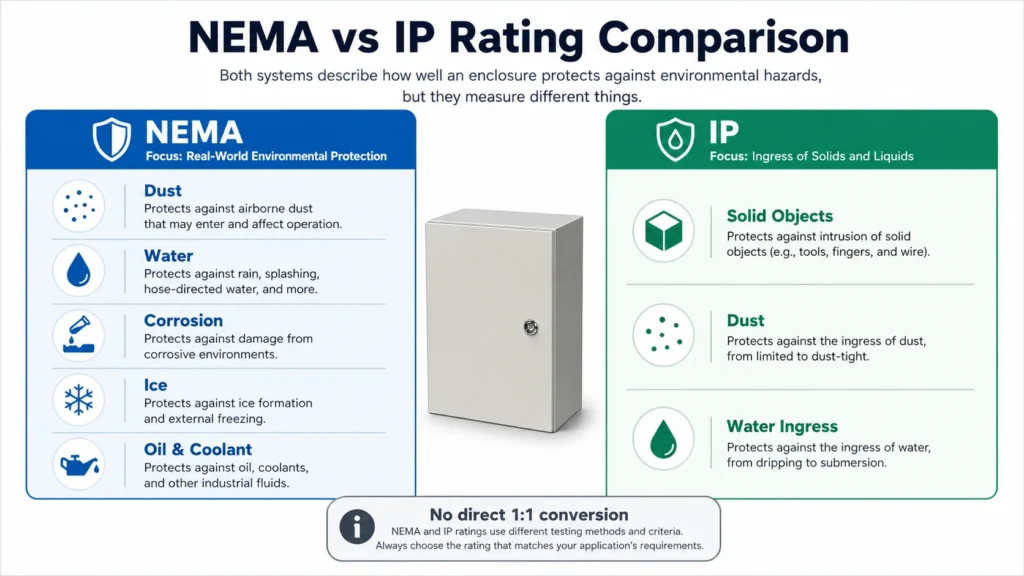
Les indices de protection NEMA et IP décrivent tous deux enceinte protection, mais elles ne sont pas interchangeables. Les indices IP mesurent principalement la protection contre les corps solides et l'eau, tandis que les indices NEMA peuvent également prendre en compte des conditions telles que la corrosion, le givrage, l'huile et l'exposition aux liquides de refroidissement.
Pourquoi les armoires électriques utilisent-elles les indices de protection NEMA et IP ?
Des descriptions telles que “ étanche ” ou “ scellé ” sont trop générales pour permettre de choisir un boîtier. Les ingénieurs ont besoin de limites précises. Le boîtier peut-il résister à de légères gouttes, à une forte pluie, à des jets d’eau ou à une immersion totale ? Ils doivent également savoir dans quelle mesure il protège contre la poussière, l’humidité, la glace et d’autres éléments susceptibles d’endommager les composants électriques.
Les indices de protection NEMA et IP fournissent ces informations. Ces systèmes classent les boîtiers en fonction du niveau de protection contre les influences extérieures qu'ils offrent.
Une protection plus élevée nécessite généralement une construction plus étanche. Les fabricants peuvent recourir à des joints d'étanchéité, des soudures et d'autres méthodes d'étanchéité. Ces caractéristiques augmentent les coûts de production. C'est pourquoi les ingénieurs doivent choisir l'indice de protection le plus bas qui reste adapté à l'installation. Un boîtier de dérivation installé à l'intérieur, par exemple, ne nécessite pas le même niveau de protection qu'un boîtier exposé aux intempéries.
Les fabricants devraient également être en mesure de fournir des rapports d'essais démontrant qu'un boîtier respecte les caractéristiques techniques indiquées. Cependant, les essais nécessitent du temps et de l'argent ; c'est pourquoi certains produits ne sont certifiés que selon un seul système, et non les deux.
Bien que les indices de protection NEMA et IP ne soient pas identiques, des indices similaires offrent souvent une protection comparable. Comprendre le lien entre ces deux systèmes aide les acheteurs à choisir un boîtier adapté, même lorsqu'un seul indice est indiqué.
Comparaison des indices de protection IP et NEMA
NEMA Les indices IP et NEMA décrivent tous deux le niveau de protection offert par un boîtier contre les agressions de l'environnement. Aux États-Unis, les indices NEMA ont traditionnellement été plus courants. Cependant, les indices IP sont désormais largement utilisés par les ingénieurs nord-américains, car de nombreux produits sont fabriqués pour les marchés internationaux.
Un indice de protection IP commence par les lettres IP, suivi de deux chiffres. Chaque numéro correspond à un type de protection différent.
Le premier chiffre indique le degré de résistance aux corps solides et à la poussière. Il varie de 0 à 6. Le deuxième chiffre indique le niveau de protection contre l'eau et varie de 0 à 8.
En général, plus le chiffre est élevé, plus la protection est efficace. Par exemple, un boîtier IP54 offre une bien meilleure résistance à la poussière et à l'eau qu'un boîtier IP10.
Le tableau ci-dessous explique la signification de chaque chiffre de l'adresse IP.
| Premier chiffre | Protection contre les objets solides | Deuxième chiffre | Protection contre l'eau |
|---|---|---|---|
| 0 | Aucune protection | 0 | Aucune protection |
| 1 | Protection contre les objets solides de plus de 50 mm | 1 | Protégé contre les gouttes d'eau tombant verticalement |
| 2 | Protection contre les corps solides de plus de 12 mm | 2 | Protégé contre les projections d'eau jusqu'à un angle de 15° par rapport à la verticale |
| 3 | Protection contre les corps solides de plus de 2,5 mm | 3 | Protégé contre les projections d'eau jusqu'à 60° par rapport à la verticale |
| 4 | Protection contre les corps solides de plus de 1 mm | 4 | Protégé contre les projections d'eau provenant de toutes les directions, avec une pénétration limitée autorisée |
| 5 | Protégé contre la poussière, bien qu'une pénétration limitée de poussière puisse se produire | 5 | Protégé contre les jets d'eau à basse pression provenant de toutes les directions |
| 6 | Entièrement protégé contre la poussière | 6 | Protégé contre les jets d'eau puissants |
| N/A | — | 7 | Protégé contre l'immersion temporaire à des profondeurs comprises entre 15 cm et 1 m |
| N/A | — | 8 | Protégé contre une immersion continue ou prolongée sous une pression spécifiée |
Tableau comparatif des indices de protection NEMA et IP
| Classification NEMA | Indice de protection IP approximatif |
|---|---|
| NEMA 1 | IP10 |
| NEMA 2 | IP11 |
| NEMA 3 | IP54 |
| NEMA 3R | IP14 |
| NEMA 3S | IP54 |
| NEMA 4 et 4X | IP55 |
| NEMA 5 | IP52 |
| NEMA 6 et 6P | IP67 |
| NEMA 12 et 12K | IP52 |
| NEMA 13 | IP54 |
Les indices NEMA et IP ne peuvent pas être mis en correspondance de manière exacte, car chaque système évalue la protection des boîtiers selon des critères différents. Toutefois, le tableau fournit une référence générale permettant d'identifier un indice IP offrant une protection similaire, voire supérieure, à un indice NEMA spécifique.
Les indices NEMA peuvent également être plus difficiles à interpréter, car un chiffre plus élevé ne signifie pas toujours une meilleure protection globale. Par exemple, un boîtier NEMA 12 offre un niveau de protection contre les influences extérieures inférieur à celui d'un boîtier NEMA 4.
Certaines classifications NEMA comportent également des lettres qui désignent des caractéristiques de performance supplémentaires. Dans la classification NEMA 4X, par exemple, la lettre X indique une meilleure résistance à la corrosion.
Comprendre les indices de protection NEMA
Les boîtiers de la série NBB d'EWJ sont classés NEMA 4X. Cela signifie qu'ils résistent à la poussière, aux éclaboussures d'eau et aux jets d'eau provenant d'un tuyau d'arrosage. Une telle protection s'avère utile dans les usines où les équipements peuvent être nettoyés lors des opérations de lavage.
Comme ces boîtiers sont en plastique, ils offrent également une résistance naturelle à la corrosion.
La série NBB bénéficie également d'un indice de protection IP66. Cet indice garantit une protection totale contre la poussière et une résistance aux jets d'eau puissants.
Bien que les normes NEMA 4 et IP66 offrent une protection similaire, leurs méthodes d'essai sont différentes. L'essai IP66 consiste à projeter un jet d'eau à une pression de 100 kPa et un débit de 100 litres par minute pendant trois minutes, à une distance d'un mètre. L'essai NEMA 4 consiste à projeter de l'eau à l'aide d'un tuyau à une pression de 31 kPa et un débit de 240 litres par minute, à une distance de trois mètres, à l'aide d'un tuyau d'un pouce de diamètre.
Ces tests sont comparables, mais ils ne sont pas identiques. Plutôt que de se concentrer uniquement sur les différences mineures entre les deux normes, les ingénieurs devraient tenir compte de l'environnement d'installation réel. Le boîtier approprié est celui dont l'indice de protection NEMA ou IP correspond à l'exposition prévue à la poussière, à l'eau, à la corrosion et au nettoyage.
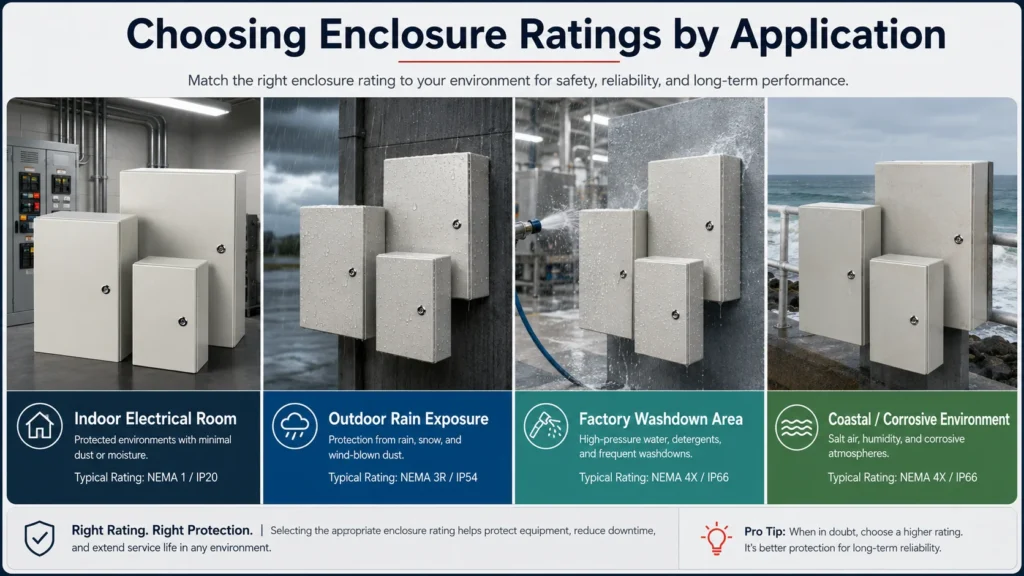
Valeurs nominales recommandées pour les applications courantes
| Environnement | Note généralement admise |
|---|---|
| Local électrique intérieur propre | NEMA 1 ou un indice de protection IP adapté à une utilisation en intérieur |
| Atelier intérieur poussiéreux | NEMA 12 ou IP5X/IP6X, selon le degré d'exposition à l'eau |
| Exposition à la pluie à l'extérieur | NEMA 3R ou un indice de protection IP adapté à une utilisation en extérieur |
| Nettoyage par rinçage dans l'industrie agroalimentaire | NEMA 4/4X ou IP66, sous réserve des exigences en matière d'hygiène |
| Environnement marin ou côtier | NEMA 4X avec des matériaux résistants à la corrosion |
| Risque d'inondation temporaire | NEMA 6 ou IP67 |
| Immersion prolongée | NEMA 6P ou IP68 dans les conditions spécifiées |
La puissance nominale finale doit être choisie en fonction des conditions d'installation complètes, des normes en vigueur et de la documentation d'essais fournie par le fabricant.
FAQ
Les indices NEMA et IP sont-ils identiques ?
Non. Ces deux systèmes décrivent le niveau de protection des boîtiers, mais ils utilisent des méthodes d'essai et des critères d'évaluation différents. Les indices IP portent principalement sur la protection contre les corps solides et l'eau. Les indices NEMA peuvent également couvrir la corrosion, le givre extérieur, l'huile, les liquides de refroidissement et d'autres conditions environnementales.
La norme IP66 est-elle équivalente à la norme NEMA 4X ?
Pas tout à fait. La norme IP66 garantit une protection totale contre la poussière et une résistance aux jets d'eau puissants. La norme NEMA 4X inclut également la résistance à la corrosion. Un boîtier IP66 ne doit pas être automatiquement considéré comme conforme à la norme NEMA 4X, sauf si le fabricant fournit des documents d'essai à l'appui.
Quelle est la différence entre les normes NEMA 4 et NEMA 4X ?
Ces deux indices garantissent une protection contre la poussière, la pluie, les projections d'eau et les jets d'eau provenant d'un tuyau d'arrosage. L'indice NEMA 4X offre en outre une résistance à la corrosion. Il est souvent choisi pour les environnements côtiers, maritimes, chimiques, agroalimentaires et autres environnements difficiles.
Quelle classe de protection convient aux armoires électriques destinées à une utilisation en extérieur ?
Le niveau de protection approprié dépend de l'exposition prévue. La norme NEMA 3R est couramment utilisée pour la protection contre la pluie en extérieur, tandis que les normes NEMA 4 ou 4X peuvent s'avérer plus adaptées en cas de présence de poussière, de projections d'eau importantes, de lavage à haute pression ou de corrosion. Pour les produits classés selon la norme IP, les indices IP65 ou IP66 sont souvent envisagés pour les installations en extérieur.
Comment les acheteurs peuvent-ils vérifier l'indice de protection d'un boîtier ?
Les acheteurs doivent demander la fiche technique du produit, le rapport d'essai, les informations relatives à la certification et les instructions d'installation. Ils doivent également vérifier si la classification s'applique à la configuration complète du boîtier, y compris les accessoires, les ouvertures et les éléments d'étanchéité.