


Waterproof Enclosure Buying Guide
How to choose the IP rating, material, size and sealing for an outdoor enclosure — written from the factory side, with the numbers we actually build to.
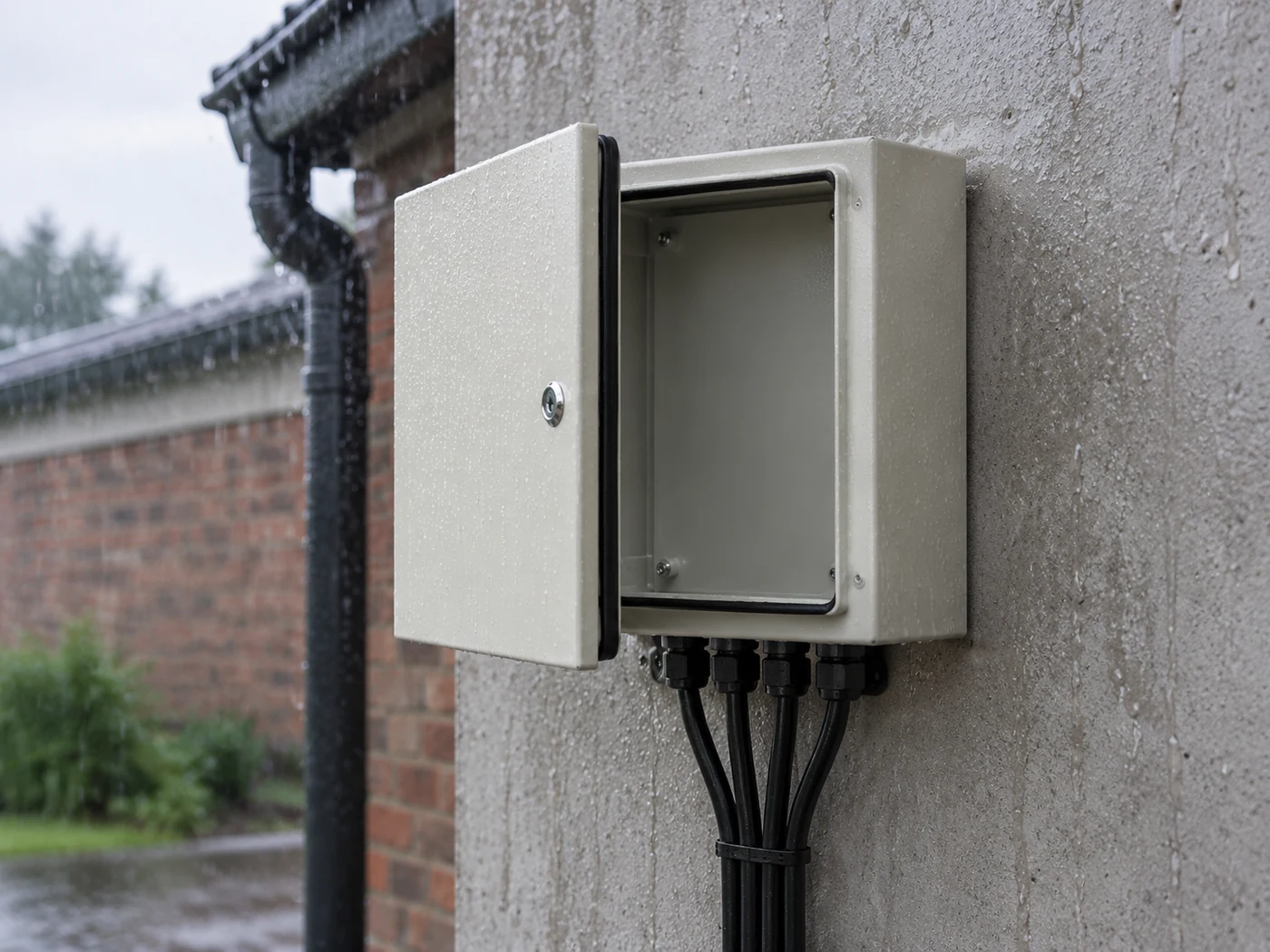
What a waterproof enclosure is — and when you need one
If you are new to specifying one, read this first. Two paragraphs save most of the mistakes.
It is a housing with a seal, not a special kind of box
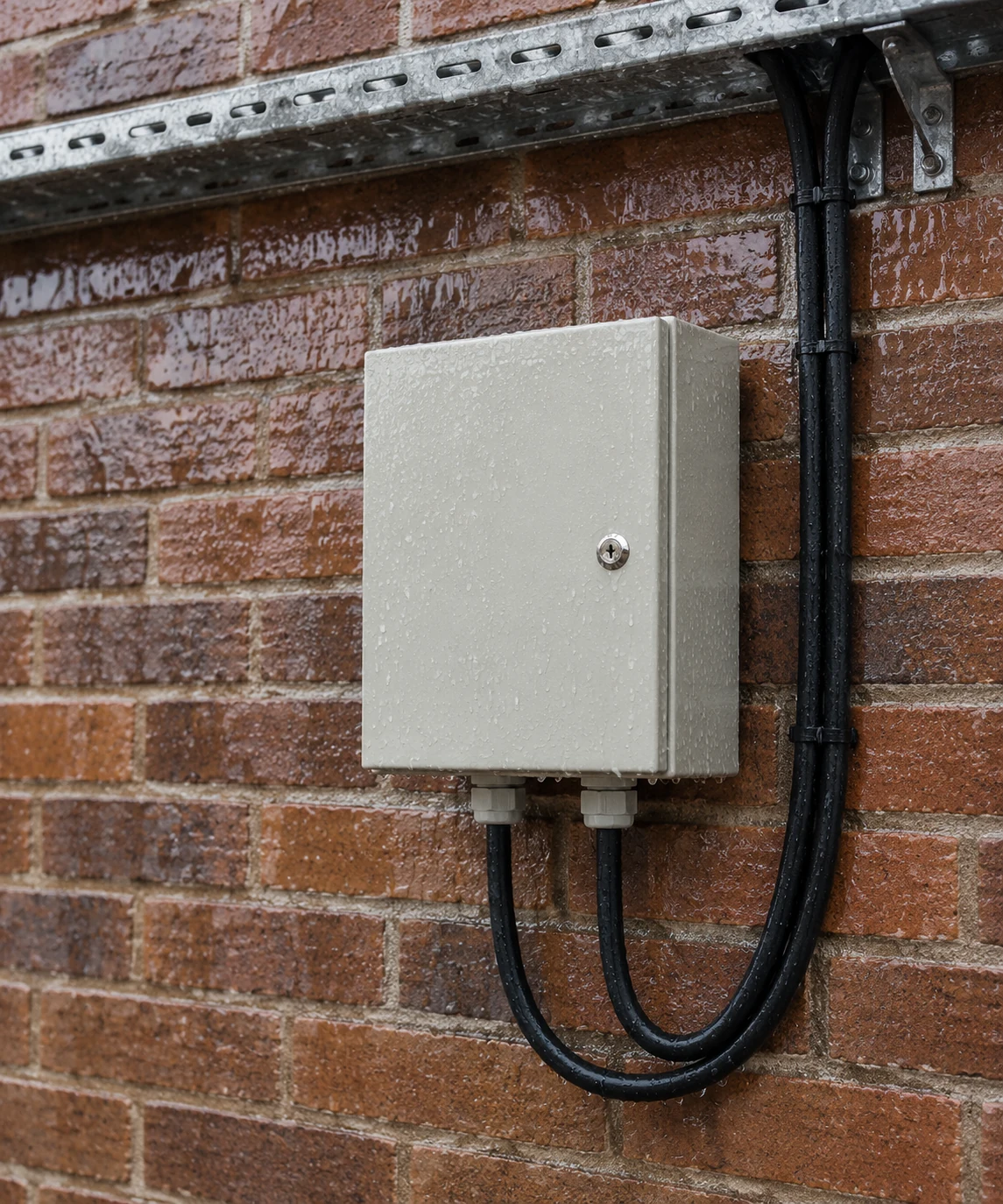
A waterproof enclosure holds the electrical parts that must stay dry — breakers, terminals, meters, control gear — and keeps water out. What makes it waterproof is not the sheet metal. It is the gasket that compresses when the door closes, and the glands where the cables enter. A plain steel box with a tired gasket is not a waterproof box, whatever the label says.
When you need one, and when you do not
You need one when the box sits outdoors, in a wet process area, in a washdown zone, or anywhere condensation forms — car parks, pump rooms, coastal sites, construction power. In a dry plant room a standard indoor box is usually enough; paying for IP66 there buys nothing. The rating should match the exposure, not the habit.
How to use this guide: work through the three decisions (protection grade, material, size), then read the sealing section before you order. The FAQ at the end covers the commercial questions — samples, lead time, payment and shipping.
Three decisions that set a waterproof enclosure specification
Most waterproof enclosure problems start before production: an IP rating chosen by habit, a material chosen by price, a box size chosen before the equipment was measured.
Protection grade
IP65 for regular outdoor mounting, IP66 for washdown and driven rain, IP67/68 where water stands or the box is buried.
Material
Coated steel for inland sites, 304 stainless for coastal and humid work, 316 where chlorides are concentrated.
Size and layout
Measure the devices first, then add wiring space and cable bend. Custom sizes follow your drawing, not a catalogue.
Waterproof enclosure specifications: IP rating, material and size
What we build, and the ranges each parameter covers. Anything outside these rows is made to drawing.
Protection grade
| Rating | Withstands | Where it fits |
|---|---|---|
| IP65 | Dust-tight; water jets from any direction | Walls, poles, plant rooms with occasional hose-down |
| IP66 | Dust-tight; powerful water jets | Washdown areas, exposed coastal sites, driven rain |
| IP67 | Dust-tight; short-term immersion | Areas with temporary flooding or standing water |
| IP68 | Dust-tight; long-term immersion | Buried or permanently wet locations |
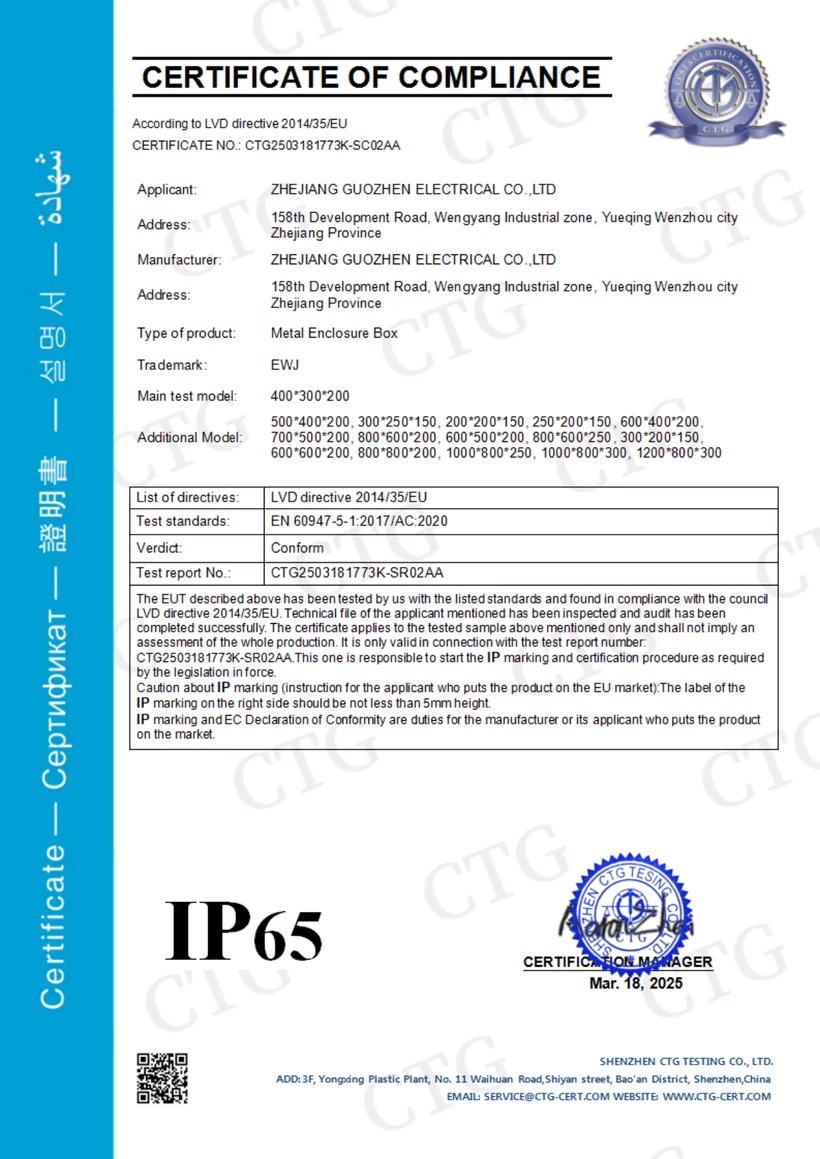
IP65 is tested to IEC 60529 — the compliance certificate and test report are supplied with the order on request. Related: IP66 enclosures.
Reading the code: the two digits are independent. The first is protection against solids (6 = dust-tight), the second against water (5 = jets, 6 = powerful jets, 7 = short immersion, 8 = long immersion). A higher second digit says nothing about impact strength or corrosion resistance.
Material
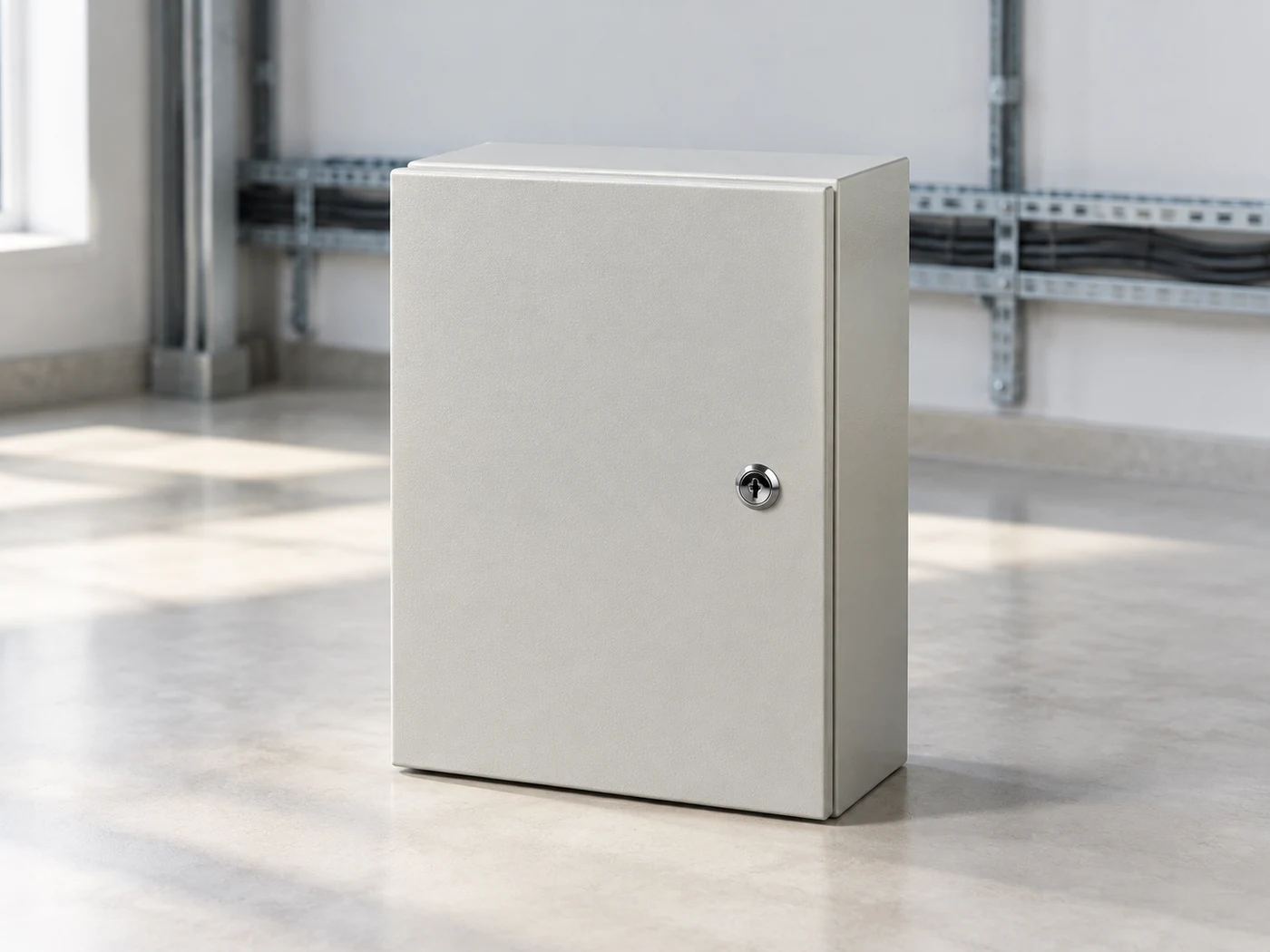
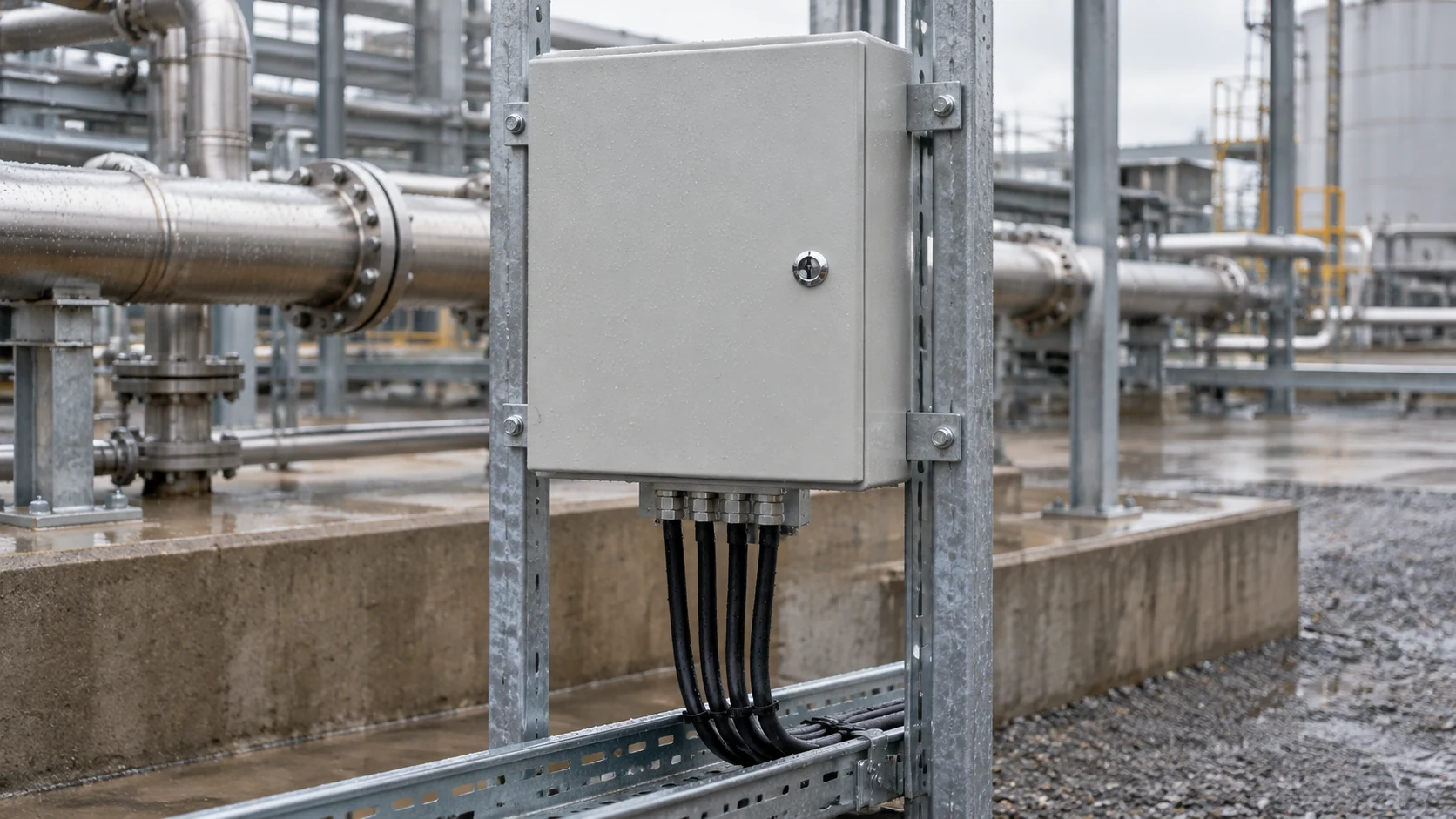
| Material | Advantages | Applicable scenarios |
|---|---|---|
| Engineering plastics (ABS/PC) | Lightweight, corrosion-resistant, good insulation | Ordinary outdoor and indoor distribution boxes |
| Stainless steel (304/316) | High strength, impact-resistant, corrosion-resistant | Chemical plants, coastal areas, high-safety sites |
| Polycarbonate (PC) | Transparent and UV-resistant | Where internal equipment has to be visible without opening the door |
Size range
| H × W × D (mm) | Model series | Typical use |
|---|---|---|
| 300 × 200 × 150 | ME302015 | Small distribution, single row of breakers |
| 400 × 300 × 200 | ME403020 | Consumer unit scale, 8–12 outgoing ways |
| 600 × 500 × 250 | ME605025 | Workshop box, mixed 4-pole and 1-pole ways |
| 800 × 600 × 250 | ME806025 | Larger distribution, transformer or charger inside |
| 1000 × 800 × 300 | ME1008030 | Industrial panel, floor or heavy wall mount |
| 1200 × 800 × 300 | ME1208030 | Double-door, plant room sub-distribution |
| 1400 × 1400 × 400 | ME1414040 | Largest standard body; beyond this is bespoke |
Sheet steel 1.2–1.5 mm, mounting plate 1.5 mm, RAL 7032 as standard (RAL 2004 or a specified RAL on request). Full model list in the EWJ catalogue (PDF).
Options
DIN rail or mounting plate · gland plate cut to your gland sizes · key lock or padlockable latch · transparent window · ventilation slots or fan · anti-condensation heater · engraved circuit labels · internal partition · RAL colour and OEM branding. Outdoor enclosures can be supplied with a rain hood and bottom entry.
Waterproof enclosure selection by installation scenario
Three cases cover most enquiries. Treat them as a starting point — a coastal car park and an inland one need different material even though the scenario reads the same.
| Scenario | Recommended configuration |
|---|---|
| Outdoor home distribution box | IP65 engineering plastic box, medium size, padlockable latch |
| Temporary construction site power box | IP67 stainless steel box, large size, heavy-duty lock |
| Parking lot charging pile protection box | IP66 transparent PC box, reserved charging interfaces |
If your site is not on this list, describe the exposure and the device list — that is enough to size a box.
Sealing a waterproof enclosure: where water actually gets in
Water almost never passes through the sheet metal. It enters at the door, the cable entries and the fixing points. Check these four items before you order.
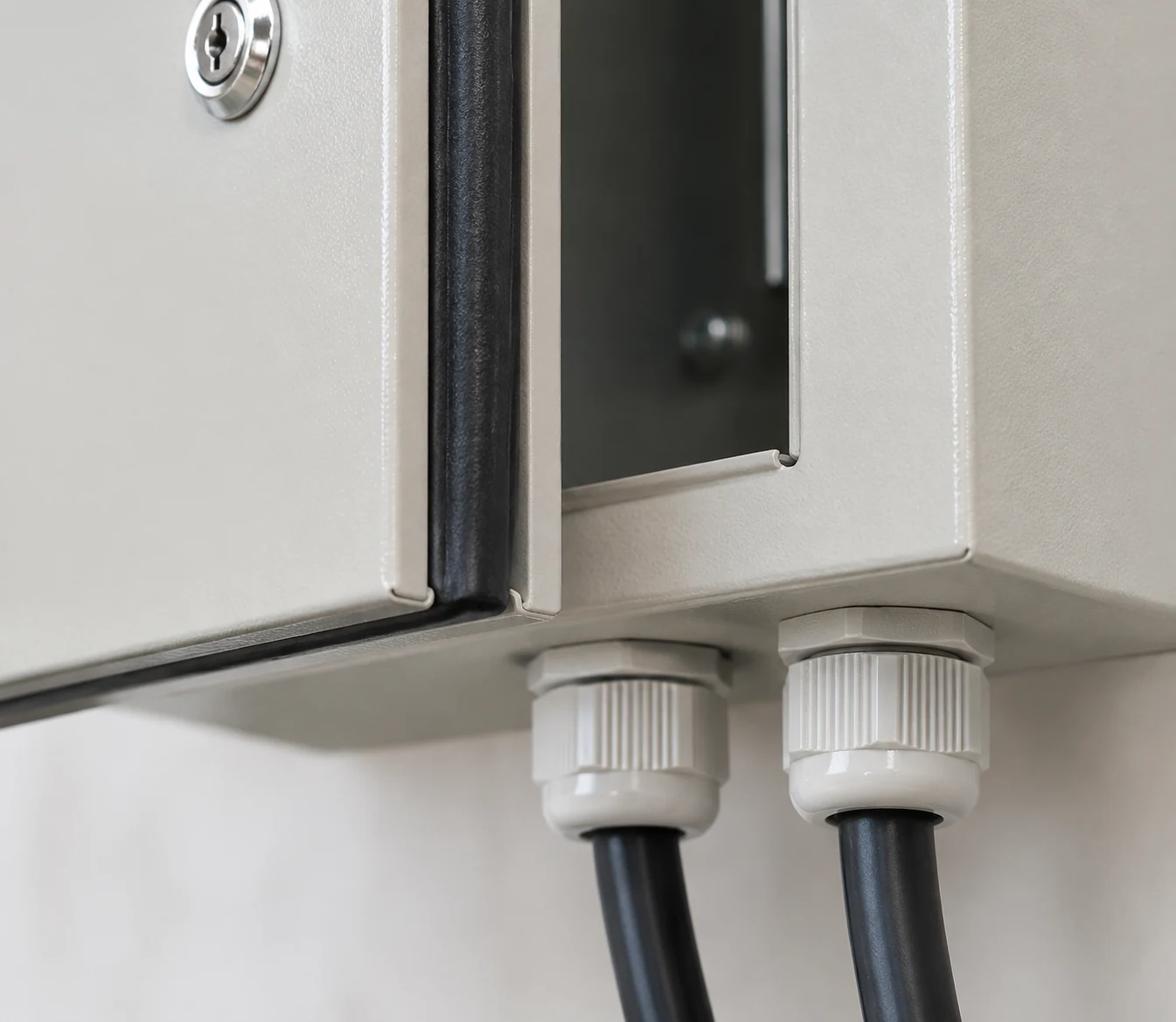
Door gasket
A continuous rubber or foam seal, compressed evenly by the latch. Look at the corners: a gasket pinched at one corner leaks there first.
Cable glands
Every entry gets a gland matched to the actual cable diameter, and unused entries are blanked with the correct plug. An oversized hole is the single most common cause of water ingress.
Door type and latch
Hinged or snap-latch doors that close against a stop, so the gasket compresses the same way every time. A door that needs force to close is not sealing evenly.
Breathing and drainage
Where temperature swings cause condensation, a breather or drain keeps water from collecting inside a sealed box.
A correctly specified IP65 box still leaks if the gland hole is too large for the cable. Confirm gland sizes at order stage, not after installation.
Five mistakes that cause waterproof enclosure leaks
These five account for most of the water-damage complaints we see on installed enclosures. None of them is a manufacturing fault.
1. Choosing the rating by habit
IP65 on every line item, because it was IP65 on the last project. The rating should follow the exposure — a washdown bay and a covered plant room are not the same requirement.
2. Gland holes cut larger than the cable
The installer arrives with a 20 mm cable and a 25 mm hole, then fills the gap with sealant. That is where the water comes in, and it is decided at order stage, not on site.
3. Drilling an extra hole for a second cable
Every added hole is a new leak path unless it is glanded properly. If the cable count may change, say so when ordering.
4. Cable entry on top of the box
Water runs down the cable and straight into an upward-facing gland. Entry belongs on the underside, with a drip loop below it.
5. Ignoring condensation
A fully sealed box on a site with wide day-night swings collects water inside, even with no rain at all. A breather or drain element solves it; nothing else does.
How a waterproof enclosure is built
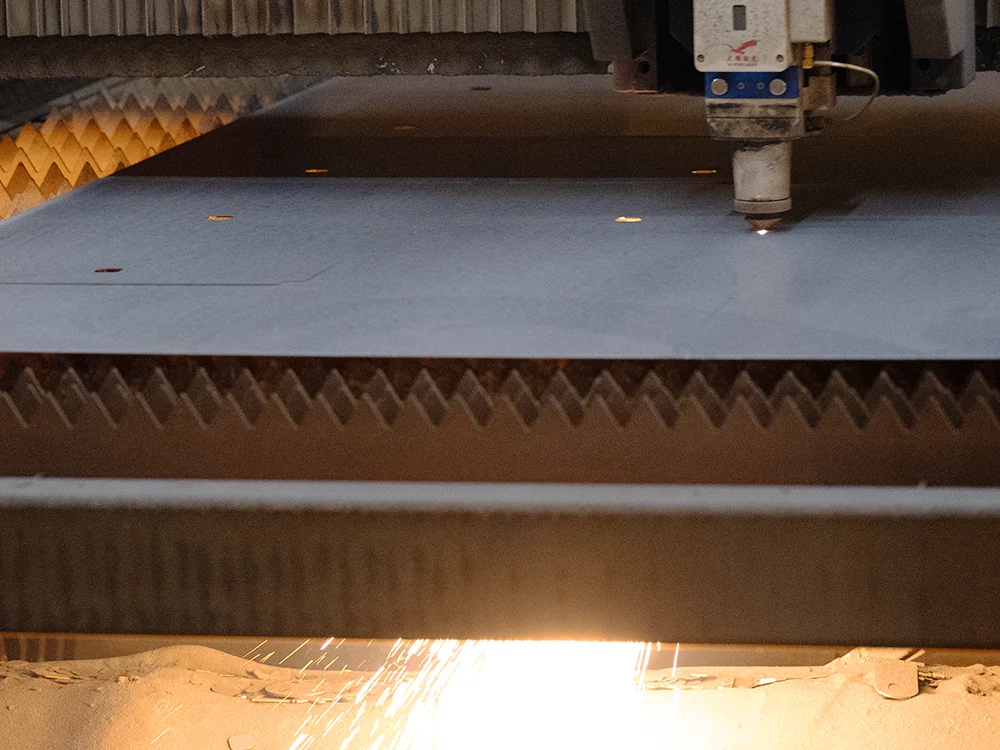
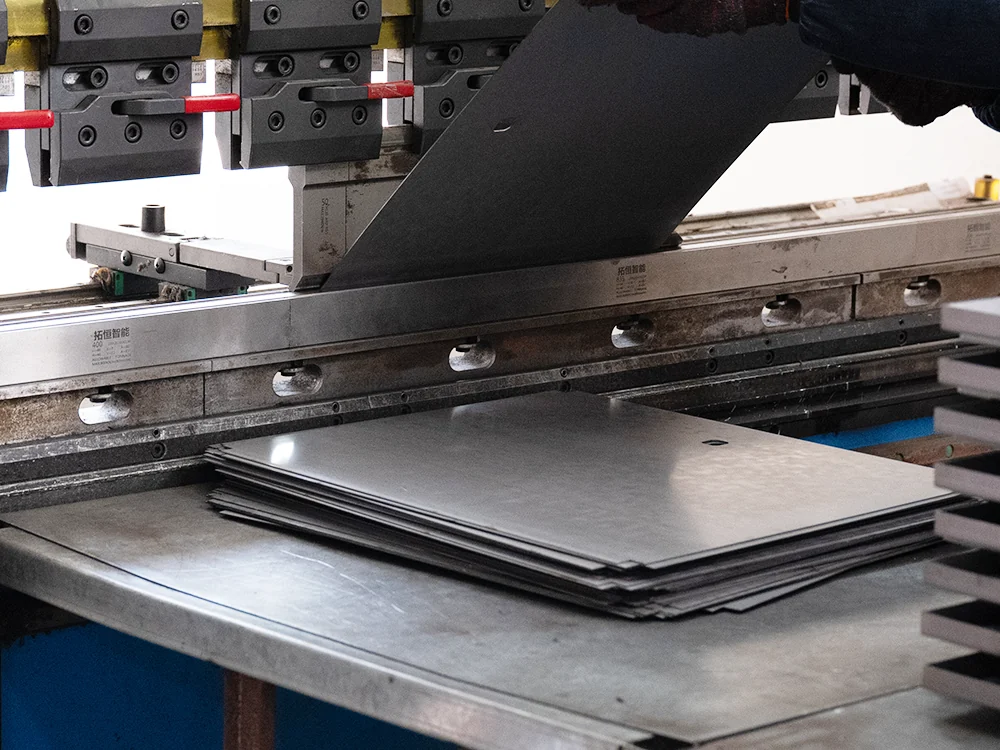
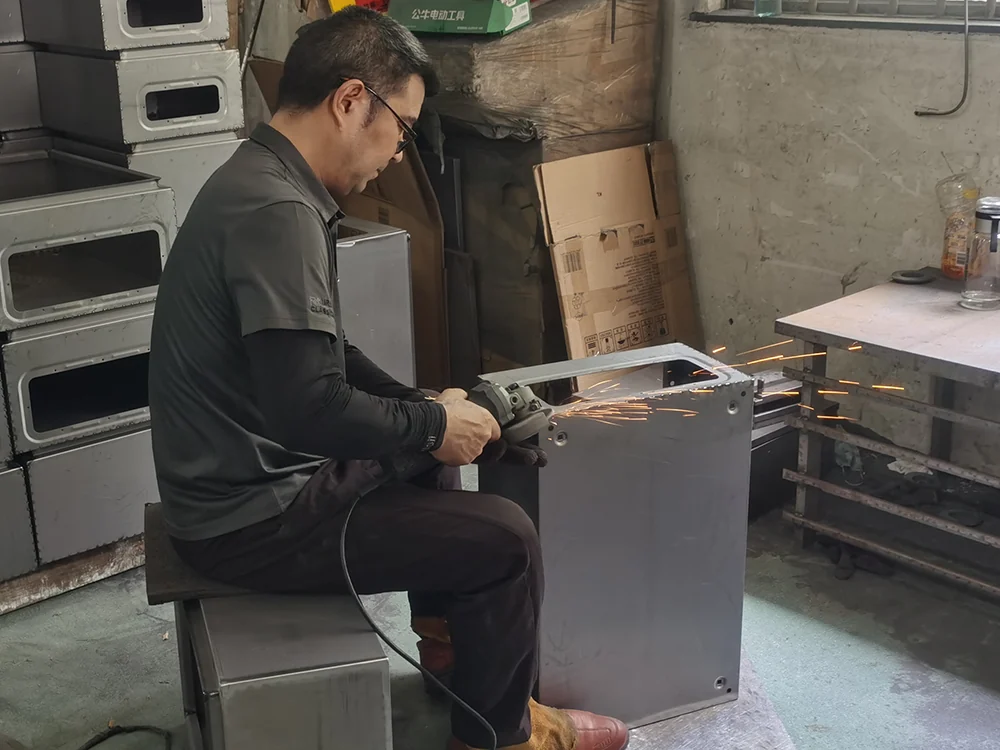
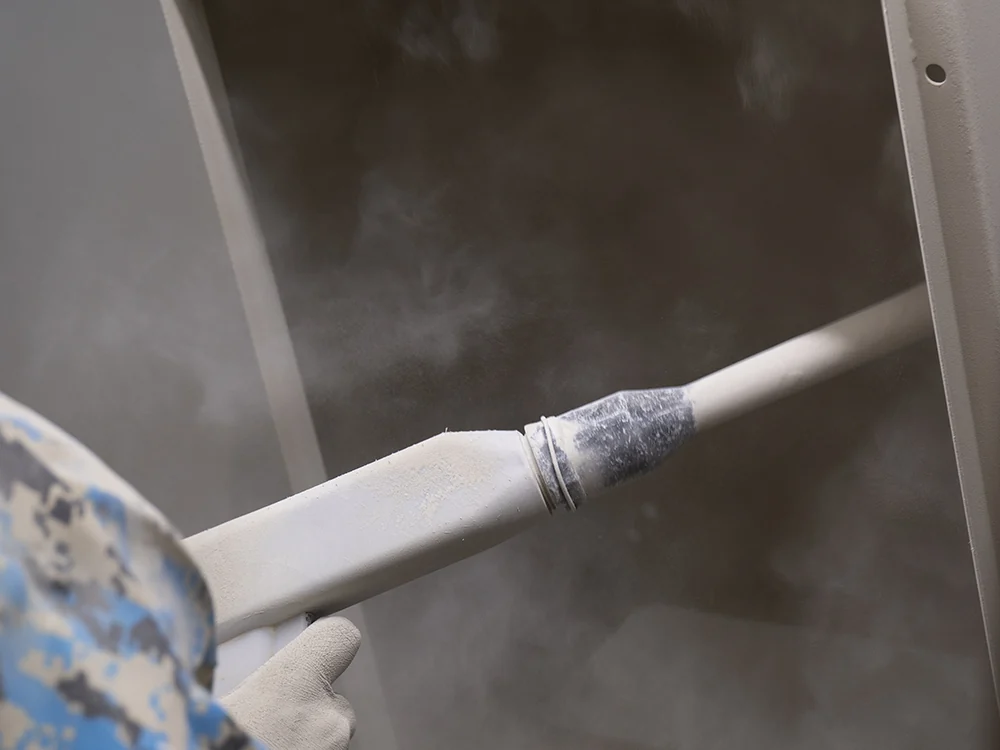
Four production steps decide whether a box that leaves as IP65 is still IP65 after a year outdoors. Drawing and final testing sit either side of them: the drawing fixes the cut-outs, and the finished housing is checked against it before dispatch.
Installing and maintaining a waterproof enclosure
An enclosure is only as waterproof as the day it was installed. These are the points that decide whether it stays that way.
On site
- Avoid low-lying positions where water collects around the base.
- Fix the enclosure firmly to the wall or bracket — vibration loosens glands and gaskets.
- Keep cable entry on the underside, with a drip loop below the gland.
- Do not drill extra holes on site; have the entry plate cut to your gland sizes at order stage.
In service
- Check the gasket every six months: if it has hardened or cracked, replace it.
- Replace the gasket rather than tightening the latch to compensate for a worn seal.
- Check that hinges and locks still move freely, and that no water is standing on the surface.
- Do not clean with corrosive agents or aim a high-pressure jet at the gasket line.
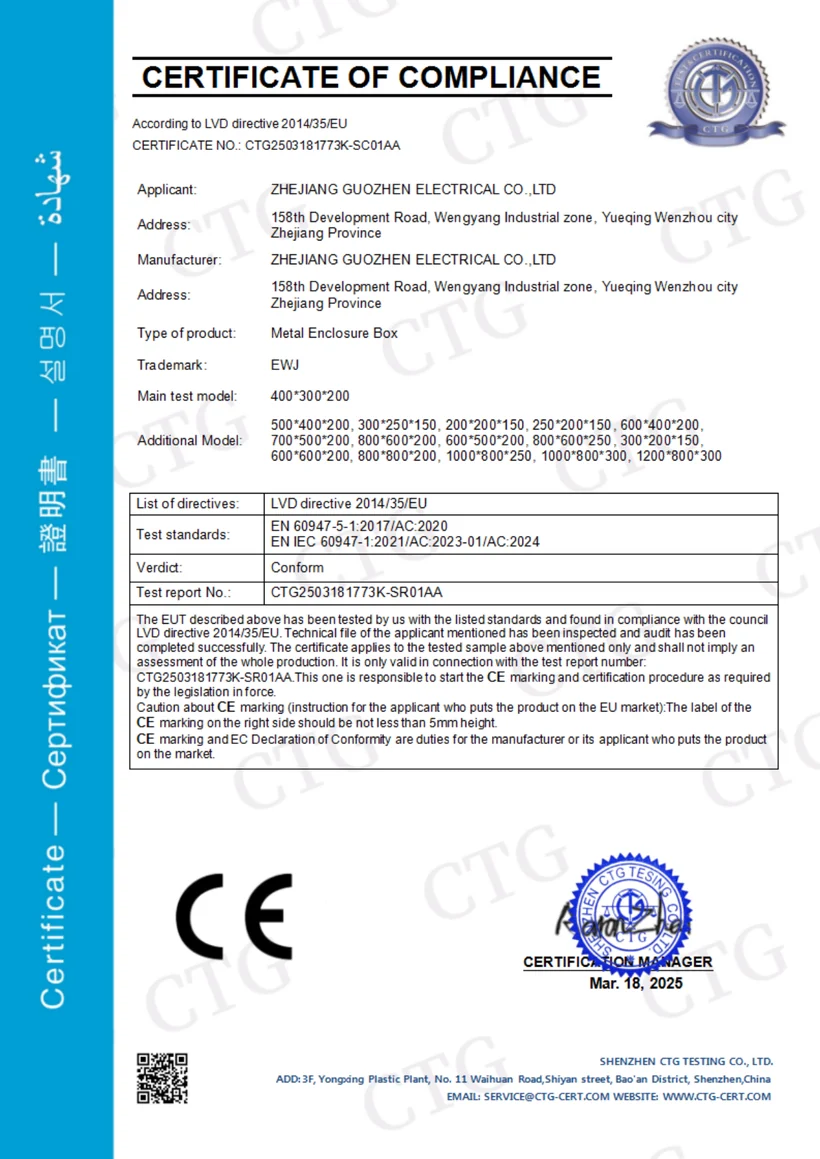
IP65 certificates and test reports for waterproof enclosures
Buyers do not need another logo wall. What matters is whether the document behind the claim exists.
CE — LVD report
Declaration of conformity plus the LVD test report, for EU-bound orders.
IP65 certificate
Compliance certificate and type test report to IEC 60529 for the declared rating.
ISO 9001
Factory quality system covering incoming material, fabrication and final inspection.
RoHS
Material declarations available on request for procurement files.
Buying the housing only, with your own devices fitted? Say so at quotation — it changes which documents apply to the order.
Waterproof enclosure FAQ: samples, lead time and payment
The questions buyers ask most, in the order they usually come up.
Are you a trading company or a manufacturer?+
We are a factory, established for 12 years, and we supply ODM and OEM orders. That means the housing is fabricated, formed and coated in-house rather than bought in and re-sold.
How does your factory handle quality control?+
Quality control starts at incoming material — sheet thickness and coating are checked before cutting — and runs through forming, welding, coating and final inspection. Finished housings are checked against the drawing and a sample is tested for the declared IP rating.
Do you provide samples? Are they free?+
Samples are supplied free of charge; the buyer covers the shipping cost. For modified or bespoke housings, we will confirm the sample arrangement with the quotation.
How long is your delivery time?+
Normally 20–25 days, depending on quantity and specification. Orders with special colours, cut-outs or assembly take longer — we confirm the date with the quotation rather than after the order.
What are your payment terms?+
30% T/T in advance, balance before shipment. We also accept Trade Assurance, PayPal and Western Union.
What is the cost of shipping?+
It depends on the destination port and the volume of the consignment, so it is quoted per order. Tell us the port and the quantity and we will include freight in the quotation.
Will a heavy storm or typhoon push water through?+
If the rating matches the exposure and the glands are sized to the cables, driven rain should not enter. What fails in storms is usually an installation error — an unused knockout left open, or a gland too large for the cable.
Can I drill the enclosure myself on site?+
You can, but every hole is a new water path and voids the ingress protection unless it is properly glanded and sealed. Have the entry plate cut to your gland sizes at order stage — it costs far less than a field modification.
How do I know which size to order?+
Measure the length × width × height of the equipment, add space for wiring and bending radius, then check the depth against the deepest device plus its cable. If the result sits between two sizes, take the larger one.
Stainless steel or plastic — which is better?+
Stainless suits corrosive environments and sites where physical security matters; it is heavier and costs more. Plastic is lighter, insulating and cheaper, and is right for ordinary distribution in moderate conditions. The decision is environmental, not absolute.
Does the enclosure need maintenance?+
Yes. A six-monthly check of the gasket, glands, hinges and lock prevents most water damage. Replace a hardened or cracked gasket rather than tightening the latch to compensate.
What warranty do you offer?+
Warranty terms are confirmed in the quotation, because they depend on the specification and the environment of the installation. We do not quote a standard period here.
Why do prices for the same size vary so much between suppliers?+
Four things drive the difference: material (stainless above engineering plastics above ordinary plastics), protection rating (IP68 above IP67 above IP65), added functions such as ventilation or heavy-duty locks, and sheet thickness. If two quotes differ on price, compare those four first — a 0.8 mm body and a 1.5 mm body are not the same product.
How do I compare two suppliers on the same box?+
Ask each for the same four documents: the drawing with sheet thickness, the IP test report for the declared rating, the CE declaration where applicable, and the warranty terms. A supplier who cannot send a drawing before quoting is selling from a catalogue, not building to your specification.
Get a quotation for your waterproof enclosure
Three points are enough to start: the exposure (indoor / outdoor / coastal), the protection grade if you already know it, and the device list or ways.
We reply within 48 hours with a size, a configuration and a price. Fields marked * are required.
Based on the EWJ waterproof enclosure purchase guide, written with the production team. Last updated 27 October 2026.