Diferencias entre las cajas eléctricas IP65 e IP66
A la hora de seleccionar armarios eléctricos En el caso de los equipos industriales, es fundamental comprender los índices de protección IP. Los índices IP65 e IP66 se encuentran entre los más habituales. Muchos ingenieros y compradores no saben con certeza cuál elegir.
Este artículo explica en detalle los índices de protección IP, analiza por separado los índices IP65 e IP66, los compara, aborda sus aplicaciones y ofrece orientación para seleccionar la carcasa adecuada.
Comprender el Código IP
¿Qué significa “IP”?
IP son las siglas de «Ingress Protection» (protección contra la entrada de partículas y líquidos), una norma definida por IEC 60529, que describe la eficacia con la que las carcasas impiden la entrada de objetos sólidos (como el polvo) y líquidos (como el agua). Se expresa como IPXY, donde:
- X – Primer dígito: protección contra el polvo y las partículas sólidas (0–6)
- Y – Segundo dígito: protección contra el agua o los líquidos (0–9K)
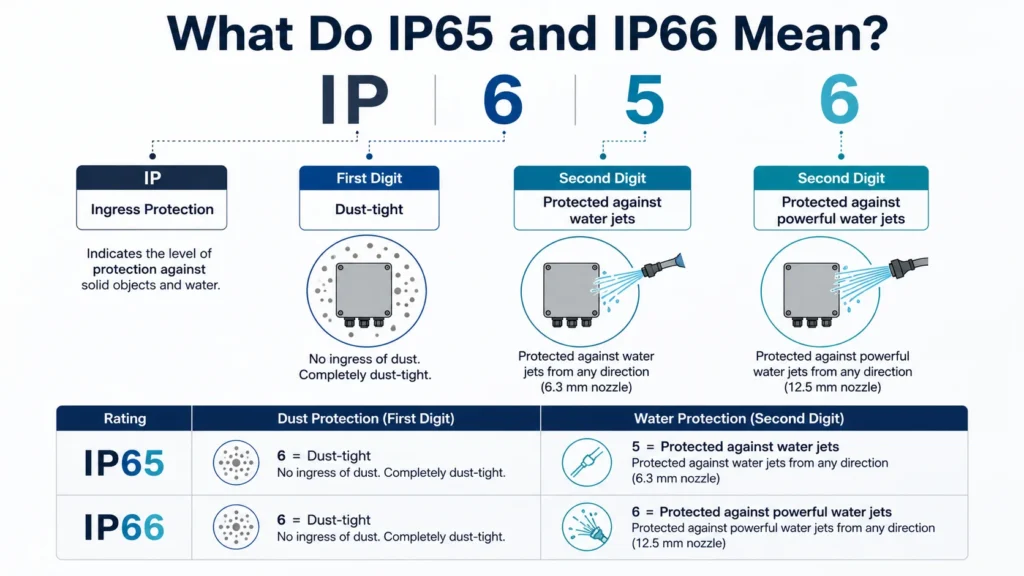
Explicación de los grados de protección IP65 e IP66:
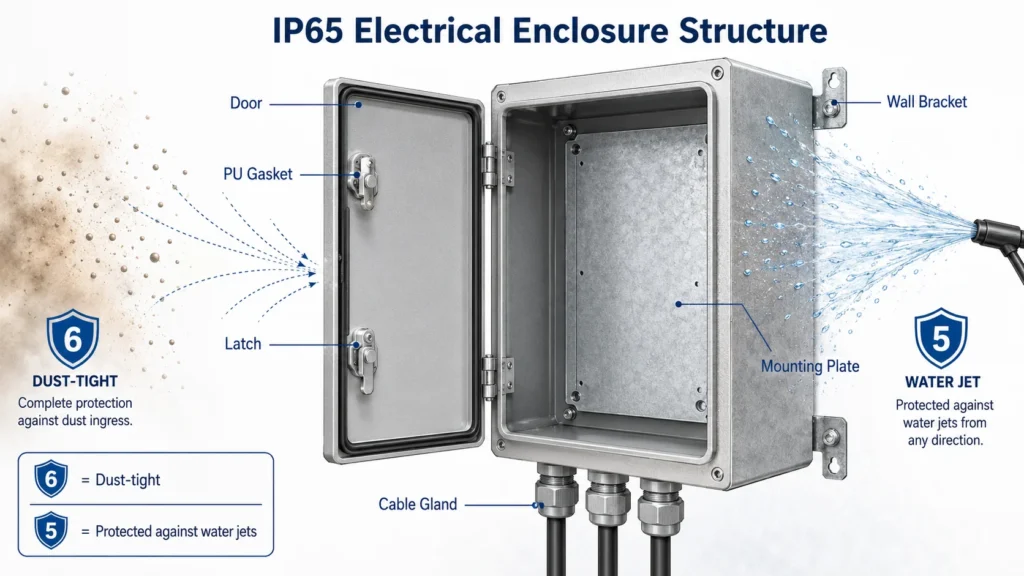
- IP65: 6 = Estanco al polvo; sin entrada de polvo; 5 = Protegido contra chorros de agua procedentes de cualquier dirección (baja presión)
- IP66: 6 = Estanco al polvo; sin entrada de polvo; 6 = Protegido contra chorros de agua a alta presión (más resistente que IP65)
Explicación detallada de los grados de protección IP65 e IP66
Cajas eléctricas IP65
- Protección contra el polvo: Totalmente hermético al polvo
- Protección del agua: Resistente a los chorros de agua a baja presión procedentes de cualquier dirección
- Opciones de materiales: Aluminio, acero inoxidable, ABS
- Casos de uso habituales: Equipos de interior o exterior expuestos a lluvia ligera, paneles de control, zonas de limpieza a baja presión
Cajas eléctricas IP66
- Protección contra el polvo: Totalmente hermético al polvo, equivalente a IP65
- Protección del agua: Resistente a los chorros de agua a alta presión; soporta los lavados industriales y las lluvias intensas
- Opciones de materiales: Acero inoxidable, aluminio, ABS
- Casos de uso habituales: Maquinaria para exteriores, zonas costeras, zonas de limpieza industrial, zonas expuestas a condiciones climáticas extremas
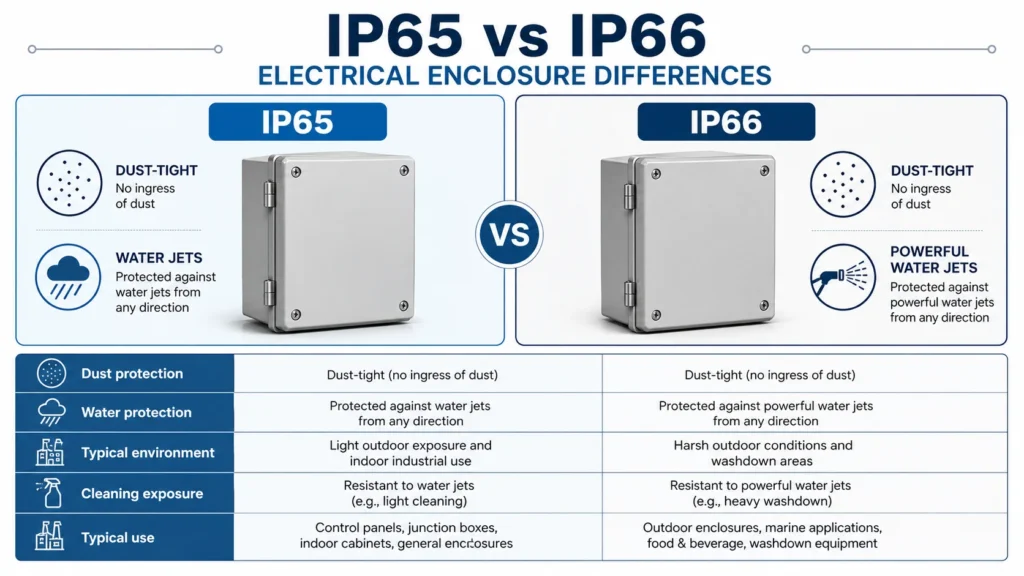
Comparación entre IP65 e IP66
La principal diferencia entre estas dos clasificaciones radica en su resistencia a la presión del agua. Ambas son estancas al polvo, pero la clasificación IP66 ofrece una mayor protección frente a chorros de agua a alta presión.
Comparación lado a lado:
| Característica | IP65 | IP66 |
|---|---|---|
| Protección contra el polvo | Totalmente hermético al polvo | Totalmente hermético al polvo |
| Protección del agua | Chorros de baja a media presión | Chorros de alta presión |
| Presión de prueba | ~30 kPa (boquilla de 6,3 mm) | ~100 kPa (boquilla de 12,5 mm) |
| Entornos ideales | Zonas semiexteriores y protegidas | Zonas al aire libre totalmente expuestas, aptas para el lavado a presión |
| Aplicaciones comunes | Iluminación exterior, señalización, cajas de control | Armarios industriales, instalaciones marítimas o alimentarias |
| Nivel de costes | Inferior | Más alto |
| Cuándo elegir | Exposición a la luz del agua | Chorros de agua directos, lavados frecuentes |
En esencia, la clasificación IP65 es suficiente para ubicaciones semiexteriores o cubiertas, mientras que la IP66 es preferible para entornos totalmente expuestos y con un alto riesgo de contacto con el agua.
Aplicaciones prácticas de los grados de protección IP65 e IP66
IP65:
- Iluminación exterior en zonas con lluvias ligeras
- Maquinaria de uso en interiores expuesta a salpicaduras ocasionales de agua
- Cuadros de control en entornos industriales de intensidad moderada
IP66:
- Equipos industriales al aire libre expuestos a lluvias intensas
- Áreas que requieren limpieza a alta presión (industria alimentaria, plantas químicas)
- Entornos costeros o húmedos con condiciones corrosivas
Cómo elegir la carcasa adecuada en función de tus necesidades
- Exposición a la luz y precio asequible: el grado de protección IP65 es suficiente
- Exposición prolongada al agua o limpieza industrial: se recomienda el grado de protección IP66
- Consideraciones sobre los materiales:
- Acero inoxidable: entornos agresivos o corrosivos
- Aluminio: ligero y económico
- ABS: Económico, resistente a la corrosión, para aplicaciones en interiores
- Consejo: Evalúa primero tu entorno —exposición a la lluvia, procesos de limpieza y condiciones corrosivas— para seleccionar el índice de protección IP y el material más adecuados.
Acerca de nuestra página web y nuestras soluciones de cerramientos
En EWJELE, nos especializamos en armarios eléctricos industriales a medida con una amplia gama de índices de protección IP, entre los que se incluyen IP65 e IP66. Nuestros productos están fabricados en aluminio, acero inoxidable y ABS.
Por qué elegirnos:
- Diseños OEM o personalizados basados en tus planos
- Fabricación fiable para entornos industriales
- Precios competitivos y plazos de entrega rápidos
Llamada a la acción: Ponte en contacto con nosotros hoy mismo para solicitar un presupuesto y encontrar la mejor solución de carcasa para tu aplicación industrial. Solicitar presupuesto
Conclusión
Comprender las diferencias entre IP65 e IP66 es fundamental para proteger tus equipos eléctricos del polvo y el agua. El grado de protección IP65 es ideal para entornos moderados, mientras que el IP66 es adecuado para condiciones más adversas con exposición al agua a alta presión. Elige tu carcasa en función de las exigencias del entorno, los requisitos de los materiales y tu presupuesto para obtener un rendimiento y una durabilidad óptimos.
PREGUNTAS FRECUENTES
¿Se pueden utilizar las cajas con clasificación IP65 en exteriores?
Sí, las cajas con clasificación IP65 pueden utilizarse en exteriores bajo lluvia ligera o en zonas con escasa exposición al agua, pero no para lavados a alta presión.
¿Es el IP66 siempre mejor que el IP65?
No necesariamente. El grado de protección IP66 ofrece una mayor resistencia al agua, pero el IP65 es suficiente para muchas aplicaciones en interiores y en exteriores con condiciones moderadas.
¿Qué materiales son los más adecuados para los entornos costeros?
Se recomienda el acero inoxidable por su resistencia a la corrosión. El aluminio también es adecuado si el coste y el peso son factores importantes.
¿Puedo personalizar el tamaño y el diseño de la carcasa?
Sí, EWJELE ofrece diseños OEM y personalizados según tus planos y especificaciones.
¿Cómo puedo decidir entre IP65 e IP66?
Ten en cuenta factores ambientales como la intensidad de la lluvia, los procedimientos de limpieza y la exposición a elementos corrosivos. Utiliza el grado de protección IP66 para condiciones más adversas y el IP65 para entornos moderados.