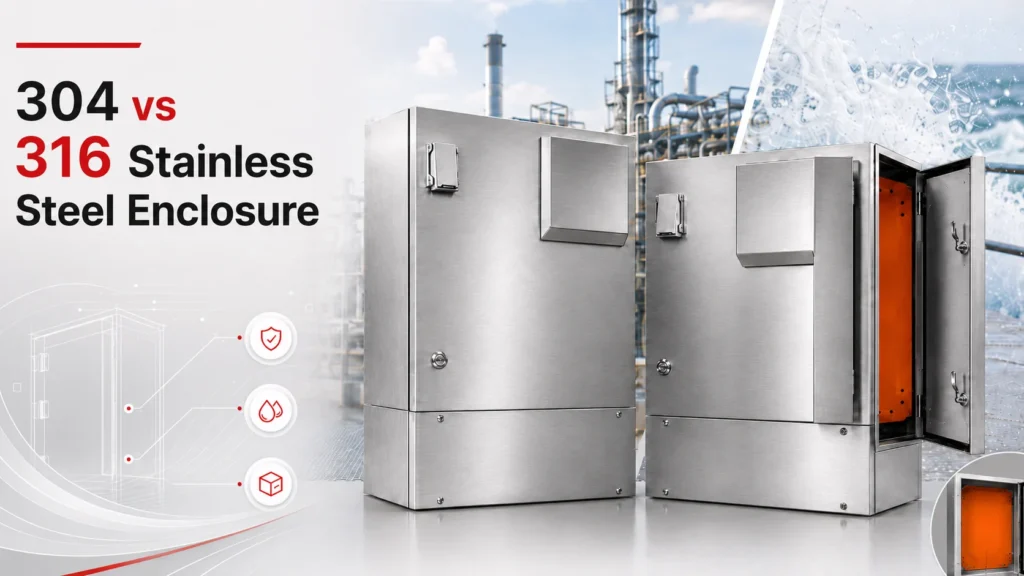
304 vs 316 Stainless Steel Enclosure
Choosing between a 304 vs 316 stainless steel enclosure depends mainly on the installation environment and corrosion risk.
For many general industrial applications, 304 stainless steel may provide a practical balance of durability, corrosion resistance, and cost. When the enclosure will face salt spray, coastal air, chloride-containing cleaners, frequent washdown, or chemical exposure, 316 stainless steel may be worth considering. For more on enclosure selection for demanding conditions, see our outdoor electrical enclosure guide.
The goal is not to choose the more expensive material by default. It is to choose the material that matches the real operating conditions of your project.
Quick Answer: 304 vs 316 Stainless Steel Enclosure
Choose 304 stainless steel for many general applications, including:
- Indoor electrical cabinets;
- Factory automation panels;
- Packaging machinery;
- Dry or mildly humid industrial areas;
- Commercial equipment;
- Non-coastal outdoor projects with limited corrosion exposure.
Consider 316 stainless steel when the enclosure may be exposed to:
- Coastal air or salt spray;
- Marine-related environments;
- Wastewater or chemical process areas;
- Chloride-containing cleaning chemicals;
- Frequent washdown;
- Persistent corrosive moisture.
In short:
304 is commonly suitable for general industrial use.
316 is often considered when chloride exposure and corrosion risk are higher.
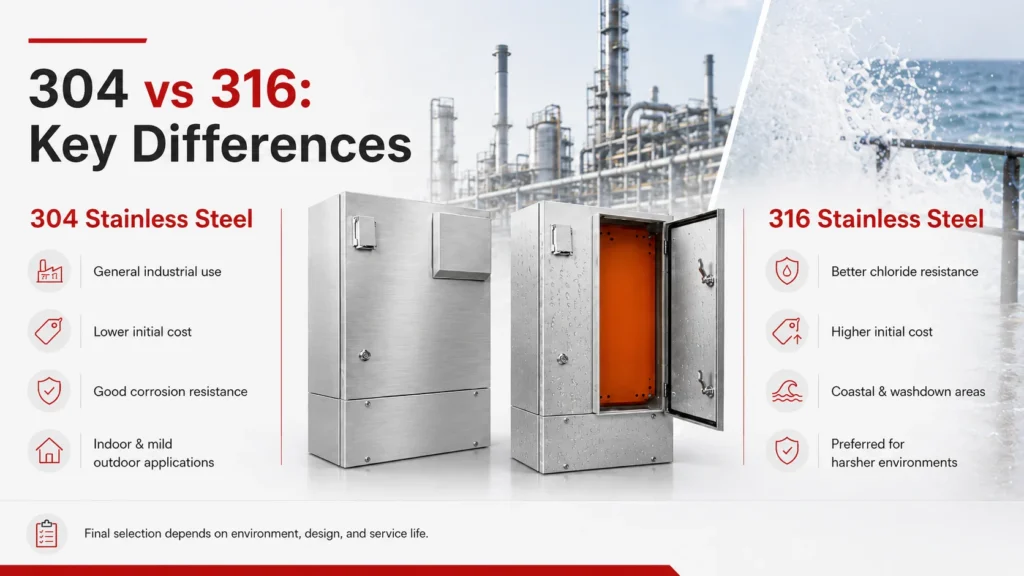
304 vs 316 Stainless Steel Enclosure Comparison
| Factor | 304 Stainless Steel Enclosure | 316 Stainless Steel Enclosure |
|---|---|---|
| General corrosion resistance | Suitable for many industrial environments | Often considered for harsher environments |
| Chloride resistance | May be suitable where exposure is limited | May offer better resistance to chloride-related corrosion |
| Coastal applications | May work in selected locations | Often preferred for coastal or marine projects |
| Chemical exposure | Suitable for mild conditions | May be considered for more demanding exposure |
| Initial material cost | Usually lower | Usually higher |
| Typical use | Indoor, general industrial, mild outdoor use | Coastal, marine, washdown, wastewater, chemical areas |
The key difference is usually not strength or appearance. It is how well the material may perform when exposed to salt, moisture, cleaning chemicals, or corrosive contaminants over time.
Why Is 316 Often Chosen for Corrosive Environments?
316 stainless steel contains molybdenum, which is generally associated with improved resistance to localized corrosion in chloride-containing environments.
Chlorides may come from more than seawater. They can also be found in:
- Coastal air;
- Salt spray;
- Brine;
- Road de-icing salts;
- Cleaning chemicals;
- Wastewater;
- Industrial process fluids.
For electrical enclosures, corrosion may begin around door edges, hinges, locks, fasteners, cable entries, welded seams, and gasket contact areas. These details can affect both enclosure appearance and long-term protection of internal components.
That is why material grade should be considered together with enclosure design, surface finish, drainage, hardware, and sealing requirements.
Can a 304 Stainless Steel Enclosure Be Used Outdoors?
Yes. A 304 stainless steel enclosure may be suitable for many outdoor applications.
Outdoor use does not automatically mean that 316 is required. For example, 304 may be appropriate for a non-coastal outdoor control cabinet where salt exposure, standing water, harsh chemicals, and frequent washdown are limited.
However, additional evaluation may be needed if the enclosure will face:
- Continuous coastal air;
- Salt spray;
- Frequent wet-dry cycles;
- Chloride-rich cleaning products;
- Chemical residues;
- High humidity with industrial pollutants.
For these projects, it is useful to provide the supplier with the installation location, environmental conditions, cleaning method, and expected service life before selecting the material grade.
304 and 316 Are Not IP or NEMA Ratings
This is an important distinction.
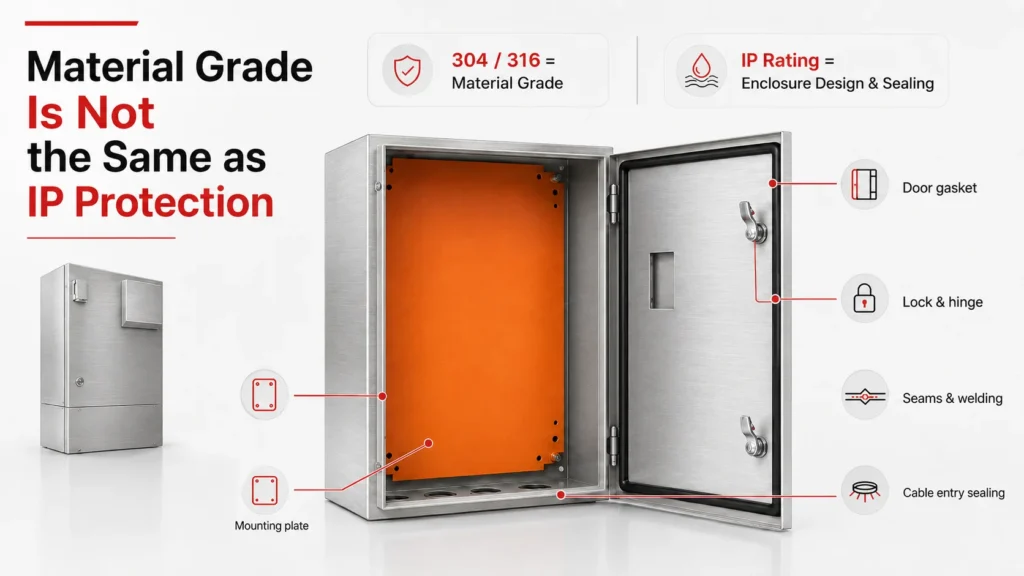
304 and 316 describe the stainless steel material grade.
IP ratings, NEMA Types, water-ingress protection, and sealing performance relate to the finished enclosure design.
A 316 stainless steel enclosure is not automatically IP66.
A 304 stainless steel enclosure is not automatically unsuitable for a specific protection requirement.
The final protection level may depend on:
- Door and gasket design;
- Welded or mechanical seams;
- Cable-entry sealing;
- Locks and hinges;
- Cutout treatment;
- Drainage design;
- Installation method;
- Applicable testing requirements.
When requesting a quote, specify both the stainless steel grade and the required protection level.
Should You Consider 316L?
For projects involving significant welding or more demanding corrosion conditions, some buyers may discuss 316L with their supplier.
316L is a low-carbon version of 316 and may be considered for certain welded fabrications. This can be relevant for custom cabinets with welded bases, continuous seams, large fabricated structures, or installations in corrosive environments.
However, 316L is not necessary for every project. The appropriate material should depend on the enclosure design, fabrication method, installation environment, and project specification.
Do Not Ignore Design Details
Material grade alone does not determine enclosure performance.
A well-designed 304 enclosure may perform better than a poorly designed 316 enclosure if the 316 cabinet has rough welds, poor drainage, incompatible hardware, or areas where salt and moisture can collect.
When corrosion resistance matters, review:
- Weld quality and seam treatment;
- Surface finish;
- Door sealing;
- Cable-entry design;
- Lock and hinge materials;
- Water drainage;
- Areas where residues may collect;
- Cleaning and maintenance requirements.
These details are especially important for marine, coastal, washdown, wastewater, and chemical-related projects. For practical guidance on keeping outdoor enclosures sealed and protected, read our article on how to keep a waterproof outdoor electrical box.
Which Grade Fits Your Project?
304 May Be Suitable For:
- Indoor automation cabinets;
- Electrical control panels;
- Packaging and production equipment;
- Dry industrial environments;
- Mildly humid facilities;
- Selected non-coastal outdoor installations.
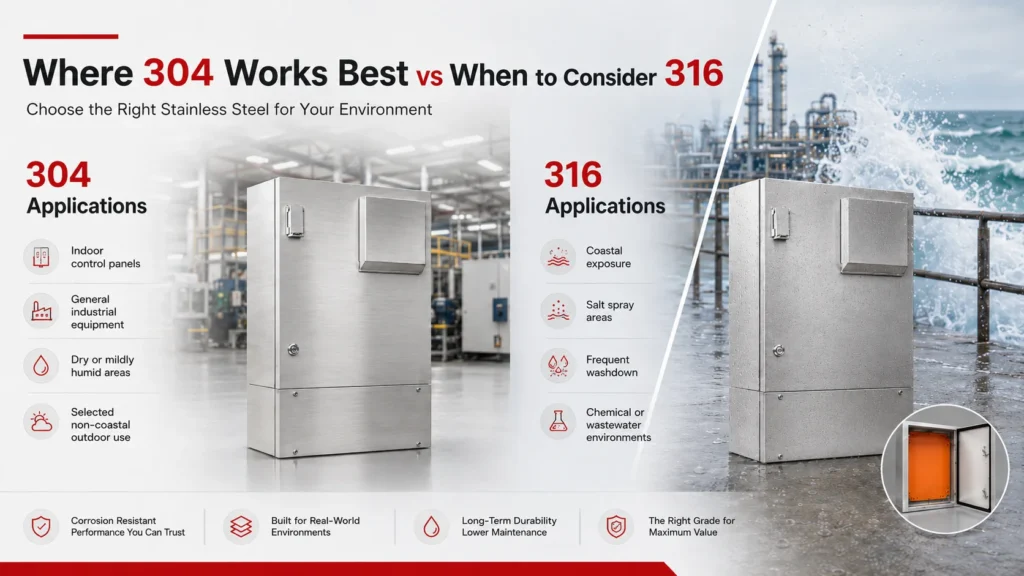
316 May Be Considered For:
- Coastal installations;
- Marine-related equipment;
- Salt-spray exposure;
- Wastewater treatment systems;
- Chemical process areas;
- Frequent washdown environments;
- Outdoor equipment near seawater.
For severe applications, such as direct seawater immersion, strong acids, very high chloride concentrations, or complex chemical exposure, consult a qualified supplier or engineer before finalizing the material.
Questions to Ask Before Ordering
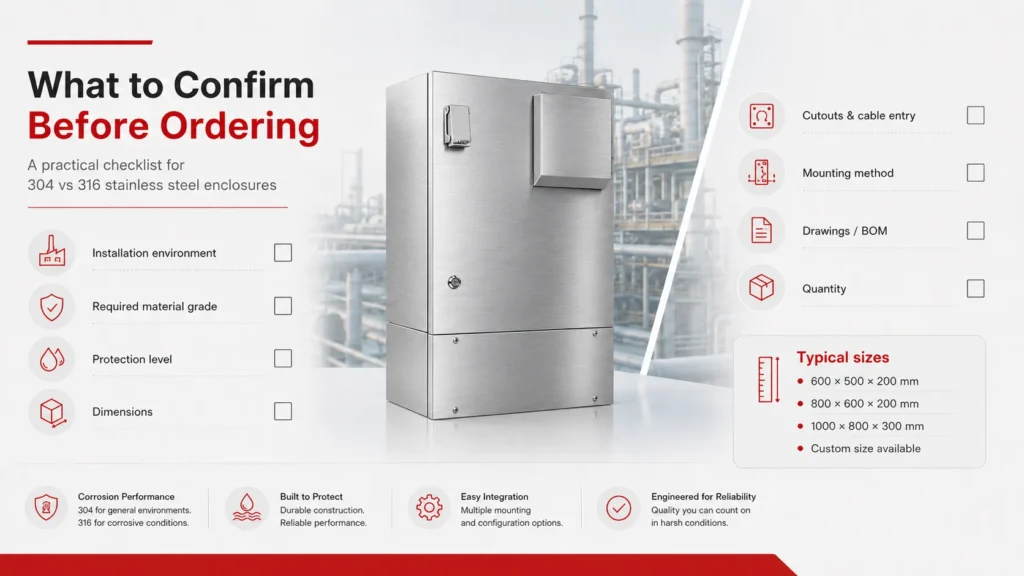
Before requesting a stainless steel enclosure quotation, prepare the following information:
- Where will the enclosure be installed?
- Will it be exposed to salt, chemicals, washdown, or wastewater?
- What protection level is required?
- What are the required dimensions and sheet thickness?
- Are custom cutouts, cable entries, locks, or mounting plates needed?
- Is the enclosure wall-mounted, floor-standing, or free-standing?
- Are welded seams or a custom base required?
- Is material documentation needed?
- Do you have drawings, samples, or a BOM file?
- What is the expected order quantity?
Providing this information early helps the supplier recommend a more suitable material and enclosure configuration. If you are evaluating suppliers, you may also find our top 10 stainless steel enclosure manufacturers in China guide helpful.
Discuss Your Project Requirements
Selecting 304 or 316 is only one part of specifying a stainless steel enclosure.
The final configuration may also depend on dimensions, mounting method, cable-entry layout, internal mounting requirements, sealing needs, operating environment, and project documentation.
Explore custom stainless steel enclosure options for your industrial or OEM project.
FAQ
Is 316 stainless steel always better than 304?
Not necessarily. 316 may offer advantages in chloride-rich or corrosive environments, while 304 may be a practical choice for general industrial applications.
Can 304 stainless steel be used outdoors?
Yes. It may be suitable for many non-coastal outdoor applications. Projects involving salt spray, chemicals, or frequent washdown may require further evaluation.
Does 316 stainless steel mean the enclosure is waterproof?
No. Waterproof performance depends on the finished enclosure design, including gaskets, seams, cable entries, doors, and testing requirements.
Can 304 and 316 look the same?
Yes. Their appearance can be very similar. For critical projects, ask the supplier whether material documentation is available.
Should I choose 316 or 316L?
316L may be considered for certain welded or corrosive applications. The final choice should depend on the project design, fabrication requirements, and installation environment.