Conception d'armoires électriques hygiéniques pour les usines agroalimentaires
Food processing environments place special demands on electrical equipment enclosures. Frequent washdown, high humidity, cleaning chemicals, food residues, and strict sanitation procedures can affect the enclosure’s material, surface condition, sealing structure, and installation design.
A standard electrical enclosure may provide adequate protection against dust and water, but that does not automatically make it suitable for a hygiene-sensitive production area. Surfaces that collect water, exposed gaps, difficult-to-clean hinges, and poorly positioned cable entries can create unnecessary maintenance and sanitation challenges.
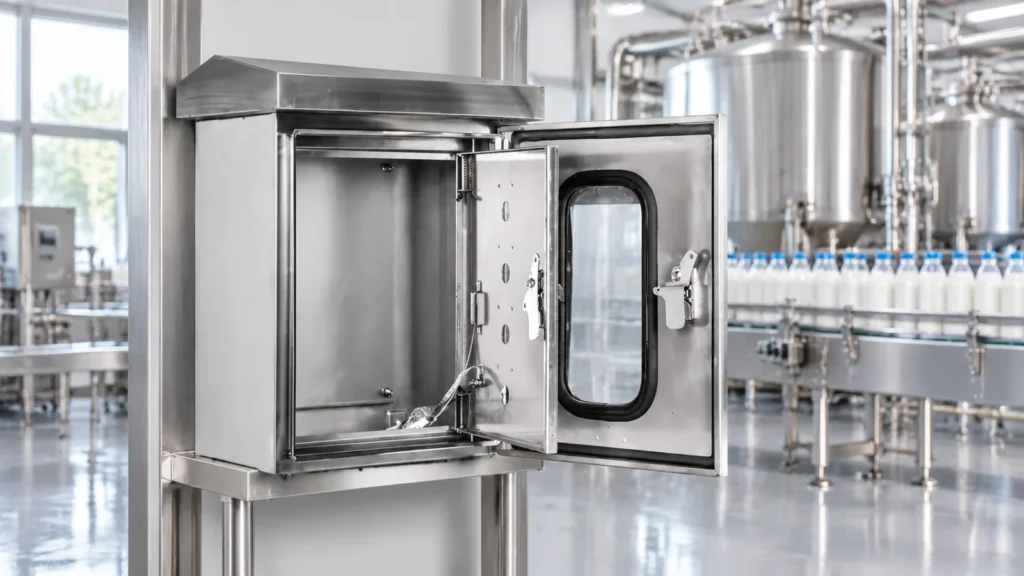
A hygienic electrical enclosure is designed to protect electrical components while making its external surfaces easier to inspect, clean, and maintain.
For food and beverage manufacturers, equipment engineers, and OEM buyers, selecting the right enclosure requires more than choosing stainless steel or specifying a high IP rating.
This guide explains the main hygienic design considerations, material options, structural features, and technical requirements for electrical enclosures used in food processing environments.
1. What Is a Hygienic Electrical Enclosure?
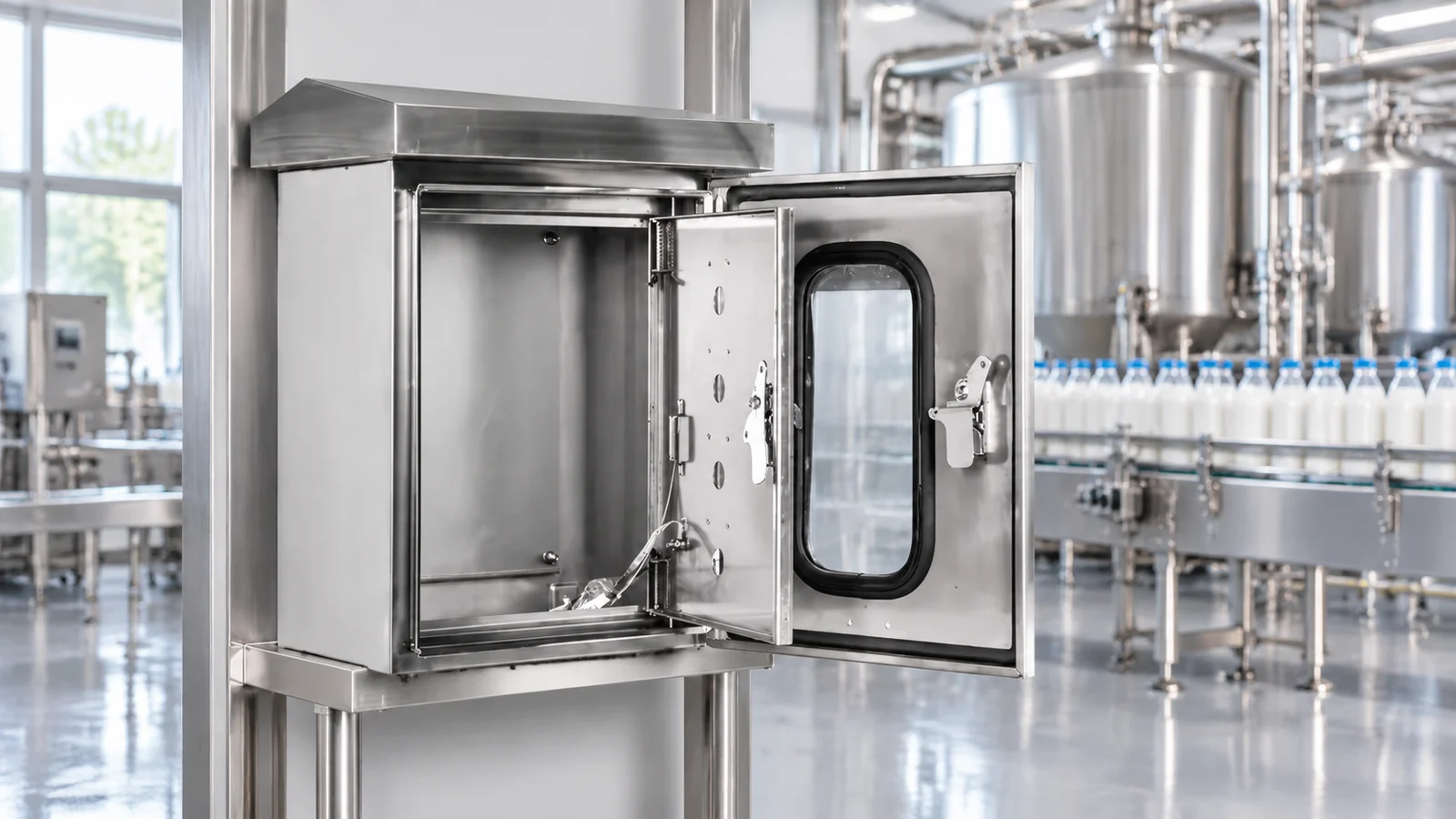
A hygienic electrical enclosure is a protective metal housing designed for electrical and electronic components installed in environments where cleanliness and regular sanitation are important.
These enclosures are commonly used around:
- Food and beverage processing lines
- Dairy production facilities
- Meat and poultry processing plants
- Bakery and food packaging equipment
- Pharmaceutical manufacturing areas
- Beverage filling and bottling systems
Unlike ordinary industrial cabinets, hygienic electrical enclosures are designed with additional attention to external surface cleanability, water drainage, sealing, and installation accessibility.
Their main functions include:
- Protecting electrical components from water, dust, and cleaning exposure
- Reducing areas where water and residues can accumulate
- Providing surfaces that are easier to clean and inspect
- Supporting corrosion resistance in wet and chemical environments
- Maintaining reliable access for electrical maintenance
It is important to distinguish an electrical enclosure from food-contact processing equipment. An electrical cabinet generally does not directly contact food. However, equipment installed within food manufacturing areas may still need to be designed and maintained so that it can be kept in a clean and sanitary condition.
For example, U.S. FDA regulation 21 CFR 117.40(c) addresses equipment located in food manufacturing, processing, packing, or holding areas that does not come into contact with food.
Therefore, hygienic enclosure design should be considered as part of the facility’s overall sanitation and equipment risk-management strategy.
2. Why Does Hygienic Enclosure Design Matter in Food Processing?
Food production facilities often use cleaning procedures that are more demanding than those found in ordinary industrial environments.
Depending on the production process, electrical enclosures may be exposed to:
- Water spray and washdown
- Cleaning detergents and sanitizing chemicals
- High humidity and temperature changes
- Food particles, grease, and organic residues
- Repeated cleaning and maintenance operations
A poorly designed enclosure may create several problems.
Water Accumulation
Flat horizontal surfaces, recessed areas, and poorly designed joints can retain water after cleaning. Standing moisture may contribute to corrosion, staining, and maintenance problems.
Difficult-to-Clean Areas
Exposed threads, narrow gaps, complicated hinge structures, and inaccessible mounting areas may make routine cleaning more difficult.
Chemical Exposure
Cleaning chemicals can affect stainless steel surfaces, protective finishes, and gasket materials. Material selection should consider the actual cleaning agents and their concentration.
Water Ingress
Repeated washdown can place additional demands on door seals, cable entries, and enclosure joints. Water entering the cabinet may damage electrical components and create equipment downtime.
A suitable enclosure should therefore address both external cleanability and internal electrical protection.
3. Seven Important Hygienic Design Features
When selecting a hygienic electrical enclosure, consider the following structural and manufacturing details.
1. Stainless Steel Material Selection
Stainless steel is widely used for electrical enclosures in food processing environments because of its corrosion resistance, durability, and cleanable surface characteristics.
The most common options include:
Acier inoxydable 304
304 stainless steel is suitable for many general food processing and industrial applications. It provides good corrosion resistance under typical atmospheric and many cleaning conditions.
Acier inoxydable 316
316 stainless steel contains molybdenum, which improves its resistance to certain chloride-containing and more aggressive environments.
It may be more appropriate for applications involving salt, chloride exposure, or demanding chemical cleaning conditions.
| Matériau | Principales caractéristiques | Éléments à prendre en compte |
|---|---|---|
| Acier inoxydable 304 | Good general corrosion resistance | General food processing environments |
| Acier inoxydable 316 | Improved chloride resistance | More aggressive chemical or salt exposure |
| Stainless Steel 316L | Low-carbon version of 316 | Projects with specific welding and corrosion requirements |
Neither grade is automatically suitable for every cleaning process. The actual chemical concentration, temperature, exposure time, and maintenance procedure should guide material selection.
For more details, see our boîtiers sur mesure en acier inoxydable.
2. Smooth and Cleanable External Surfaces
Surface condition is an important part of hygienic enclosure design.
A smooth, properly finished exterior is generally easier to wipe down and inspect than a surface with deep scratches, rough welds, or unnecessary recesses.
When reviewing enclosure surface requirements, consider:
- Consistent surface appearance
- Proper finishing around welded joints
- Removal of sharp edges and burrs
- Avoidance of unnecessary grooves and gaps
- Compatibility with the intended cleaning chemicals
- Accessibility for routine inspection
Surface roughness requirements should be specified according to the actual application.
EHEDG guidance discusses surface condition and cleanability for hygienically designed processing equipment. However, requirements for direct food-contact surfaces should not automatically be applied as a universal specification for every external electrical cabinet surface.
If a project requires a particular surface finish, state the finish type and acceptance criteria in the engineering drawing.
3. Sloped Roof and Water Drainage
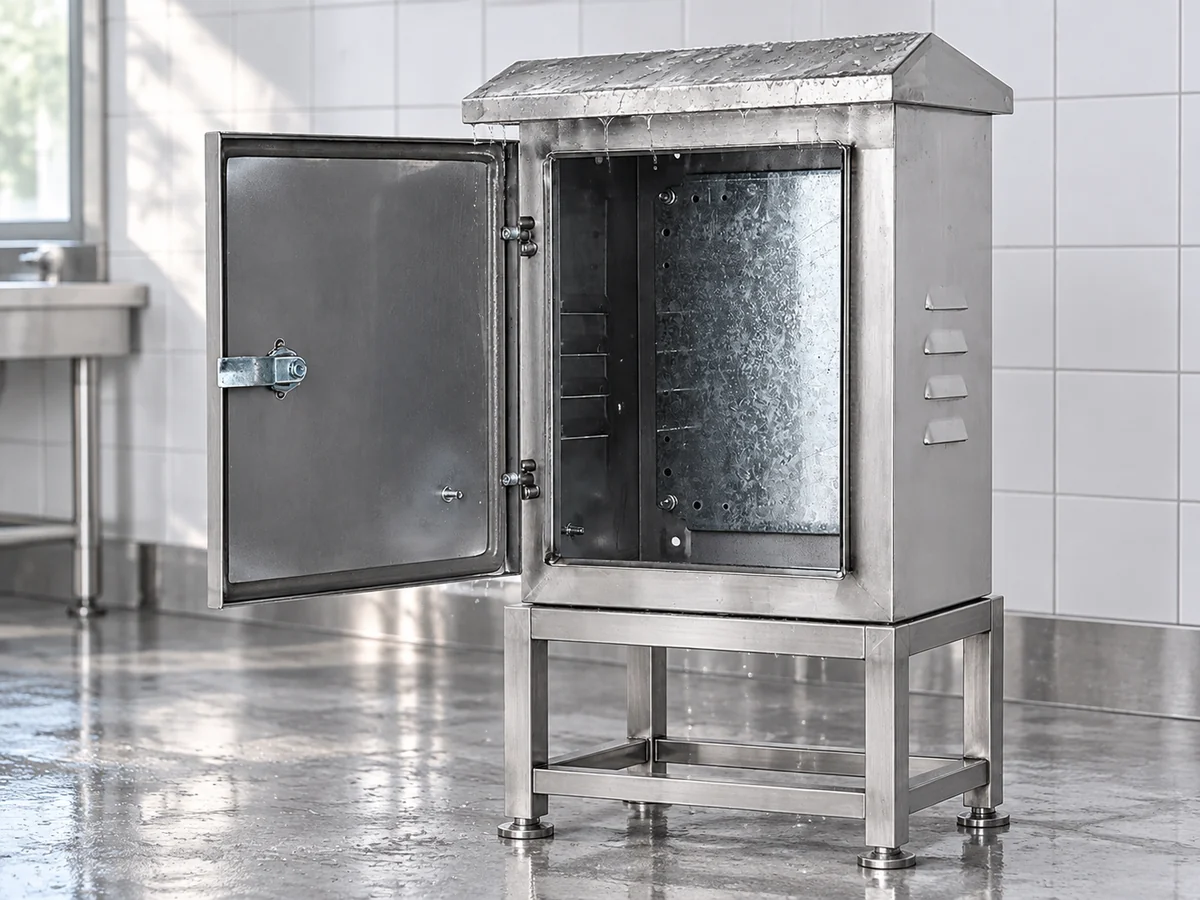
A sloped roof is a useful structural feature for electrical enclosures installed in wet-cleaning environments.
A conventional flat-top enclosure may collect water, dust, or cleaning residues. An inclined top surface helps reduce water pooling and makes external cleaning easier.
Important design considerations include:
- Roof inclination appropriate for the installation
- Smooth transitions between the roof and side panels
- No unnecessary horizontal ledges
- Suitable edge finishing
- Drainage paths that do not direct water toward cable entries or door seals
The required slope depends on the enclosure dimensions, installation position, and cleaning conditions. There is no single angle that is correct for every project.
A sloped top should be treated as one part of the overall hygienic design rather than a guarantee of complete drainage.
4. Hygienic Hinges, Handles, and Locks
Hinges, handles, and locking systems are frequently overlooked during enclosure design.
However, these components can create small gaps, exposed threads, and difficult-to-clean surfaces.
For hygiene-sensitive installations, consider:
- Smooth external hardware surfaces
- Accessible hinge areas
- Reduced exposed fastening points
- Secure door alignment
- Easy access for inspection and maintenance
- Hardware materials compatible with the operating environment
The door should open and close reliably without creating unnecessary recesses or inaccessible cleaning areas.
The final hardware arrangement should also maintain the required door-sealing performance.
5. Sealed Doors and Gasket Design
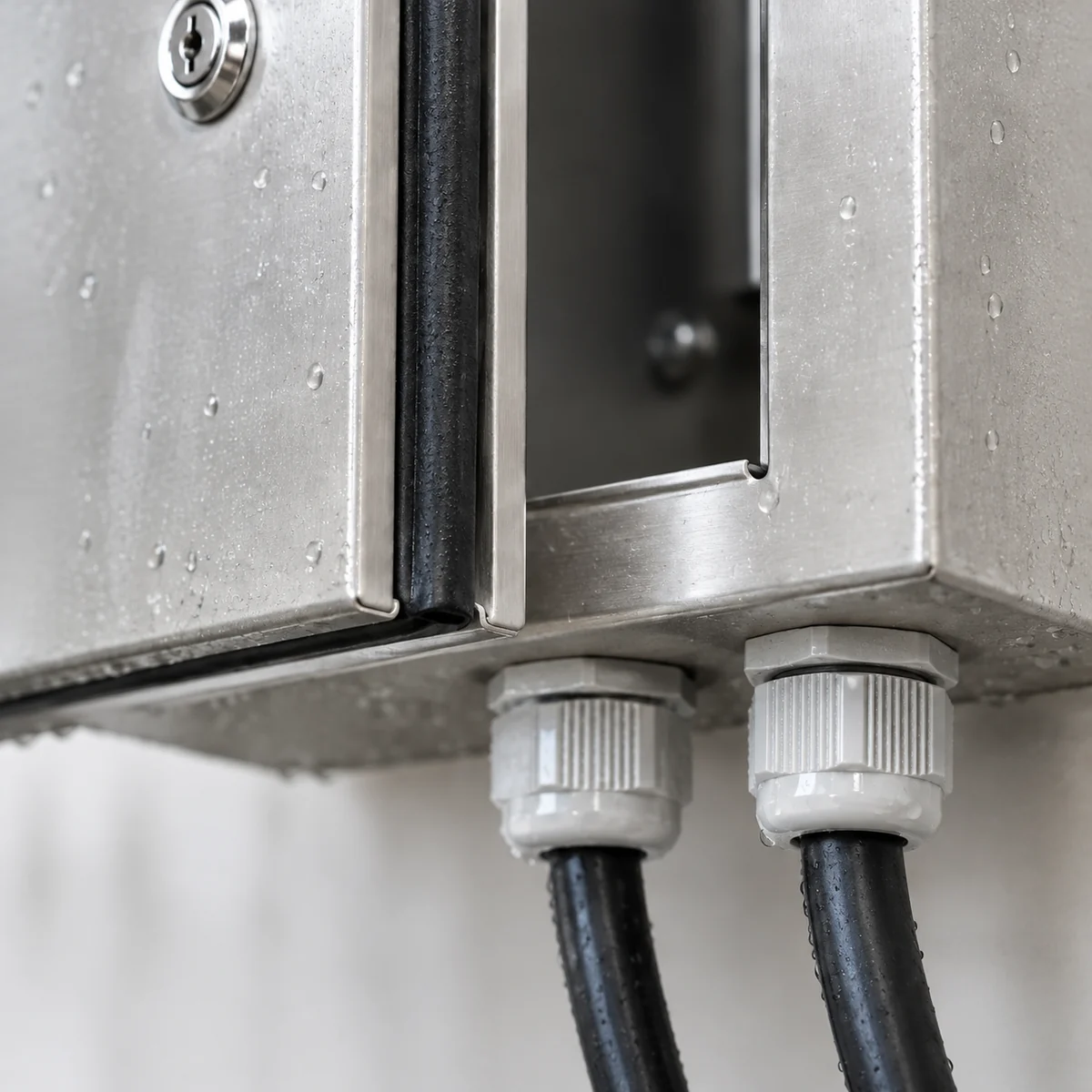
A reliable door seal helps prevent water and cleaning agents from entering the enclosure.
However, selecting a gasket based only on its appearance or material name is not sufficient.
The gasket should be compatible with:
- Cleaning chemicals and sanitizers
- Operating temperature
- Water exposure
- Required compression
- Expected opening and closing frequency
- Long-term environmental conditions
EPDM and silicone are two common gasket material families, but neither is universally compatible with every chemical or cleaning procedure.
The door structure, gasket profile, hinge arrangement, and locking pressure must work together to provide consistent sealing.
The gasket should also be accessible for inspection and replacement.
For additional technical information, read our electrical enclosure gasket guide.
6. Cable Entries and Openings
Cable entries are potential weak points in any sealed electrical enclosure.
In food processing environments, poorly planned openings may allow water or cleaning residues to enter the cabinet.
Before manufacturing, review:
- Cable entry positions
- Cable gland dimensions and thread types
- Removable gland plate arrangements
- Unused openings and sealing plugs
- Distance between cutouts and door joints
- Accessibility for installation and maintenance
Where the layout permits, cable entries can be positioned away from direct water exposure.
Every opening should have a suitable sealing arrangement based on the intended protection requirement.
Do not assume that an enclosure’s original IP rating automatically remains valid after additional holes, accessories, or cable entries are added.
7. Wall Mounting and Rear Clearance
The area behind an electrical enclosure can be difficult to inspect and clean, particularly when the cabinet is mounted directly against a wall.
Two mounting approaches are commonly considered.
Standoff Mounting
Standoffs create clearance between the enclosure and the wall, allowing cleaning access behind the cabinet.
This arrangement can be useful where the rear surface and surrounding area must remain accessible.
Sealed Flush Mounting
In some installations, a properly designed sealed interface between the enclosure and the mounting surface may be more appropriate.
The objective is to avoid creating an inaccessible gap where moisture or residues can accumulate.
The correct arrangement depends on the installation layout, sanitation procedures, and maintenance requirements.
4. How to Choose the Right IP Protection for Washdown
Material and structural design are only part of the selection process. The enclosure must also provide suitable protection against water and dust.
The required protection level should be based on the actual cleaning procedure.
Before selecting an IP rating, identify:
- Whether cleaning involves occasional splashing or regular washdown
- Water pressure and temperature
- Nozzle distance and spray direction
- Cleaning frequency
- Exposition à des substances chimiques
- Cable entry and accessory requirements
For example, IP66 provides protection against powerful water jets under its defined test conditions. However, it should not automatically be treated as equivalent to IP69K or as proof that an enclosure is suitable for every hot, high-pressure cleaning process.
An IP rating also does not establish hygienic design compliance or chemical compatibility.
The complete enclosure assembly must be considered, including the body, door, gasket, latches, cable glands, mounting interfaces, and any additional openings.
For a detailed comparison, see our NEMA enclosure ratings guide et IP66 enclosure solutions.
5. How to Specify a Hygienic Electrical Enclosure
When ordering a custom enclosure for a food processing project, clear technical requirements help the manufacturer evaluate the design before production.
The following information should be included in the engineering specification.
| Spécifications | Information to Provide |
|---|---|
| Demande | Food processing, dairy, beverage, packaging, or other |
| Matériau | Stainless Steel 304, 316, or 316L |
| Dimensions | Width, height, and depth |
| Finition de surface | Required finish and cosmetic acceptance criteria |
| Roof Structure | Flat or sloped top |
| Door Design | Single door, double door, or removable cover |
| Étanchéité | Gasket material and required protection level |
| Cable Entries | Position, quantity, size, and thread type |
| Montage | Wall, floor, pole, or standoff mounting |
| Cleaning Conditions | Chemicals, temperature, pressure, and frequency |
| Quantité | Prototype, initial order, and estimated batch quantity |
For more complex projects, provide both a 2D engineering drawing and a 3D CAD file.
A 2D drawing should define dimensions, material, tolerances, finishing, and sealing requirements.
A 3D model helps the manufacturer review the enclosure structure, door arrangement, mounting interfaces, and cable entry positions.
Notre Liste de contrôle du dossier technique des plans de l'enceinte explains what information to prepare before requesting a quotation.
Planning a Hygienic Enclosure Project?
Share your enclosure drawings, cleaning conditions and project requirements with our team to discuss a suitable custom metal enclosure structure.
6. Common Hygienic Enclosure Design Mistakes to Avoid
Even when stainless steel is selected, several design mistakes can reduce the practical cleanability of an enclosure.
Assuming Stainless Steel Automatically Means Hygienic
Stainless steel provides corrosion resistance, but the complete enclosure design must also consider surface condition, joints, hardware, and cleaning access.
Ignoring Horizontal Surfaces
Flat tops and recessed structures can retain water and residues. Consider suitable slopes and drainage during the design stage.
Overlooking the Rear Mounting Area
An enclosure mounted directly against a wall may create an inaccessible cleaning area. Review standoff or sealed mounting options.
Selecting Gaskets Without Checking Chemical Compatibility
A gasket that performs well under ordinary conditions may deteriorate when exposed to certain cleaning chemicals or temperatures.
Assuming IP Protection Equals Hygienic Certification
Ingress protection and hygienic design address different requirements. A high IP rating does not automatically demonstrate cleanability or compliance with a specific hygiene standard.
Making Unapproved Modifications
Additional holes, windows, ventilation openings, or hardware changes can affect the enclosure’s sealing performance. Review modifications before production or installation.
A design review involving the enclosure manufacturer, electrical engineer, and facility sanitation team can help identify these issues early.
Questions fréquemment posées
What makes an electrical enclosure hygienic?
A hygienic electrical enclosure is designed to protect electrical equipment while providing external surfaces and structural details that are easier to clean and inspect. Important features include suitable materials, smooth surfaces, drainage, accessible hardware, and properly designed seals.
Is stainless steel enough for a hygienic electrical enclosure?
No. Stainless steel provides corrosion resistance, but hygienic suitability also depends on the enclosure geometry, surface condition, joints, gaskets, cable entries, mounting arrangement, and cleaning procedure.
Should I choose 304 or 316 stainless steel for food processing?
304 stainless steel is suitable for many general food processing applications. 316 stainless steel may be more appropriate where chloride exposure or more aggressive cleaning chemicals are involved. The selection should be based on the actual operating and cleaning environment.
Does an IP66 enclosure qualify as a hygienic enclosure?
Not automatically. IP66 describes protection against dust and powerful water jets under defined test conditions. It does not establish hygienic design compliance, cleanability, or suitability for every high-pressure washdown process.
Is a sloped roof necessary for a hygienic electrical enclosure?
A sloped roof is often useful because it helps reduce water and residue accumulation. Whether it is necessary depends on the installation position, cleaning method, and project requirements.
Can a hygienic electrical enclosure be mounted directly against a wall?
Yes, if the mounting interface is properly designed and sealed to avoid inaccessible gaps. Alternatively, standoff mounting may provide access for cleaning behind the enclosure.
Does a hygienic electrical enclosure need EHEDG certification?
Not every electrical enclosure automatically requires EHEDG certification. The applicable hygienic requirements depend on the equipment type, installation zone, and project specifications. Certification should only be claimed when the specific product or assembly has completed the required evaluation.
What information should I provide when requesting a custom hygienic enclosure?
Provide enclosure dimensions, stainless steel grade, surface finish, cleaning chemicals, washdown conditions, required IP rating, cable entry positions, mounting method, and order quantity. Engineering drawings and 3D CAD files are also helpful.
Get a Custom Stainless Steel Enclosure from EWJ
Looking for a reliable stainless steel enclosure manufacturer for your food processing or hygiene-sensitive project?
EWJ provides custom stainless steel enclosure manufacturing based on customer drawings and project requirements.
Available customization options include:
- Stainless Steel 304, 316, and 316L
- Dimensions et structures de boîtiers sur mesure
- Single-door and double-door configurations
- Customized cutouts and cable entries
- Wall, pole, and floor-standing mounting options
- Surface finishing and polishing
- Customized mounting plates, hinges, locks, and accessories
Whether you are developing a new food processing control system or sourcing stainless steel electrical cabinets for an existing production line, our team can review your drawings and discuss suitable enclosure structures.
Send us your engineering drawings and project requirements to discuss your custom enclosure solution.
Envoyez vos plans et le cahier des charges de votre projet à notre équipe. En tant que custom stainless steel enclosure manufacturer, EWJ reviews each requirement against the drawings before quoting.
Demander un devis pour un boîtier sur mesure en acier inoxydable