Пожарная безопасность соединительных коробок солнечных батарей: что на самом деле предотвращает возгорание
Most solar fires are not caused by panels failing in daylight. They start in the wiring between the array and the inverter — and the combiner box is where that wiring is concentrated, terminated and fused. Because PV circuits stay live whenever the array is illuminated, a fault there does not clear itself the way an AC fault does. Understanding why that happens is the first step to designing it out.
This article looks at the fire safety of a solar combiner box from an engineering angle: what actually ignites, which parts of the enclosure matter, what the codes require, and what to specify and check on site.
Why a combiner box is a fire-risk point
A combiner box gathers several DC strings into one output. That means it holds the highest current density in the DC part of the system, in the smallest space, with the most terminations. Three properties make faults there worse than elsewhere:
- DC arcs do not self-extinguish. Alternating current passes through zero twice per cycle, which helps an arc collapse. Direct current has no zero crossing, so a drawn arc keeps burning until the circuit is physically opened.
- The array cannot be switched off. Unlike an AC installation, there is no upstream breaker that de-energises the modules. Opening the combiner box for service does not remove voltage from the incoming string terminals.
- Faults are often series faults. A loose terminal or a corroded fuse holder adds resistance in series with the string. The result is local heating rather than a clean short circuit, so an overcurrent device may never trip.
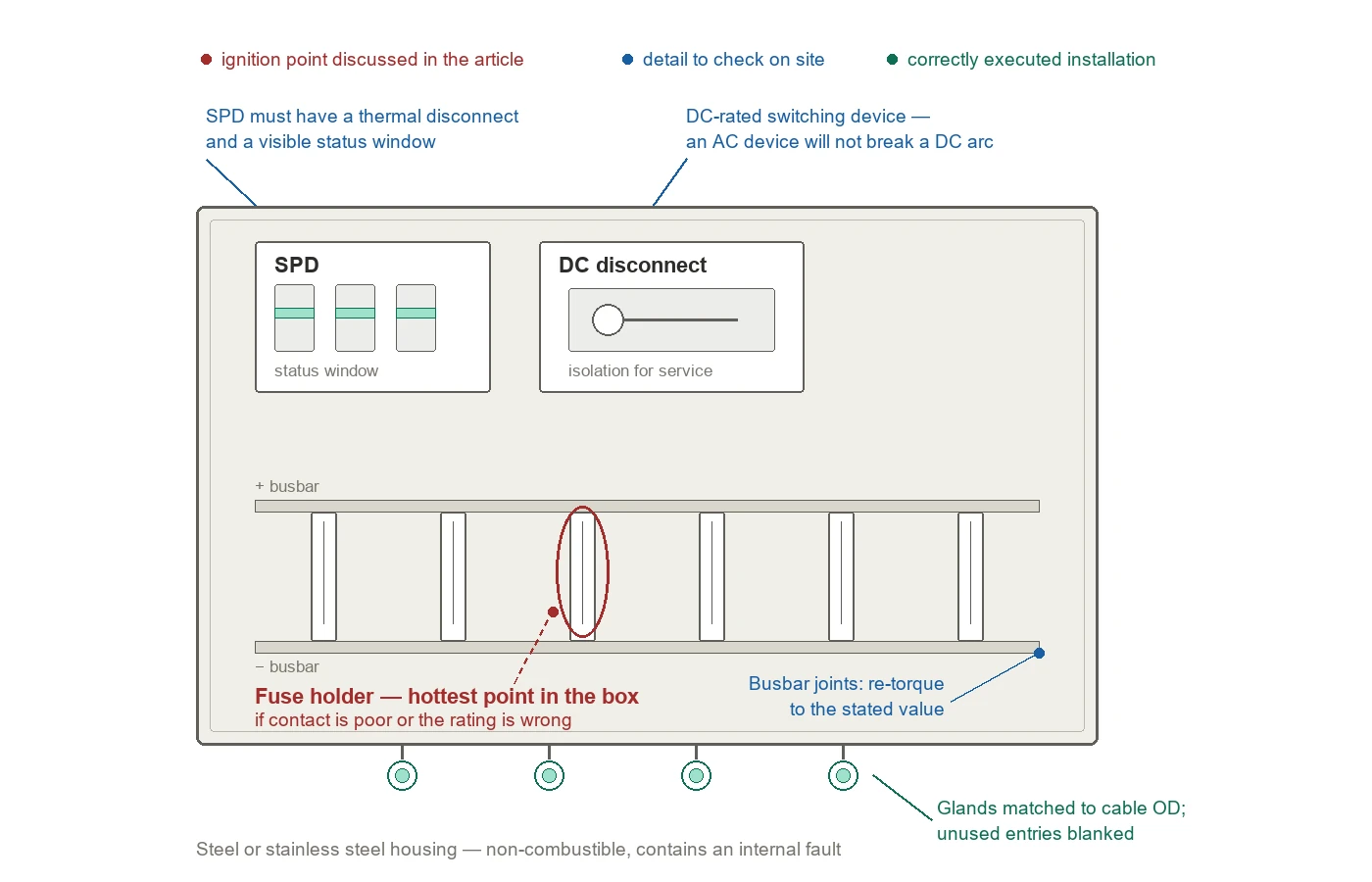
The four realistic ignition paths
In practice, combiner box fires trace back to a small number of mechanisms. Each has a different prevention route.
1. Loose or corroded terminations
An under-torqued terminal has higher contact resistance. Under load it heats, the metal expands, the joint loosens further, and the cycle accelerates. Thermal cycling between day and night drives the same process even when the initial torque was correct. This is why torque values, a calibrated tool and a re-check at commissioning matter more than the brand of terminal block.
2. Fuse and breaker failure
String fuses protect against reverse current from the rest of the array. If a fuse holder makes poor contact, or a fuse is replaced with the wrong rating, the holder becomes the hottest point in the box. DC-rated fuses and holders must be used — an AC-rated fuse does not reliably interrupt a DC arc.
3. Surge protective devices at end of life
An SPD absorbs surges until its elements degrade. A quality device disconnects itself thermally at end of life and shows a status window. A device without that thermal disconnect can fail short and overheat inside the enclosure. Specifying an SPD with a visible status indicator, and including it in the maintenance schedule, removes a failure mode that is otherwise invisible.
4. Water ingress and corrosion
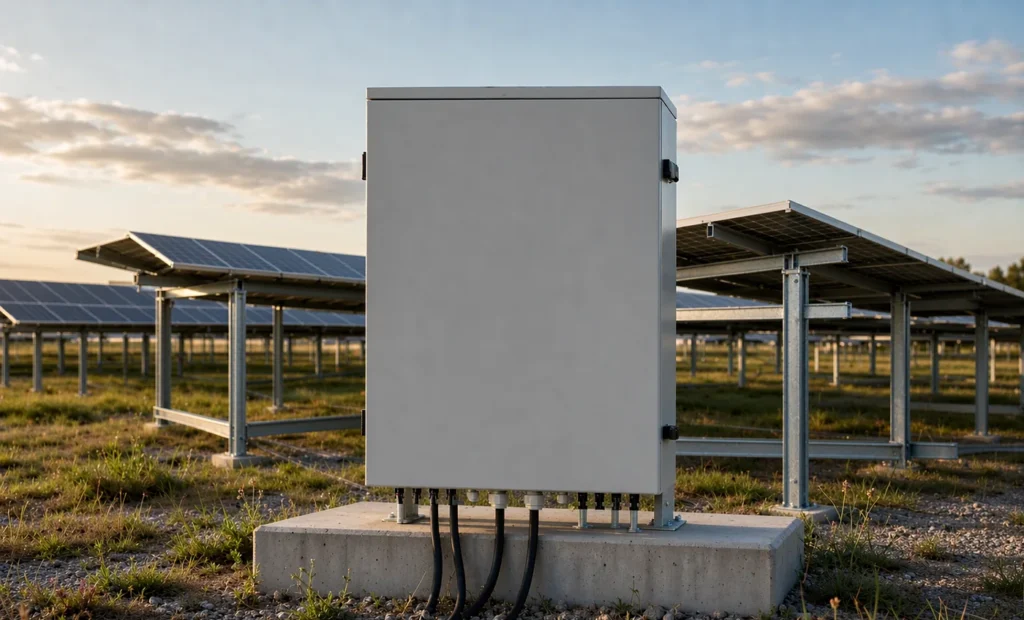
Moisture inside the enclosure attacks terminals and busbars, and pooled water can bridge clearances. The usual entry points are cable glands that were not matched to the cable diameter, a gasket compressed by an over-tightened door, or a breather/drain arrangement that was omitted because the enclosure was assumed to be sealed. IP65 is a minimum for outdoor DC; coastal and washdown sites justify IP66.
What the codes actually require
Requirements differ by market, but the direction is consistent: detect arcs, contain them, and make isolation possible.
- NEC 690.11 requires arc-fault circuit protection for PV DC circuits on buildings at 80 V or above, with the AFCI listed for PV use.
- NEC 690.12 covers rapid shutdown, limiting conductor voltage outside the array boundary for first-responder safety.
- IEC 62548 sets design requirements for PV arrays, including protection and isolation provisions.
- IEC 60529 is the IP rating that the enclosure is actually tested against — the number on the datasheet should reference it.
Where AFCI is required, the arc detection can sit in the combiner box or in the inverter, depending on the architecture. If it sits in the box, the device needs space, a supply and a test routine in the maintenance plan.
Why the enclosure material matters
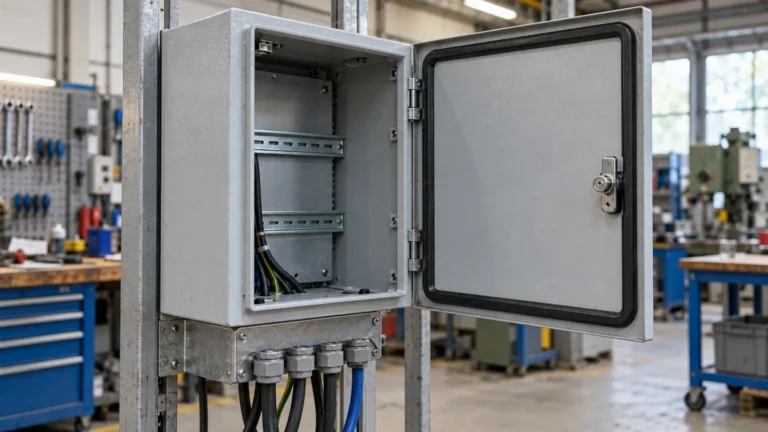
Containment is the last line of defence. A steel or stainless steel enclosure is non-combustible: it will not add fuel to an internal fault, and it keeps flame and molten material inside long enough for the fault to be noticed. A thermoplastic enclosure can soften and collapse at the temperatures a DC arc produces.
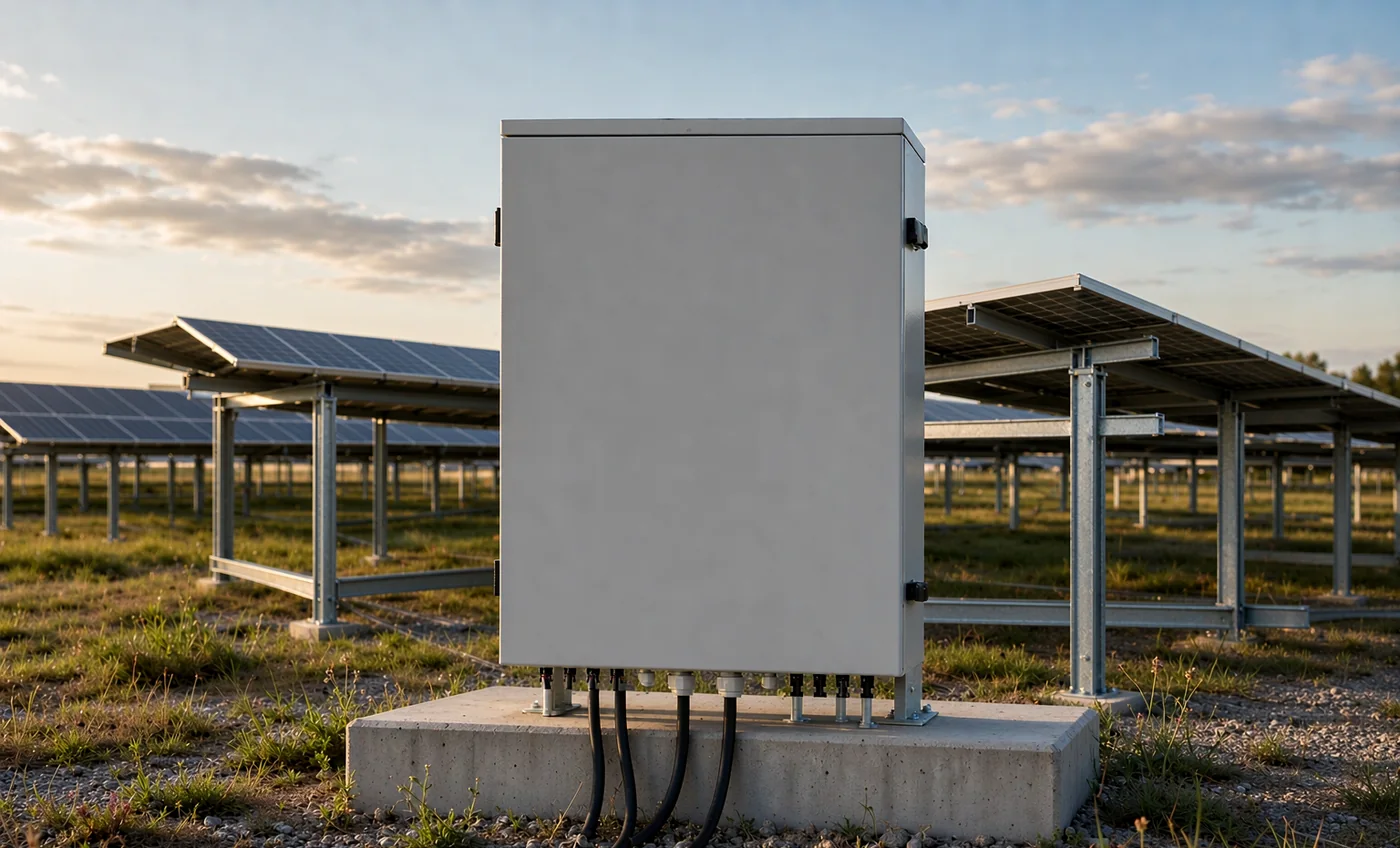
Material choice also drives the longer-term risk. Galvanised steel with powder coating suits most inland sites; stainless steel is the practical choice for coastal, chemical and high-humidity environments where a coated surface would corrode and expose bare metal. The trade-offs between grades are covered in our guide to корпуса из нержавеющей стали.
A practical inspection checklist
Most of these items take minutes and catch the failures that cause fires.
- Thermal scan of terminals, fuse holders and SPD connections under load — look for a hotspot relative to neighbouring poles, not an absolute temperature.
- Re-torque incoming and outgoing terminations to the manufacturer’s value at commissioning and at the first annual service.
- Check the SPD status window and replace the cartridge at end of life, not at the next fault.
- Confirm gland sizes match cable diameters and that unused entries are blanked with the correct plugs.
- Inspect gaskets for compression set, and check that the door still closes against its stop without force.
- Verify labelling: string numbers, polarity and the DC hazard warning must still be legible after years outdoors.
- Confirm the AFCI self-test (where fitted) completes, and record the result.
What to specify on the purchase order
Fire safety is largely decided before the box is built. Five points are worth writing into the specification:
- DC-rated fuses and fuse holders, with the rating stated per string.
- SPD with thermal disconnect and a visible status indicator.
- Enclosure material and IP rating tied to the site environment, referencing IEC 60529.
- Internal layout that leaves space for AFCI or monitoring hardware if it may be added later.
- Documented torque values and a terminal map supplied with the unit.
The housing side of these decisions — steel grade, coating, gland plate arrangement and string count — is set out in our pv combiner boxes selection guide, which lists the EWJ-PV range from 2 to 36 input strings.
Часто задаваемые вопросы
Does a combiner box need AFCI?
It depends on the code that applies to the installation. Under NEC 690.11, PV DC circuits on buildings at 80 V or above need arc-fault protection, which can be located in the combiner box or in the inverter. In markets without that requirement, AFCI is a specification choice rather than a legal one — but the underlying risk does not change.
Is a metal enclosure safer than plastic?
For fire containment, yes. Steel does not burn and holds a fault inside the enclosure. Thermoplastic housings have their place in low-voltage indoor work, but they are a poor match for an outdoor DC enclosure where an arc fault is possible.
Can a combiner box fire be prevented by maintenance alone?
No. Maintenance catches loose terminations and degraded SPDs, which are the most common causes, but it cannot compensate for an AC-rated fuse in a DC circuit or a plastic housing. Design and specification come first; inspection protects the design.
What IP rating should an outdoor combiner box have?
IP65 is the practical minimum: dust-tight and protected against water jets. Specify IP66 for coastal sites, open-rack mounting or anywhere washdown and powerful jets are expected. The rating should be stated against IEC 60529 and be verifiable in a test report.
Final thoughts
Fire safety in a combiner box is not one feature. It is the sum of DC-rated components, correct torque, a housing that contains a fault, and an inspection routine that finds degradation before it becomes ignition. Most of that is decided at specification stage — which is why the cheapest way to reduce risk is to get the purchase order right.
Related reading: what a solar combiner box does, how the components work together, and what to check before buying.