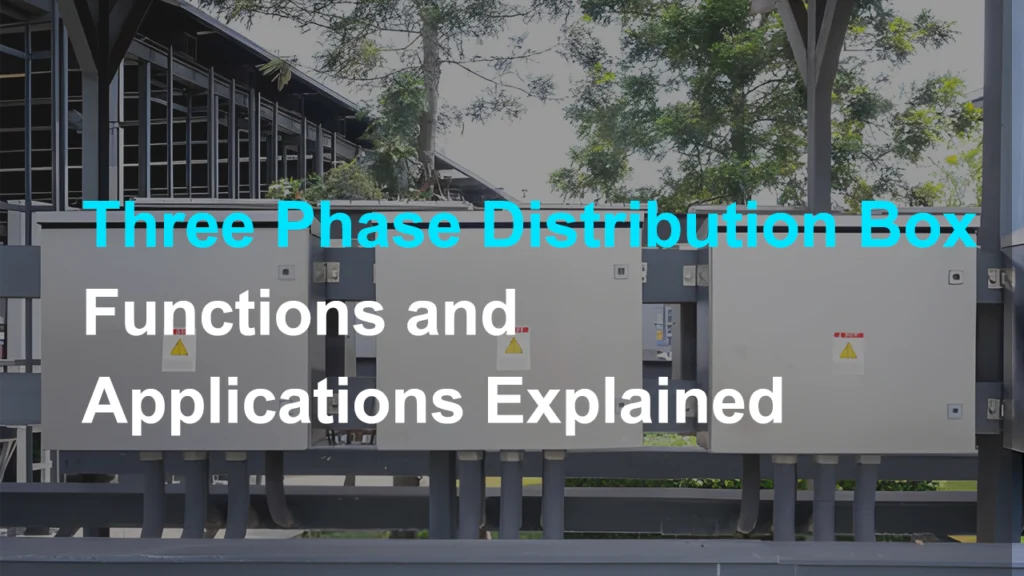
Three Phase Distribution Box Functions and Applications Explained
A three phase distribution box guards and distributes electricity in three-phase power systems. It ensures power flows to large machines safely and efficiently, letting factories run motors, air compressors, and heaters without hiccups.
Big commercial buildings—multi-story complexes—rely on these boxes for steady, dependable power. Even in high-demand homes, a three-phase distribution box can help manage heavy-duty appliances, balancing everyday needs with moments of peak demand.
Three Phase Distribution Box Overview
Definition and Purpose
A three-phase distribution box acts as the main electricity hub in three-phase systems. It routes power from the source to multiple circuits, ensuring each machine or area receives the appropriate load. Circuit breakers and fuses help keep all circuits safe.
Key roles
- Distribute power to many circuits for better control.
- Protect circuits from short circuits and overloads.
- Hide wires and consolidate controls to enhance safety.
- Support energy efficiency and improved circuit performance.
- Allow customization for special needs.
- Provide instrumentation and signaling capabilities.
- Ensure power safety and reliability across varied environments.
Single vs. Three Phase
| Aspect | Single-Phase Distribution Box | Three-Phase Distribution Box |
|---|---|---|
| Number of Conductors | One AC wave | Three AC waves offset by 120 degrees (three conductors + neutral) |
| Power Output Capacity | Lower; suitable for small homes | About 180% more power; suited for large factories |
| Efficiency | Less efficient; potential power problems | More efficient; lighter cables for the same load |
| Reliability | More fluctuations; steadiness is lower | Fewer fluctuations; steadier and more reliable |
| Typical Applications | Homes, small lights, low-power devices | Factories, HVAC, tall buildings, data centers, farms |
| Voltage Levels | Usually 120/240V | Usually 120/208V or 277/480V; configurable for higher voltages |
| Maintenance & Cost | Cheaper upfront; higher future repair costs | Higher upfront cost but lower running costs over time |
| Power Delivery | Prone to up-and-down fluctuations | Power stays steadier due to balanced three-phase supply |
| Wiring Complexity | Simpler | More complex but uses less metal per kW |
| Suitability | Best for homes or small shops | Essential for large buildings, factories, critical facilities |
Three-phase distribution boxes excel in demanding environments. They handle larger, steadier power delivery and balance loads more effectively, making them ideal for factories, offices, and other facilities with heavy or variable power needs. Single-phase boxes remain suitable for homes and small businesses, but they cannot match the capacity and stability of three-phase systems in tougher applications.
Power Distribution
Key Functions
Power Distribution
A three-phase distribution box acts as the central hub for three-phase power, taking input from the main source and distributing it to multiple circuits. Each circuit can supply individual rooms, machines, or equipment, while protective devices limit risk from overcurrent or short circuits. The box helps ensure lights, motors, and other loads receive stable power, even as demand shifts across a facility.
Protection and safety
The distribution box houses protective elements such as circuit breakers, RCCBs, fuses, and surge protection to automatically interrupt power during faults. These features minimize damage to equipment and reduce safety hazards for personnel. Proper enclosure sealing and environmental ratings protect components from dust, moisture, and other adverse conditions.
Monitoring and control
Many modern distribution boxes include monitoring and control capabilities, enabling real-time reading of voltage, current, power factor, and energy usage. Some systems support remote monitoring, alarms, and integration with building management or industrial automation platforms.
Load balancing and efficiency
Three-phase systems distribute power across three conductors in a balanced way, reducing losses and improving efficiency. Proper phase balancing helps prevent overheating, voltage drop, and unnecessary wear on equipment.
Three Phase Distribution Box Components
Busbars are the main metal strips inside the box. They carry a lot of electricity to different circuits. These bars connect the power coming in to all the breakers and fuses.
- They provide one main path for strong currents and high voltage. This helps electricity move quickly and smoothly.
- They can handle large problems, like excessive current, and keep the system safe.
- Labels on busbars help workers locate issues quickly.
- Sensors can monitor heat and vibration, so workers know if something is wrong.
- Workers can check busbars from a distance, so they do not touch live parts.
- Some busbars are designed to be replaced or upgraded easily.
- Newer busbars include safety features, such as limiting excessive current.
Copper and aluminum are the most common materials for busbars. The table below compares them:
| Property | Copper Busbar | Aluminum Busbar |
|---|---|---|
| Electrical Conductivity | High (~58 MS/m) | Moderate (~37 MS/m) |
| Weight | Heavy | Light |
| Cost | Expensive | Cheaper |
| Mechanical Strength | Strong | Softer |
| Corrosion Resistance | Good | Average, needs treatment |
| Current Capacity | High | Needs larger size for same current |
Breakers and Fuses
Breakers and fuses protect against overcurrent and short circuits by automatically cutting power when faults occur. This keeps people safe and machinery protected. Three phase distribution boxes use several breaker types:
- 3P (Three-pole): Three terminals for pure three-phase loads.
- 3PN (Three-pole + Neutral): Four terminals to handle mixed three-phase and single-phase loads.
- 4P (Four-pole): Four terminals and neutral interruption for systems needing neutral control.
Breakers can trip in different ways. Type C breakers work well for most applications, while Type D breakers are better suited for motors or equipment requiring higher starting current.
Enclosure and Safety
The enclosure is the outer box that protects all components. It shields parts from dust, water, and impact. In risky environments, special enclosures can prevent sparks or fires from escaping. These boxes are typically made from sturdy metals such as stainless steel or cast aluminum. Gaskets seal the enclosure to keep out gases and dust. Some enclosures are designed to limit internal hazards, such as preventing sparks or maintaining safe air quality. Enclosures bearing ATEX or UL marks meet strict safety standards. Proper cooling helps prevent overheating, and regular inspection of seals and gaskets helps ensure long-term safety.
Safety Tip: Always inspect the enclosure for damage before starting work. Maintaining the enclosure reduces the risk of accidents.
Applications and Benefits
Industrial and Commercial Use
Three-phase distribution boxes are widely used in industrial and commercial settings to safely distribute high-power loads.
They support heavy machinery, HVAC systems, data centers, and large event venues, delivering reliable power with controlled distribution.
In construction, mining, and engineering environments, these boxes help power large equipment while maintaining safety and efficiency.
Emergency response teams also rely on these units to provide stable power during outages or field operations. For events and entertainment, they ensure power to lights, sound systems, and stage equipment stays steady throughout performances.
Portable and Specialized Types
Some three phase distribution boxes are designed to be moved. These portable boxes suit short-term projects. The table highlights their key differences:
- Standards Compliance | EN 60439-4, IEC 60529
- Protection Rating | Waterproof and shockproof up to IP67
- Material | Polycarbonate resin (PC); lightweight, strong, smooth
- Design | Stackable modular design; saves space; allows daisy chaining
- Portability | Compact; easy-to-carry handle
- Operating Temperature | -20°C to +75°C
- Safety Features | Circuit breakers (MCB), RCD, RCCB, RCBO for overload protection
- Assembly | Quick assembly; safe connections; reusable components
- Customization | CNC perforation; pre-wiring; OEM/ODM services
- Applications | Construction; events; industrial; military; marine; railway; airports
Portable boxes can adapt to different needs. Some use twist-lock or camlock connectors. Many include covers to protect against rain and dust. They are safe for outdoor use and equipped with strong safety features. These boxes comply with NEC, OSHA, and UL standards.
Note: Portable three-phase distribution boxes simplify and secure temporary power setup.
Advantages
A three-phase distribution box offers several benefits over other power-sharing methods:
- It improves efficiency and reduces power loss.
- Power is distributed evenly, extending equipment life.
- It provides ample supply for large machines and elevators.
- It stabilizes voltage, preventing flickering lights.
- It enhances safety by lowering fire and shock risks.
- Motors stay cooler, increasing longevity.
- Suitable for diverse locations such as offices and charging stations.
- Compatible with both Delta and WYE configurations for flexibility.
These benefits make three-phase distribution boxes a strong choice for modern factories and large buildings.
Selection and Installation
Capacity and Voltage
Choosing a three phase distribution box begins with assessing power needs. Electricians total the wattage of all equipment and verify the voltage requirements. Common factory voltages are 208V, 400V, or 480V. The box must support the highest expected current. Allowing extra headroom helps prevent overloads as new equipment is added. Tip: select a box that can carry more current than currently required to accommodate future growth.
A quick reference table:
- Total Load: Sum all equipment wattages.
- Voltage Rating: Align with site supply (e.g., 400V).
- Number of Circuits: Count the required circuits.
- Expansion Room: Provide space for future expansion.
Compliance and Safety
Safety and adherence to regulations are essential in every setup. Electricians should follow local codes such as NEC or IEC standards. The three-phase distribution box should display safety marks like UL or CE, indicating it has passed safety evaluations. The enclosure must meet the appropriate IP rating for its environment; higher IP ratings protect internal components in wet or dusty locations. Always choose boxes with clear labeling and safety marks to aid inspectors and keep workers safe.
Installation Tips
A proper installation ensures the system operates reliably and remains safe. Mount the box on a solid wall or frame and use appropriately sized conductors for each circuit. All connections should be tight to prevent overheating, and proper grounding reduces electric shock risk. Do not work on the box while power is energized.
Plan the layout before starting. Label every circuit to simplify troubleshooting. Test the system before energizing the main power to verify correct operation and safety.
Always hire a trained electrician to install the box. This minimizes risk and ensures compliance with relevant standards.
A three-phase distribution box helps manage power safely and efficiently. It distributes load evenly, protects equipment, and works with both Delta and Wye configurations. Factories use these boxes for motors, HVAC, and data centers; large residences benefit from steady power and reliable charging. Correct planning and installation extend equipment life and reduce maintenance.
If challenges arise, consult an expert. Understanding how power is shared keeps systems safe and reliable. Consider ONESTOP distribution boxes for experienced manufacturing, international certification, and a proven track record in circuit safety protection.
FAQ
What is the main difference between a three phase and a single phase distribution box?
A three-phase distribution box handles more power and supports larger machines, using three live conductors. A single-phase box serves smaller loads with a single live conductor. Three-phase systems are preferred for factories and large buildings due to balanced, higher-capacity power delivery.
Can a three-phase distribution box be used outdoors?
Yes, some models are designed for outdoor use with covers to protect against rain and dust. Check the IP rating to ensure suitability for outdoor environments.
How often should a three phase distribution box be inspected?
It should be inspected at least once per year to identify loose connections, worn parts, or overheating early and maintain safety.
What safety features do three phase distribution boxes include?
Typical features include circuit breakers and fuses, grounding bars, surge protection, and sometimes heat sensors. These elements help protect people and equipment from electrical faults.
Who should install a three phase distribution box?
Only a licensed electrician should install or service a three-phase distribution box to ensure safety and code compliance.